Budgeting & saving
How to Budget With Irregular Income: A Plan for Uneven Months
Freelancers, gig workers and anyone on commission or a zero-hours contract can't budget on a paycheck that doesn't exist. Here's how to set a baseline and pay yourself the same amount every month.
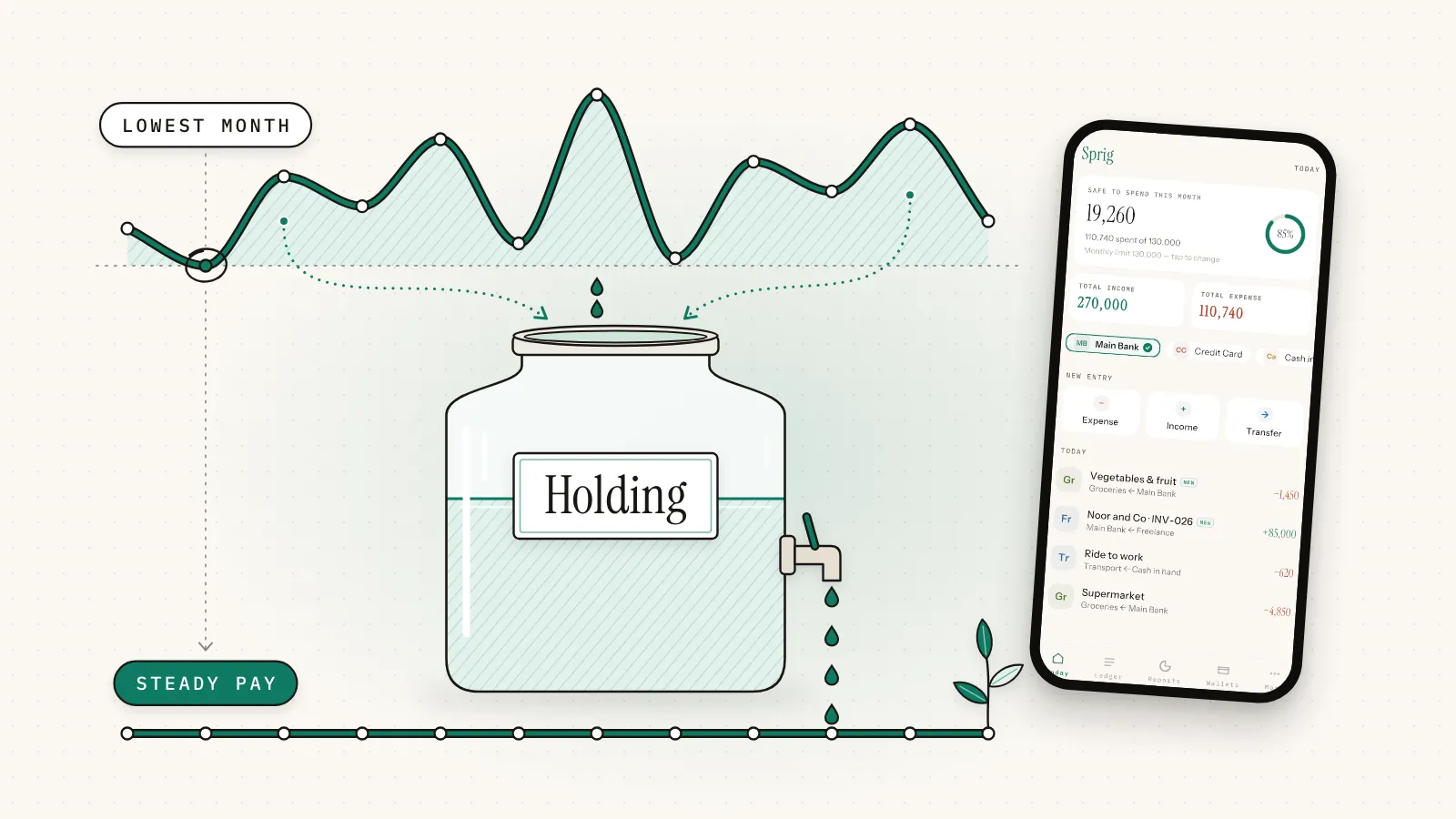
Most budgets start with next month's pay, the one number you don't know if you freelance, drive or deliver through an app, work a zero-hours contract or earn commission. Here's how to swap the guess for a figure you can count on. The examples are hypothetical and work in dollars or pounds.
| Source | Guidance | Page date |
|---|---|---|
| MoneyHelper (UK) | Budget on your lowest-earning month; keep three months of essential outgoings available | June 2026 copy |
| consumer.gov (FTC, US) | Not paid every month? Add up last year's income and divide by 12 | August 2024 |
| CFPB income tracker (US) | Know which income is regular, irregular, seasonal or one-time | 2018 |
Why do normal budgets break on irregular income?
Most budgets assume a fixed paycheck, so they plan spending around money that may not arrive. On an irregular income, a good month tempts you to spend at that level, and the next lean month leaves bills short. The fix is to budget on a figure you can rely on, not on what you hope to earn.
The Consumer Financial Protection Bureau's income and benefits tracker puts it plainly: "Knowing what income is regular, irregular, seasonal, and one-time-only can help you be prepared for when you have less coming in."
- Regular
- The same amount at predictable times, like a part-time salary or a retainer.
- Irregular
- Amounts and dates that change: invoices, app payouts, commission, zero-hours shifts.
- Seasonal
- Busy and quiet stretches that repeat every year.
- One-time
- A tax refund or a single big project. Never build the monthly budget on it.
Only the regular slice behaves like a paycheck, so a variable income budget assumes the worst month and treats anything better as a bonus.
How to budget with irregular income: lowest month or average?
Budget on your lowest recent month unless you already have savings behind you. MoneyHelper, the UK's free money guidance service, says to "budget for your lowest monthly income" so major costs are always covered. The FTC's consumer.gov divides last year's income by 12 for a monthly estimate. That's higher, and our example shows it needs a cushion.
For example, say last year's take-home pay, after tax, ran from $1,900 (or £1,900) in February to $4,200 (or £4,200) in July. Paying yourself the lowest month from a holding account that starts at zero looks like this:
| Month | Income | Holding balance |
|---|---|---|
| Jan | 2,400 | 500 |
| Feb | 1,900 | 500 |
| Mar | 3,100 | 1,700 |
| Apr | 2,700 | 2,500 |
| May | 3,600 | 4,200 |
| Jun | 2,200 | 4,500 |
| Jul | 4,200 | 6,800 |
| Aug | 2,000 | 6,900 |
| Sep | 3,300 | 8,300 |
| Oct | 2,900 | 9,300 |
| Nov | 3,800 | 11,200 |
| Dec | 2,500 | 11,800 |
| Year | 34,600 | 11,800 |
You never run short, and 11,800 is left for your buffer, annual bills and goals. The average tells a different story:
| Lowest month | Average | |
|---|---|---|
| Suggested by | MoneyHelper (UK) | consumer.gov (FTC, US) |
| Monthly pay | 1,900 | 2,883.33 (34,600 ÷ 12) |
| Months with income below it | 0 | 6 |
| Deepest shortfall | None | 1,466.67, end of February |
| Left at year end | 11,800 | None |
The February gap: two months at the average is 5,766.67 (34,600 ÷ 6) against 4,300 earned, so 1,466.67 has to come from savings or a credit card. Our suggestion: start on the lowest month, then raise your pay in steps toward the average once your buffer is full. If your lowest month was a fluke, like a month you were ill, use the next-lowest; with under a year of history, use the lowest you have.
How do you build a bare-bones budget for lean months?
List only the costs you must pay to keep a roof overhead, the lights on, food on the table and yourself able to work. That total is your bare-bones budget. If it fits under your lowest month, the plan works; if it doesn't, close the gap before anything else.
Start from MoneyHelper's list of regular outgoings: rent or mortgage, travel, phone, electricity and gas, insurance, Council Tax (UK) and food. Add minimum debt payments and the costs of earning, like fuel if you drive for work. Leave out anything you could pause for a month.
| Essential cost | Per month |
|---|---|
| Housing, plus Council Tax in the UK | 900 |
| Energy, water and phone | 180 |
| Food | 300 |
| Getting to work | 120 |
| Insurance | 60 |
| Minimum debt payments | 40 |
| Bare-bones total | 1,600 |
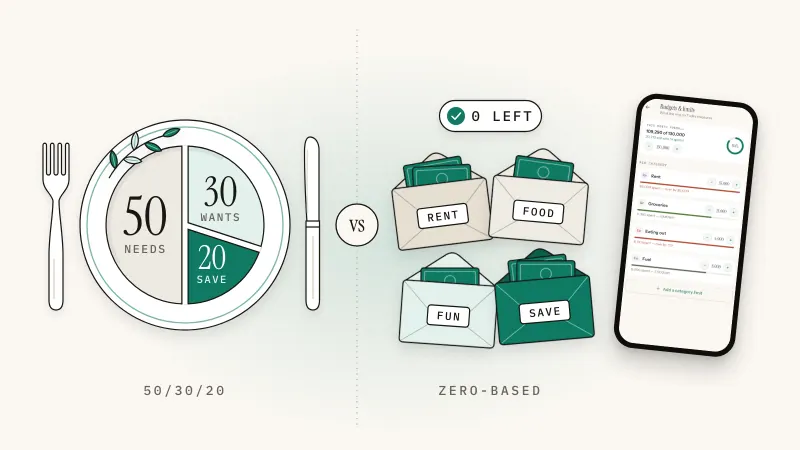
That leaves 300 of a 1,900 lowest month for everything else. If your total is higher than your lowest month, cut a fixed cost, earn more in slow months or build a cushion first. Zero-based budgeting fits neatly on top, since you give the same steady paycheck a job each month; compare it in 50/30/20 vs zero-based budgeting.
How does a holding account smooth your income?
A holding account is a separate account where all your income lands first. On the same day each month, you move a fixed amount, your steady pay, to the account you spend from. Good months leave money behind in holding; lean months draw it down, so your spending account sees the same paycheck every month.
It's also called an income smoothing account, and MoneyHelper suggests a version for regular bills, topped up in higher-income months. Our suggested routine:
- Send all income to holding. One savings account, apart from the one you spend from.
- Take tax out first. If nobody withholds tax, move your share to a tax pot as each payment lands.
- Pay yourself on a fixed day. Move your baseline, 1,900 here, to your everyday account at month end.
- Build a month in hand. Keep at least one month's pay in holding, so next month's paycheck is already there.
- Sweep the extra. After payday, move anything above that cushion to your buffer, then to annual-bill savings, then to goals.
- Review quarterly. Raise your pay only when the buffer is full and holding kept its cushion; cut it if holding keeps running low.
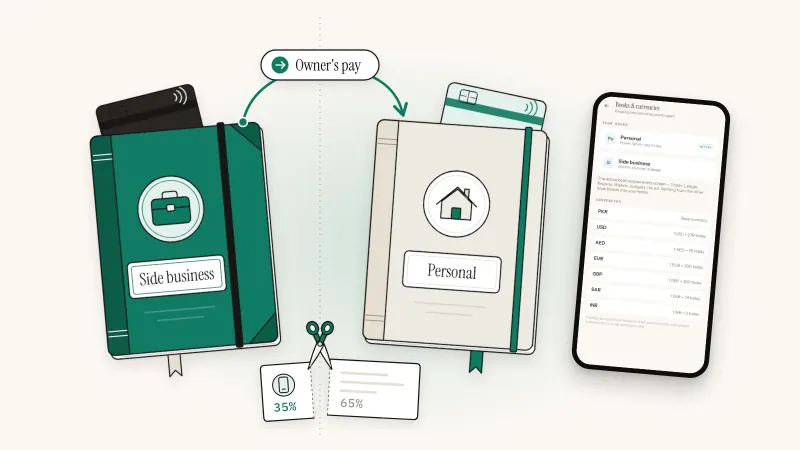
The CFPB's emergency fund guide makes the same point: "use the weeks when you have more money available to move a little extra into savings." Count income once, when it lands in holding; your monthly pay is just a transfer (here's why a transfer between your own accounts isn't income). Run a side business? Its account can be your holding account, and paying yourself from it is an owner's draw.
How big a buffer do you need on an irregular income?
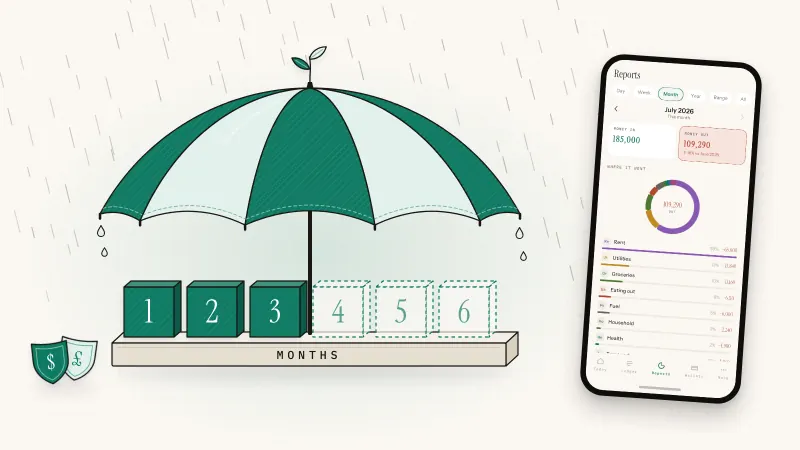
MoneyHelper suggests keeping three months of essential outgoings available, and says even one month's income in savings helps with some income shocks. With bare-bones costs of 1,600, that's a target of 4,800 ($4,800 or £4,800). Fill it from the holding account's surplus before you raise your own pay.
In the example, sweeping everything above a 1,900 cushion fills the 4,800 buffer by July. By December, holding still has its 1,900, the buffer holds 4,800, and 5,100 has gone to annual bills and goals: the same 11,800 as the table. For where to keep it, see how much emergency fund you need.
What about tax if you're self-employed?
Budget on money after tax. If nobody takes tax from your pay, as is normal for freelancers and most gig work, move your tax share to a separate tax pot as each payment lands, and count only the rest as income. MoneyHelper warns that your first self-employed tax bills can come as a shock.
US
As of October 2026, the IRS says you generally have to make estimated tax payments if you expect to owe $1,000 or more when you file. The final payment for tax year 2026 is due 15 January 2027 (Form 1040-ES), and paying weekly or monthly is fine if enough is in by each quarter's end. See how much to set aside for taxes in the US and quarterly estimated taxes. Not tax advice; rules change; check IRS.gov or a CPA.
UK
If you make payments on account, each is half of last year's tax bill, due by 31 January and 31 July. To spread the cost, HMRC's Budget Payment Plan takes weekly or monthly Direct Debits toward your next Self Assessment bill if you're up to date with your last one. See how much tax to set aside as a UK sole trader and your first Self Assessment. Not tax advice; rules change; check GOV.UK or your accountant.
What should you do in a bumper month or a bad month?
In a bumper month, pay yourself the usual amount and let the extra fill your tax pot, buffer and annual-bill savings before you spend any of it. In a bad month, still pay yourself from the holding account, switch to your bare-bones budget, and pause extras until holding recovers.
In a bumper month
- Tax first. A bigger month means a bigger tax share.
- Keep your pay the same until the quarterly review.
- Refill in order: the holding cushion, the buffer, then sinking funds for the bills you can see coming.
- Save windfalls. The CFPB suggests putting all or part of a large one-time check into savings, particularly on an irregular income.
In a bad month
- Pay yourself as normal. That's the holding account's job.
- Switch to the bare-bones budget and pause flexible spending.
- Chase late payers and set payment terms that get you paid on time.
- Cut your pay if it lasts. If holding stays below a month's pay, drop to your bare-bones figure until it recovers.
For seasonal swings
The CFPB's Planning for the year tool (2021, written for military families) has you note when income rises or falls and when irregular costs land, to "make the most of extra income or plan to have financial resources on hand to cover occasional expenses." MoneyHelper flags Christmas, birthdays and annual bills like car insurance. Save for a predictable quiet season in the busy one.
How Sprig helps you budget on an irregular income
Sprig is a private, offline double-entry bookkeeping app for iPhone and Android, made by Secundum Reality. With no account and no bank link, you record each payment and transfer yourself, which suits a plan built on transfers you choose to make.
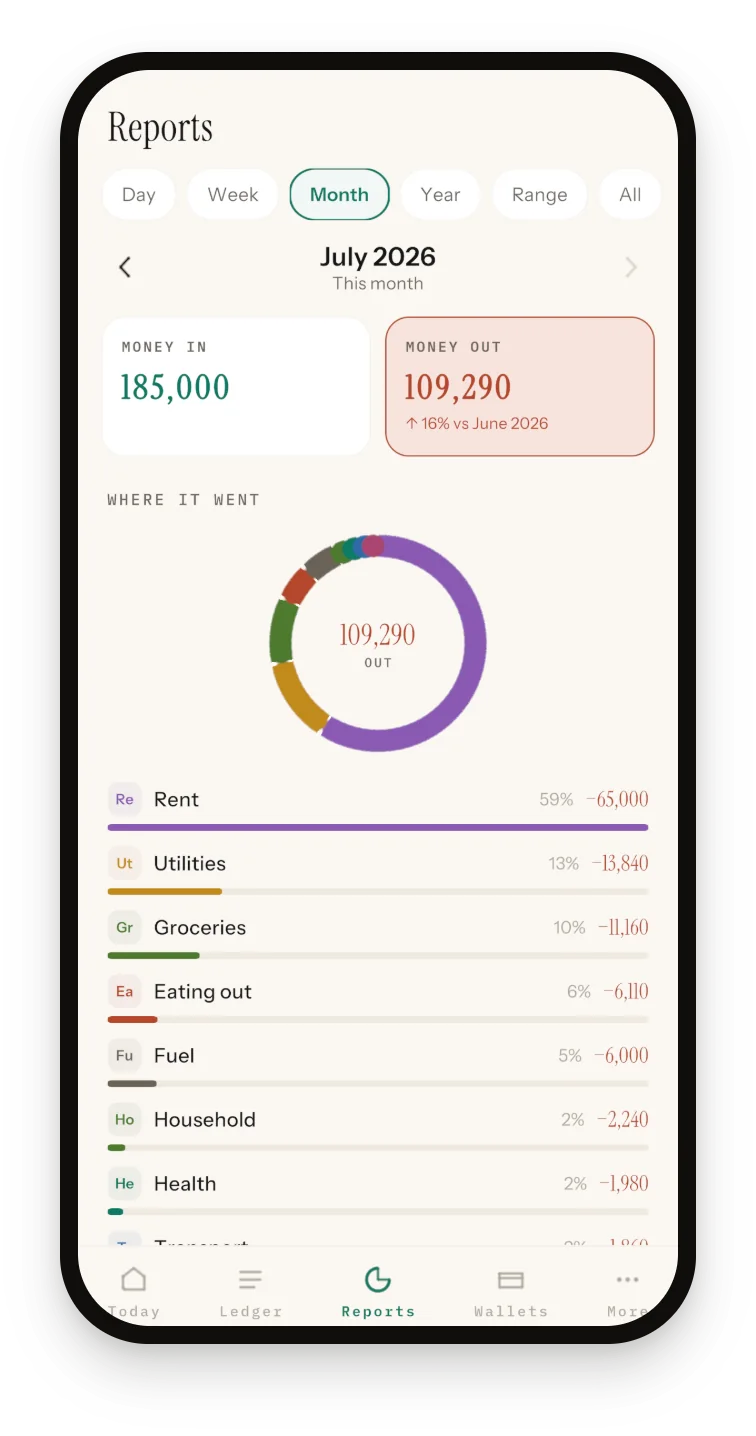
- Find your lowest month. In Reports, choose Month, step back with the arrow and note Money in each time. Transfers never count toward it, and the percentage under Money out compares spending only. Entries are dated the day you log them, so bring in past income with More → Export → Import CSV, dates as YYYY-MM-DD; imports don't use free entries.
- Add the wallets. In Wallets, tap Add an account and choose Savings for Holding, plus Tax pot and Buffer if you want them. With Holding picked on Today's wallet strip, log each payment as Income under Freelance (
Holding ← Freelance) or your own category, such as Gig payouts. - Pay yourself. On payday, record a Transfer of your steady pay, such as
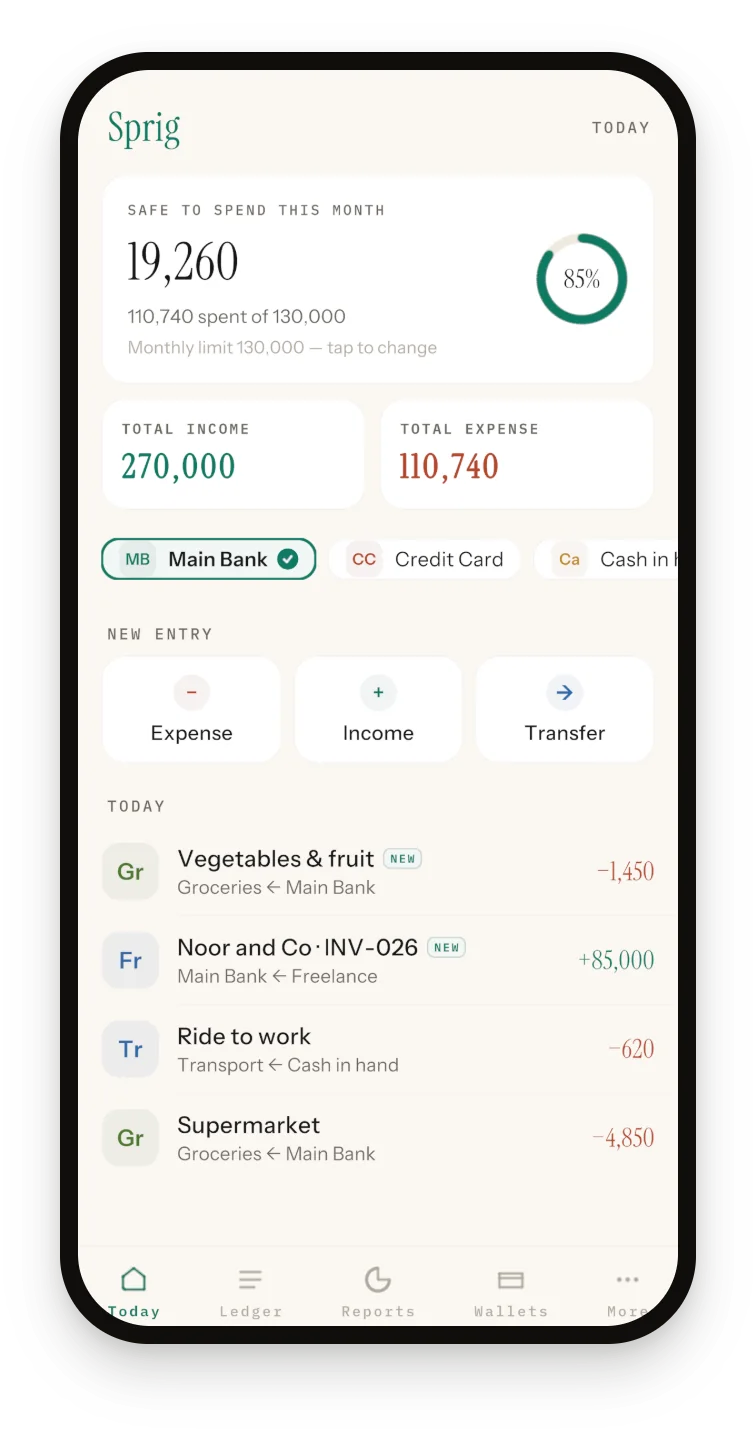
Holding → Main Bank. Tax and buffer moves work the same way. - Set your limit. Tap the Safe to spend card on Today and type your monthly limit, such as 1,900. It shows what's left after this month's spending and turns red if you go over.
How Sprig helps
Uneven income in, a steady paycheck out, and both sides of every move on record.
- Money in by month in Reports, and spending compared with the previous month.
- Savings wallets for holding, tax and buffer money. Transfers never count as income or spending.
- Safe to spend on Today, measured against the limit you type.
- Private by design: no account, no sign-in, no bank login. Your books stay on your phone.
The honest limits. Sprig doesn't connect to your bank, so you make each transfer in your banking app and record it in Sprig. You can't create recurring rules, and there are no reminders, notifications or forecasts, so put payday in your calendar. Each transfer uses one of the 50 free entries (a one-time allowance, not monthly); an optional ad adds 20 (up to four a day), every feature is included, and yearly Premium removes the limit. Amounts are plain numbers with no currency symbol; keep every wallet in the same currency (the default). The monthly limit is shared by both books, and if client money runs through Side business, paying yourself takes two entries. Here's everything else the Sprig offline expense tracker does.
Sprig for iPhone and Android
Keep your books in four taps.
Private, offline double-entry bookkeeping. No account, no bank login, no cloud. Free to start with 50 entries.
Frequently asked questions
How do you make a budget when your income changes every month?
Start from a figure you can count on: your lowest month of take-home pay over the last year, checking that your essential costs fit under it. Then send all income to a holding account and pay yourself that amount on the same day each month. Good months refill holding and your buffer; lean months draw on them.
Should I budget using my average monthly income?
Only with savings behind you. The FTC's consumer.gov suggests adding up last year's income and dividing by 12, a fair yearly picture that hides the dips. In our example, income fell below the 2,883.33 average in 6 of 12 months, and paying yourself the average left you 1,466.67 short by February. Start with the lowest month instead.
How do I pay myself a steady amount as a freelancer?
Use a holding account, also called an income smoothing account. Client payments land there first, minus your tax share; on a fixed day each month, move the same amount to the account you spend from. Keep a month's pay in holding before sweeping extra into savings. From a business account, that payment is an owner's draw.
How should gig workers budget when pay arrives every few days?
Treat each payout as income for your holding account, not spending money. If no tax is withheld, set some aside: the IRS's Form 1040-ES lists gig economy work among the income estimated tax covers, and UK self-employed people usually pay through Self Assessment. Then pay yourself on a fixed day each week or month, based on your lowest recent month.
How do I budget on a zero-hours contract?
Budget for your lowest-earning month, as MoneyHelper suggests for anyone whose pay varies, including zero-hours workers. Use the take-home pay on your payslips: GOV.UK says most people pay Income Tax through PAYE, taken by the employer before wages are paid. Pay yourself a fixed amount from a holding account and let high-hours months build a buffer.
Sources and further reading
- MoneyHelper: How to budget for an irregular income (checked via the Internet Archive copy of 5 June 2026)
- consumer.gov (FTC): Making a Budget (August 2024)
- CFPB: Income and benefits tracker, Your Money, Your Goals (2018)
- CFPB: An essential guide to building an emergency fund (updated 29 October 2025)
- IRS: Estimated taxes (reviewed 25 September 2026)
- GOV.UK: Payments on account
Published 3 October 2026. Feature details were checked against Sprig 1.1 for iPhone and Android. This article is general information, not tax or legal advice; rules differ by country, so confirm anything you file with your accountant or tax authority.