Tax time
Quarterly Estimated Taxes 2026–27: Dates, Safe Harbor, Catch-Up (US)
Three of the four 2026 payments are behind us. Here are the 2026 and 2027 dates, the safe-harbor amounts that keep the penalty away, and a catch-up plan.
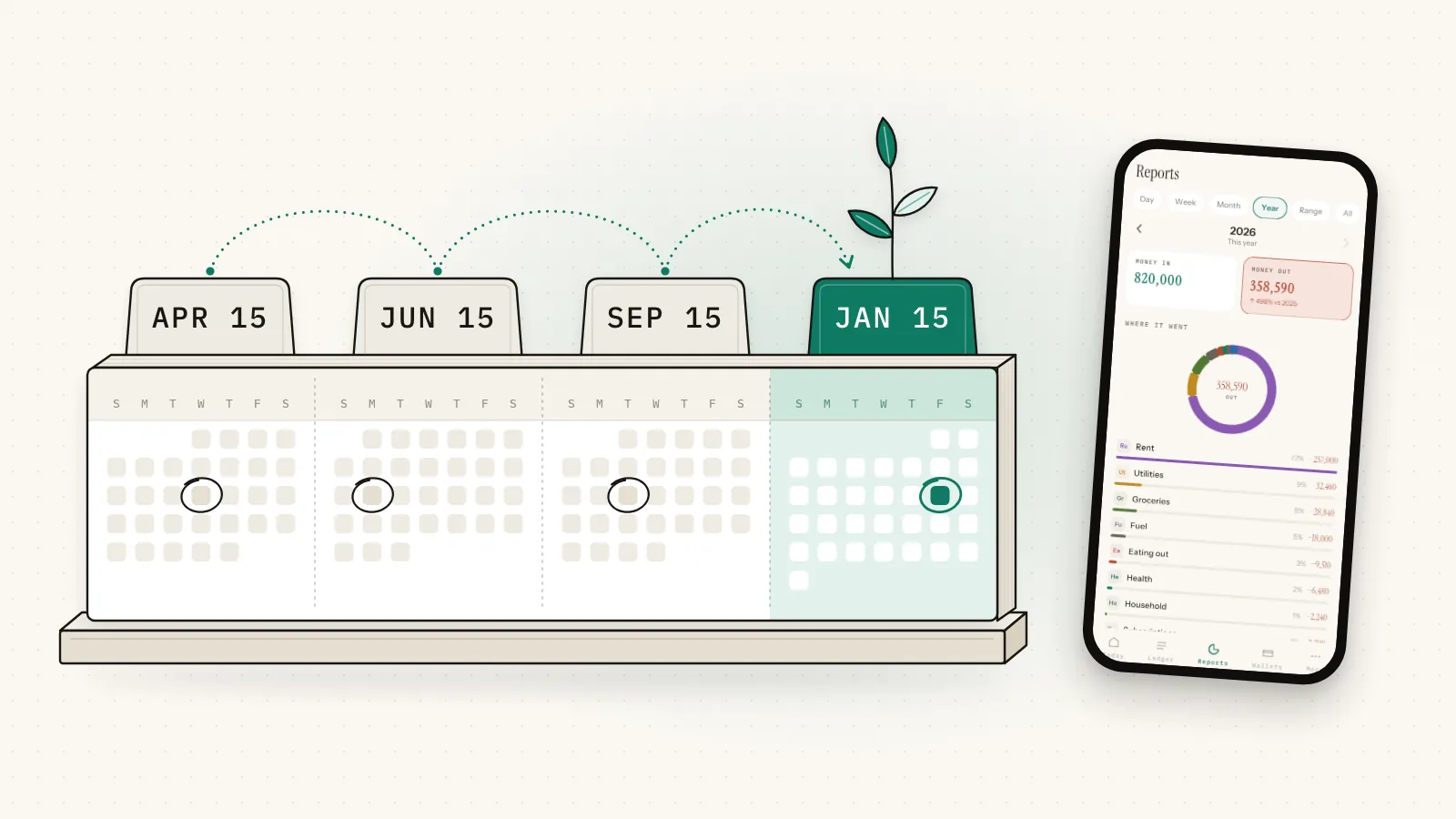
If nobody withholds tax from your income, the IRS expects you to pay as you earn, in four installments. As of October 2026, three of the four payments for tax year 2026 have passed.
Key dates
Next payment: Friday 15 January 2027. Skip it only by filing your 2026 return by 1 February 2027 and paying in full. 2027 payments (our calculation): 15 April, 15 June and 15 September 2027, then 18 January 2028.
What are quarterly estimated taxes, and who has to pay them?
Quarterly estimated taxes are payments you make during the year on income that has no tax withheld, such as self-employment profit. For 2026, you generally must pay if you expect to owe at least $1,000 after withholding and refundable credits, and those won't cover the safe-harbor amount explained below.
Freelancers, 1099 contractors and sole proprietors usually meet that test: IRS Publication 505 says people "in business for themselves will generally have to pay their tax this way."
The payments cover self-employment tax as well as income tax. That's 15.3% (12.4% for Social Security plus 2.9% for Medicare) on 92.35% of net earnings, once those reach $400 (IRS Topic 554). For 2026 the Social Security part stops at $184,500 of combined wages and self-employment earnings (2026 Form 1040-ES); the IRS self-employment tax page still shows the 2024 cap.
- Safe harbor
- The least you can pay on time, through withholding and estimated payments, to avoid a penalty.
- Annualized income installment method
- Sizing each payment by the income received by the end of each period, on Form 2210, Schedule AI.
Who can skip it: anyone who was a US citizen or resident alien for all of 2025 and had no tax liability for that full 12-month year, meaning total tax of zero or no need to file (IRS: estimated taxes). Wage earners can instead ask their employer to withhold more with a new Form W-4.
This guide covers federal tax; if your state taxes income, check its own rules. In the UK? Start with your first Self Assessment as a sole trader.
When are estimated tax payments due for 2026 and 2027?
For tax year 2026, the IRS due dates are 15 April, 15 June and 15 September 2026, and 15 January 2027. By our calculation, the 2027 dates are 15 April, 15 June and 15 September 2027, then 18 January 2028, because 15 January 2028 is a Saturday and the Monday after is Martin Luther King Jr. Day.
| Payment | Covers income received | Tax year 2026 | Tax year 2027 (our calculation) |
|---|---|---|---|
| 1st | 1 January to 31 March | 15 April 2026 | 15 April 2027 |
| 2nd | 1 April to 31 May | 15 June 2026 | 15 June 2027 |
| 3rd | 1 June to 31 August | 15 September 2026 | 15 September 2027 |
| 4th | 1 September to 31 December | 15 January 2027 | 18 January 2028 |
The "quarters" run three, two, three and four months, so June's payment lands just two months after April's. A date that falls on a weekend or legal holiday moves to the next business day (Publication 505); 15 January 2027 is a Friday, so it stays put. Check our 2027 column against the 2027 Form 1040-ES once it's out.
Started earning partway through the year? Table 2-1 of Publication 505 starts you at the first due date after your income begins, so work that began in September 2026 means one payment, by 15 January 2027. If you start owing after 31 March, the 2026 Form 1040-ES says to annualize: attach Form 2210 with Schedule AI to your return, or the penalty is figured as if a quarter of the year's payment was due on each date.
How much should each estimated tax payment be?
Enough to reach the safe harbor on time. For 2026, that's the smaller of 90% of your 2026 tax or 100% of the tax on your 2025 return, counting withholding. If your 2025 AGI was over $150,000 ($75,000 married filing separately), use 110% instead of 100%. With steady income, pay a quarter by each date.
The prior-year route is usually easier, because the number already exists: your 2025 total tax (Form 1040, line 24, with a few adjustments listed in Publication 505). If your income is falling, 90% of this year's tax may be smaller, but it protects you only if your estimate holds. Withholding counts, and so does any 2025 refund you applied to 2026.
| Your 2025 AGI | Rule | Pay by the four due dates | Each installment |
|---|---|---|---|
| $150,000 or less | 100% | $6,000 | $1,500 |
| Over $150,000 | 110% | $6,600 | $1,650 |
Lumpy income? Publication 505 says to split the year evenly only if your income is basically the same throughout the year. If a big contract landed in the fall, the annualized method bases each installment on income from 1 January to 31 March, 31 May, 31 August and 31 December, which can shrink the early ones. You file Form 2210 with Schedule AI, and if you use it for one due date, you must use it for all (Form 2210 instructions).
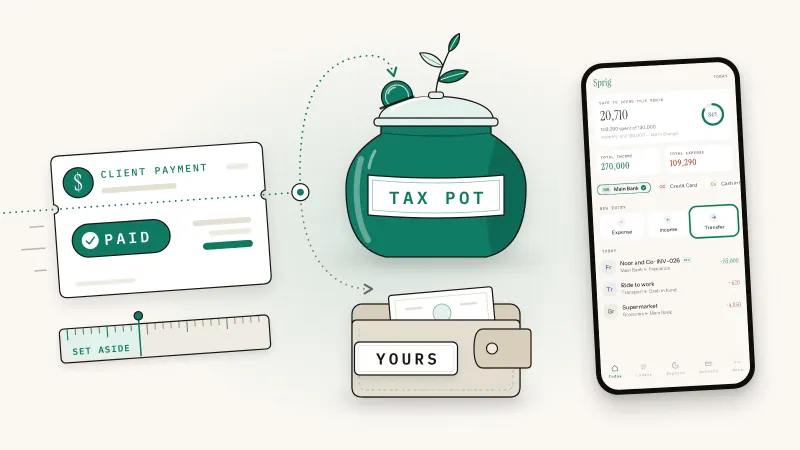
To have the money ready, move a share of every client payment into a separate tax pot the day it arrives. Here's how much to set aside from each payment.
What happens if you miss an estimated tax payment?
You may owe an underpayment penalty. It works like interest: the IRS applies its quarterly underpayment rate to each late or short installment for the days it stays unpaid. The rate was 7% a year for most of 2026 and 6% from April to June. The penalty can apply even if you're due a refund.
Each due date is figured separately, so a big December payment doesn't erase April's shortfall; it just stops the clock. Payments fill the oldest gap first, even if you label them for a later installment (Form 2210 instructions).
| Quarter | Rate per year |
|---|---|
| January to March | 7% |
| April to June | 6% |
| July to September | 7% |
| October to December | 7% |
Sources: IRS quarterly interest rates and IR-2026-98. The rate for January to March 2027 hadn't been announced as of October 2026.
Example
For example, a $1,500 first installment due 15 April 2026 and paid on 15 October 2026 was late for 76 days at 6% and 107 days at 7%: $1,500 × (6% × 76 + 7% × 107) ÷ 365 is about $50 ($49.52). Form 2210 decides the exact figure.
The IRS can waive the penalty after a casualty, disaster or other unusual circumstance, or if you retired after reaching age 62 or became disabled in 2025 or 2026 and had reasonable cause (IRS). Owe less than $1,000 after withholding and refundable credits, and you generally avoid it (IRS Topic 306).
Behind on 2026 estimated taxes? How to catch up before 15 January
Pay the shortfall now, because the penalty grows every day it stays unpaid. If most of your income arrived late in the year, the annualized method can shrink the early installments. If you have a paycheck, extra withholding counts as paid evenly all year. Or file and pay in full by 1 February 2027 to skip January's payment.
- Pay the shortfall now. With equal installments, three-quarters of your annual target was due by 15 September. With the $6,000 target above and nothing paid yet, that's $4,500 today and the last $1,500 by 15 January 2027.
- Annualize if your income came late. If you earned little before the summer, Schedule AI may show smaller April and June installments, or none. You file Form 2210 with your return.
- Raise your W-4 withholding, if you have a paycheck. The Form 2210 instructions treat withholding as paid one-fourth on each due date unless you show otherwise, so extra tax from your last few 2026 paychecks also covers April, June and September. The IRS Tax Withholding Estimator asks about self-employment and gig income.
- File early and pay in full. File your 2026 return by 1 February 2027 and pay the whole balance, and you can skip the January payment. Penalties on missed earlier installments still run until the day you pay.
Why two dates?
The 2026 Form 1040-ES says file by 1 February 2027 to skip January; Publication 505 (2026) says 31 January 2027, which is a Sunday. We use the form's date, the next business day. To satisfy both, file and pay by Friday 29 January 2027.
This is general information, not tax advice. If you're far behind, a CPA or enrolled agent can run Form 2210 both ways.
How do you pay estimated taxes?
Online is quickest. Your IRS Online Account takes same-day payments or schedules them up to 365 days ahead. IRS Direct Pay takes money from a checking or savings account with no sign-in and no fee. Card processors charge a fee. You can still mail a check with a Form 1040-ES voucher, but pay online near a deadline.
| Method | Good to know |
|---|---|
| IRS Online Account | Same day or scheduled; shows past payments, including estimated tax |
| IRS Direct Pay | From a checking or savings account; free; no sign-in |
| Card or digital wallet | Through a processor that charges a fee |
| EFTPS | Existing users only; individuals can no longer enroll |
| IRS app | Replaced IRS2Go in September 2026; pay from your phone |
| Check or money order | Mail with that due date's 1040-ES voucher. The postmark is the date a USPS facility processes it, which may be after you mail it |
Pick estimated tax and the right year, and save the confirmation.
How do you keep a record of your estimated payments?
Log each payment's date, amount, method and confirmation number, labeled with the tax year and installment, such as "2026 Q4 1040-ES". The year's total goes on your return, so you or your preparer will need the list. Check it against the payment history in your IRS Online Account before you file.
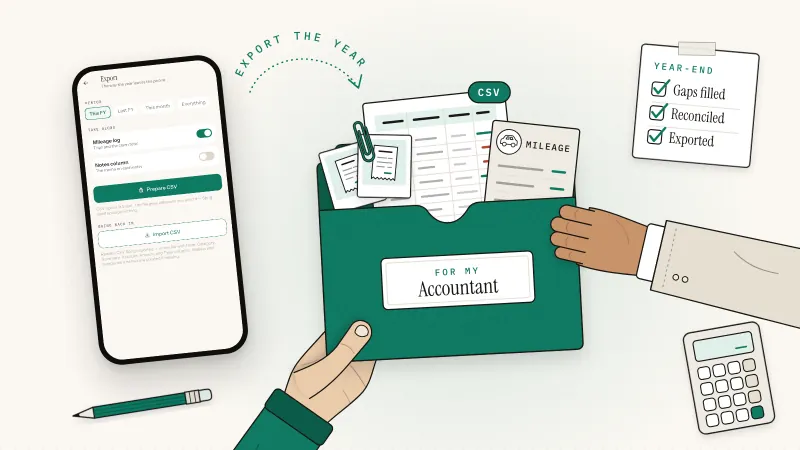
Give IRS payments their own category in your books, so they're never counted as business costs. At year end, list your 1040-ES payments for your accountant, and check how long to keep payment records before you clear anything out.
How Sprig helps you get each quarter's numbers
Sprig is a private, offline double-entry bookkeeping app for iPhone and Android, made by Secundum Reality. It doesn't work out your tax, but it gives you the income and spending totals your estimate starts from.
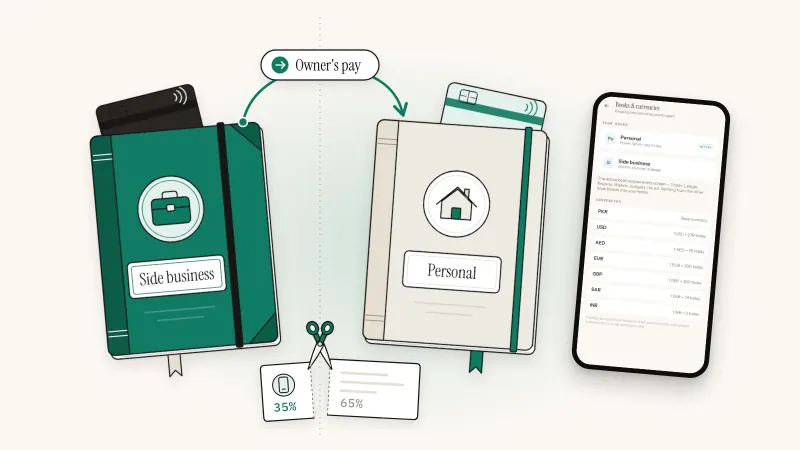
- Open the Side business book. Switch under More → Books & currencies. Sprig opens on Personal after a restart, so check before you read a report.
- Read the period. Reports → Year covers 1 January to 31 December; Range takes any dates up to today, such as Schedule AI's periods.
- Keep a tax pot. If you hold tax money in a separate savings account, add it as a Savings wallet called "Tax pot" and Transfer a share of each payment into it. Transfers never count as income or spending.
- Log each IRS payment as an expense from Tax pot in a category you create, such as "Tax payments", with a note like "2026 Q4 1040-ES". Subtract that bar from Money out when you read profit.
- Hand over the year. Export → Everything, then filter the Date column from 2026-01-01 to 2026-12-31.
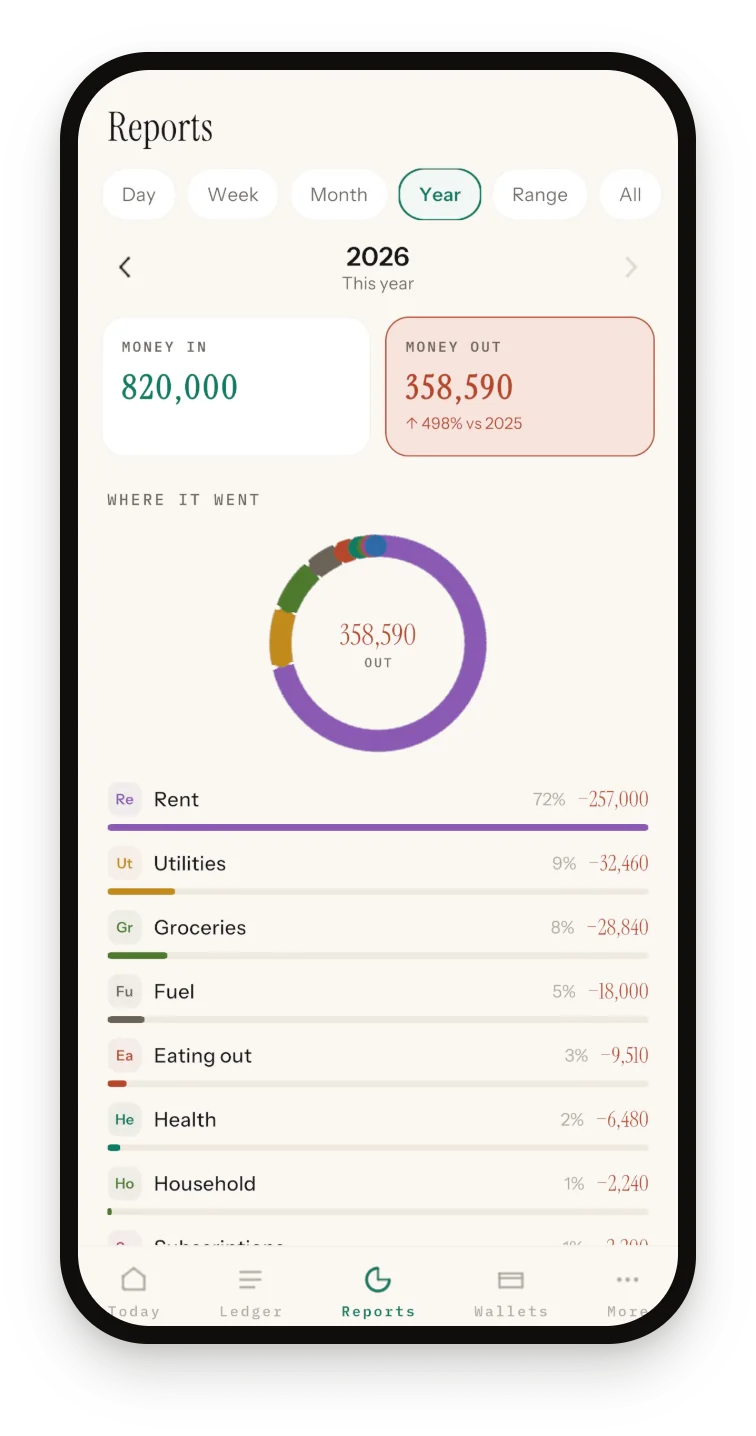
How Sprig helps
Books kept as you go make each due date quick.
- Income on the day it lands: Mark paid on an invoice writes the income entry.
- Both sides of every entry:
Tax payments ← Tax potshows where the money went and which wallet paid. - Private: no account, bank link or cloud.
What Sprig won't do
- Tax math, reminders or IRS payments. No tax or penalty calculations, no notifications and no IRS connection, so put the due dates in your calendar.
- A US year in the Tax summary. The Tax summary and the This FY and Last FY exports run July to June, Pakistan's tax year. Use Year, Range and Export → Everything instead.
- Currency symbols or backdating. Amounts are plain numbers, so keep every wallet in the same currency (the default). Entries are dated the day you log them; for older ones, import a CSV with YYYY-MM-DD dates.
Sprig is free for 50 entries, plus 20 more per optional ad (up to 4 a day), with every feature included; each transfer uses one entry. See the whole offline bookkeeping app.
Sprig for iPhone and Android
Keep your books in four taps.
Private, offline double-entry bookkeeping. No account, no bank login, no cloud. Free to start with 50 entries.
Frequently asked questions
Do I have to pay estimated taxes in my first year of self-employment?
Not if you had no tax liability for 2025, meaning total tax of zero or no need to file, and were a US citizen or resident alien for that full 12-month year. Otherwise the usual test applies: pay if you expect to owe at least $1,000 for 2026 after withholding and refundable credits, unless those already reach the safe harbor.
Can I pay all my estimated tax at once?
Yes. You can pay the whole year's estimated tax by the first due date, 15 April, or pay weekly or monthly, as long as enough is paid by each due date. One payment late in the year doesn't cancel penalties on earlier installments you missed.
Is it too late to pay estimated tax for 2026?
No. The penalty on a missed installment grows daily until it's paid, so paying now costs less than waiting. The fourth 2026 installment is due 15 January 2027, or you can skip it by filing your 2026 return by 1 February 2027 and paying the full balance.
Do I need estimated tax payments if I also have a W-2 job?
Maybe not. File a new Form W-4 asking your employer to withhold more, sized with the IRS Tax Withholding Estimator, which asks about self-employment and gig income. Withholding counts as paid evenly over the four due dates, so raising it late in the year still helps.
What is the safe harbor rule for estimated taxes?
If withholding and estimated payments reach the smaller of 90% of your 2026 tax or 100% of the tax on your 2025 return, paid on time, there's no underpayment penalty. If your 2025 AGI was over $150,000 ($75,000 married filing separately), use 110% of 2025 tax instead of 100%.
How much is the penalty for a late estimated tax payment?
The IRS applies its quarterly underpayment rate to each late installment for the days it stays unpaid: 7% a year for most of 2026, and 6% from April to June. For example, $1,500 due 15 April 2026 and paid 15 October 2026 costs about $50. Figure it on Form 2210, or the IRS can figure it and send a bill.
Sources and further reading
- IRS: Estimated taxes
- IRS: Form 1040-ES (2026), Estimated Tax for Individuals
- IRS Publication 505 (2026): Tax Withholding and Estimated Tax
- IRS: Instructions for Form 2210 (2025), Underpayment of Estimated Tax by Individuals
- IRS: Quarterly interest rates
- IRS: Self-employment tax (Social Security and Medicare taxes)
Published 3 October 2026. Feature details were checked against Sprig 1.1 for iPhone and Android. This article is general information, not tax or legal advice; rules differ by country, so confirm anything you file with your accountant or tax authority.