Bookkeeping basics
How to Separate Business and Personal Finances, Even on One Account
Mixing money costs side hustles deductions and weekends at tax time. Here is how to split accounts, books, shared bills and your own pay, with US and UK rules.
Most side businesses start inside a personal bank account. The first client pays into the account your salary lands in, the first domain name goes on your everyday card, and by tax time you're scrolling a year of statements trying to remember which coffee was a client meeting. Separating business and personal money fixes that, for far less effort than the cleanup it saves. This guide is for sole proprietors, sole traders, freelancers and side hustlers.
Why separate business and personal finances?
Keeping them apart shows your real profit and makes deductions easy to prove. Mixing the two, often called commingling, turns tax time into an archaeology project: every shared transaction has to be explained and sorted later, often from memory. With separate money and separate books, the business numbers are there when you or your accountant need them.
- Missed deductions. A business cost buried among groceries is easy to forget, and every one you miss means paying tax on profit you never made.
- Weaker proof. If a tax authority asks which transactions were business, a mixed statement makes the answer slow and less convincing.
- No clear profit. When client payments and your salary share an account, you can't tell whether the business earns money or borrows from your rent.
Do you legally need a separate business bank account?
For sole traders and sole proprietors, a separate account is strong advice rather than a legal rule. UK sole traders aren't legally required to have one, though some personal accounts don't allow business use. In the US, IRS Publication 583 says to open a business checking account and keep it separate. UK limited companies must have one.
US
IRS Publication 583 (December 2024) says one of the first things to do when you start a business is open a business checking account and keep it separate from your personal one, and to "use the business account for business purposes only." An LLC or corporation is legally separate from you, so keeping its money apart matters even more.
UK
The UK government's Business.gov.uk site says sole traders and normal partnerships are not legally required to have business bank accounts, but separating the two makes accounting simpler. Some personal accounts don't allow business transactions, so check your bank's terms. The same page says certain businesses, like limited companies, must have a business bank account.
Pakistan
The FBR's income tax basics define the normal tax year as the twelve months ending on 30 June, but that page doesn't cover business bank accounts. Check your bank's terms or ask a tax advisor. The 1 July start of the tax year is also a natural date to begin separate books.
Elsewhere
In India, the UAE and beyond, the practical advice is the same: one account, or at least one card, for business. Ask your bank and tax authority whether it's required.
This is general information, not tax or legal advice. Rules change, so check current guidance or ask an accountant.
How to separate business and personal finances in 5 steps
- Separate the money. A business account, or at least a business-only card.
- Separate the books. Record business money in its own books, even on a shared account.
- Split mixed-use bills. Only the business share goes in the business books.
- Pay yourself on a schedule. A planned owner's draw instead of dipping in.
- Check monthly. Ten minutes to match balances and catch strays.
Step 1: Give business money its own account, or at least its own card
The cleanest setup is an account that only sees business money: client payments in, business costs out, and a transfer to you on payday. A second account or a business-only card gets you most of the way.
| Setup | How separate | Tax-time effort | Watch out for |
|---|---|---|---|
| One shared account | Only in your books | Highest: every line needs sorting | Small business costs going unrecorded |
| Shared account plus a business-only card | Spending separated, income still mixed | Medium | Client payments landing with personal money |
| Second account used only for business | Separate in practice | Low | Bank terms that ban business use of a personal account |
| Business bank account | Fully separate | Lowest | Fees; compare before you open one |
Whichever you choose, route both income and costs through it, or you'll have two accounts to sort instead of one.
Step 2: Keep separate books, even with one account
A bank account separates money. Books separate meaning. Even on one account, keep the business in its own books from day one: business payments in the business book, everything else in the personal one. Your statement stays mixed; your records don't.
On a shared account, treat the business as a slice of it: give the business book its own account for that slice, starting at zero. The two balances added together should equal your bank balance, which makes a handy monthly check.
| Money move | Business book | Personal book |
|---|---|---|
| A client pays you | Money in, e.g. Freelance | Nothing |
| Software, supplies or another business cost | Money out, in its category | Nothing |
| Groceries, home rent, a family dinner | Nothing | Money out |
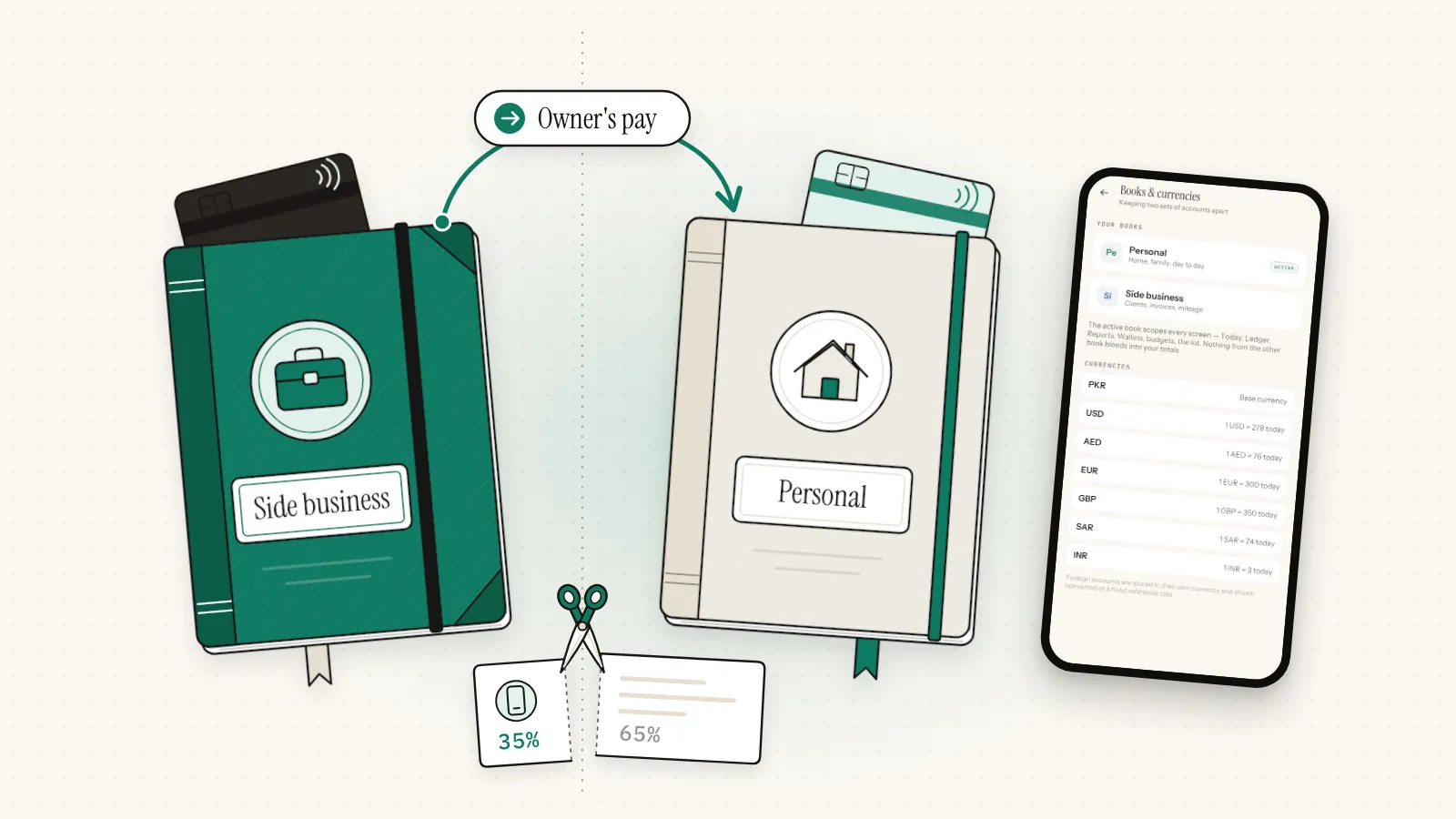
| You pay yourself | Money out, labeled Owner's draw | Money in, labeled Owner's pay |
| A bill that is partly business | The business share only | The personal share |
| Business cost paid on a personal card | Money out when the business pays you back | The card payment, then the repayment as money in |
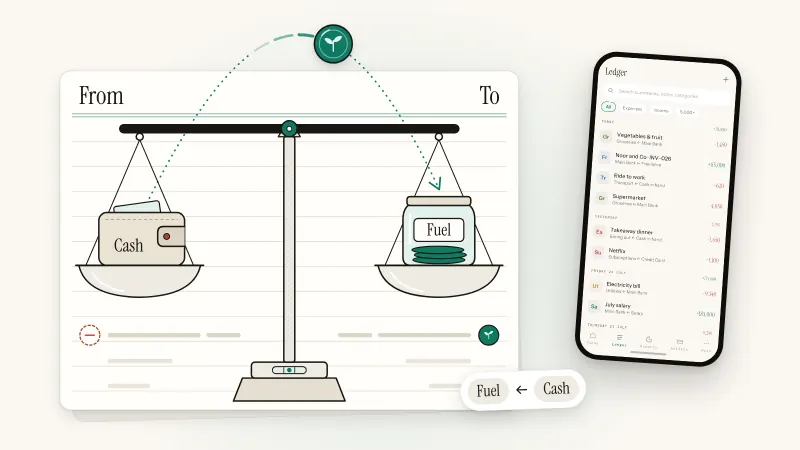
Recording both sides is the core of double-entry bookkeeping, explained without the jargon: every amount comes from somewhere and goes somewhere.
Step 3: How do you split a bill that's part business, part personal?
Work out a fair business share once, write down how you got it, and record only that share as a business expense. If the business account pays the whole bill, record the personal share as an owner's draw. If your personal account pays it, the business can pay you back the business share.
IRS Publication 334 says to separate the personal part of an expense that is partly business, and that the personal part is generally not deductible. GOV.UK's guide to self-employed expenses gives the example of a £200 phone bill with £70 of business calls: you claim £70.
For example, say your phone bill is 4,000 a month and your usage comes out at 35% business. The business share is 1,400; the personal share is 2,600.
- The business account pays. In the business book, record 1,400 as a business expense and 2,600 as an owner's draw.
- Your personal account pays. Record the 4,000 bill in the personal book, then have the business pay you back 1,400: a business expense, and money in on the personal side.
Recheck the 35% when your usage changes. For choosing a fair basis, and which costs count at all, see the self-employed tax deductions checklist.
Step 4: How do you pay yourself from your business?
As a sole proprietor or sole trader, you pay yourself with an owner's draw (UK: drawings): a transfer from the business account to your personal one. It isn't a salary and isn't a business expense, so it doesn't lower your taxable profit. Draw a set amount on a set date, after putting money aside for tax.
IRS Publication 334 says you can't deduct your own salary or any personal withdrawals from your business, because as a sole proprietor you are not an employee of it. GOV.UK says allowable expenses don't include money taken from your business for personal use. You're taxed on the profit, however much of it you draw. A limited company is different: GOV.UK lists salary, expenses and benefits, dividends and directors' loans as the ways to take money out.
A routine for uneven income, with example numbers:
- Find your typical profit. Average it over three to six months. Say 150,000 a month.
- Set aside tax first. Move a share into a savings pot: 20% here, or 30,000. Your real share depends on your income and country; ask your accountant.
- Keep a buffer of a month or two of business costs. Here, 10,000 tops it up.
- Draw the rest on a fixed date. 110,000 on the 1st: Owner's draw in the business book, Owner's pay in the personal one.
US
Sole proprietors generally have to make estimated tax payments if they expect to owe $1,000 or more when they file, using Form 1040-ES (IRS: Estimated taxes). A tax pot makes each one a transfer, not a scramble.
UK
Unless last year's tax bill was under £1,000, or more than 80% of the tax you owed was paid outside Self Assessment, you make two payments on account, due by 31 January and 31 July, each half of last year's bill.
Step 5: Run a 10-minute monthly check
Separation drifts, so run this check monthly, on the day you pay yourself. IRS Publication 583 gives the same advice: when your bank statement arrives, make sure it and your books agree.
- Match balances. Compare each account in your books with your bank app. A gap means a missing or doubled entry.
- Sweep for strays. Scan the business book for personal spending and the personal book for business costs.
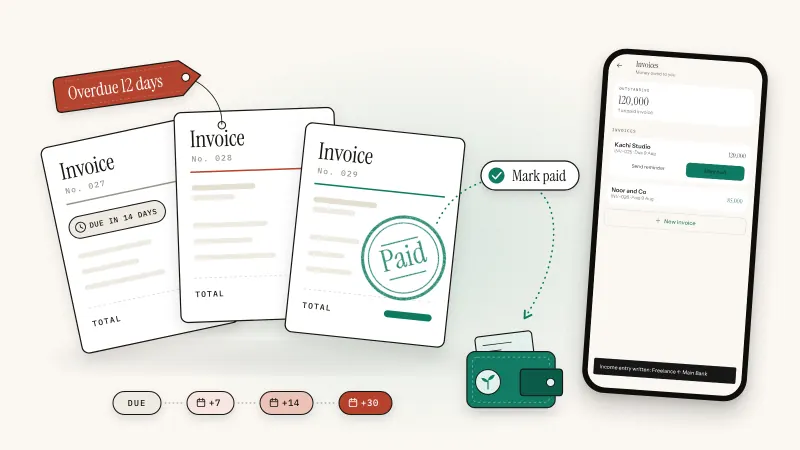
- Chase what you're owed. Follow up on overdue invoices. Here's how to track unpaid invoices as a freelancer.
- Clear the paper. File receipts and log business trips.
- Pay yourself and the tax pot. Then back up your books.
What if your money is already mixed together?
Don't try to fix every year at once. Pick a clean start date, usually the first day of your current tax year, and go through each statement since then, marking every business transaction. Total them by category, note business costs paid personally and personal costs paid by the business, then keep separate books from today on.
A spreadsheet works well, one row per business transaction. If you move to Sprig later, import that sheet as a CSV into Side business: you get a preview, duplicates are skipped and each row keeps its date. Handing the year to an accountant? See our guide to preparing your books for your accountant.
How Sprig keeps personal and business books apart
Sprig is a private, offline double-entry bookkeeping app for iPhone and Android, made by Secundum Reality. No account, no server, no bank link: both sets of books stay on your phone.
Sprig has exactly two books, Personal and Side business, and the active book scopes every screen: Today, Ledger, Reports, Wallets, budgets, invoices, mileage, receipts, the tax summary and the export.
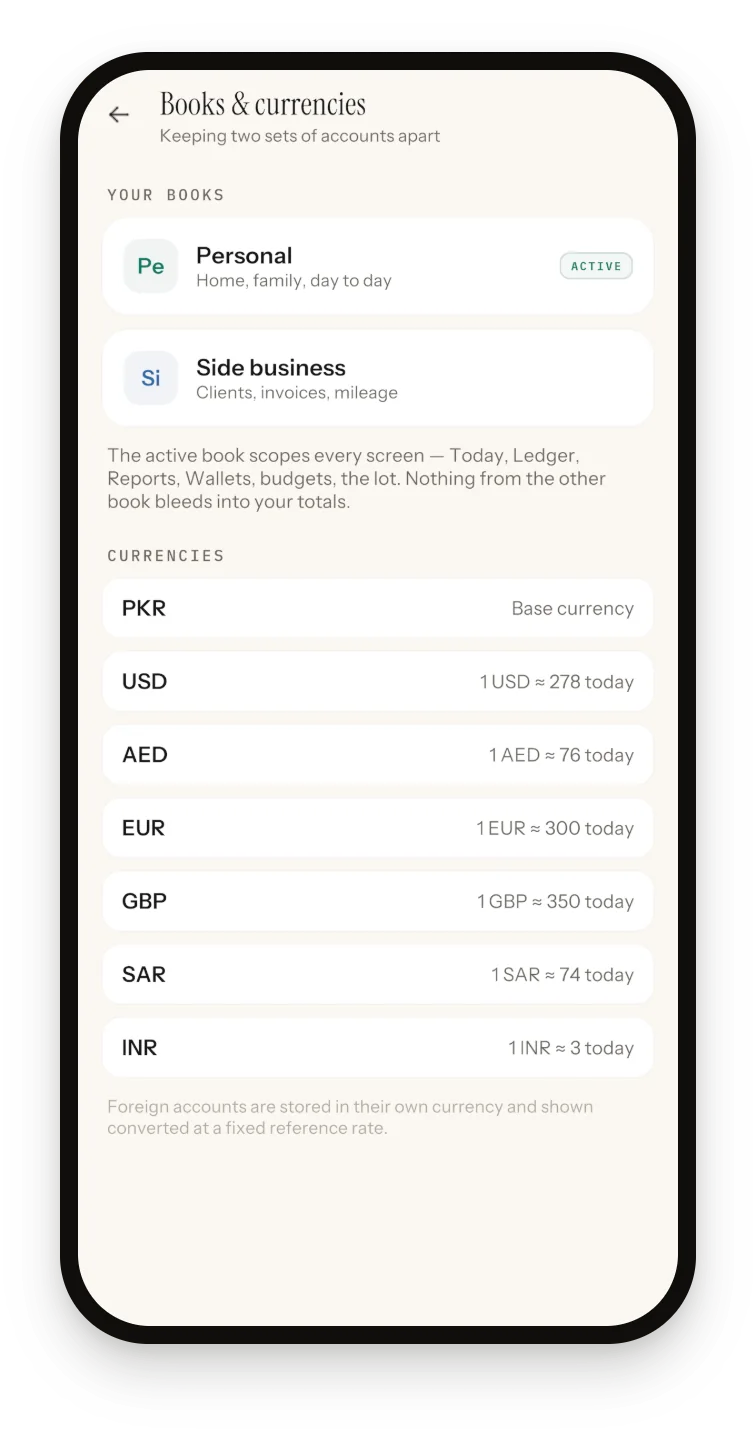
- Switch to Side business in More → Books & currencies.
- Add business wallets. Wallets → Add an account: bank, credit card, cash or savings. A name like Business Bank shows on Today which book you're in. On a shared bank account, add one for the business slice, starting at zero.
- Add owner's pay categories. On the category step, tap New: Owner's draw as an expense in Side business, Owner's pay as income in Personal. Sprig's tax summary never counts custom categories.
- Log as you go. Expense, category, what it was (or Skip), amount, Save: four taps and the amount. Each entry shows its pair, such as
Utilities ← Business Bank.
How Sprig helps
Two books that never mix, with real double entry underneath: balances move only through entries, so they can't drift.
- Invoices in the business book. See who owes you and what's overdue; Mark paid posts the income.
- Mileage log in kilometers. Business trips feed Vehicle & fuel in the tax summary.
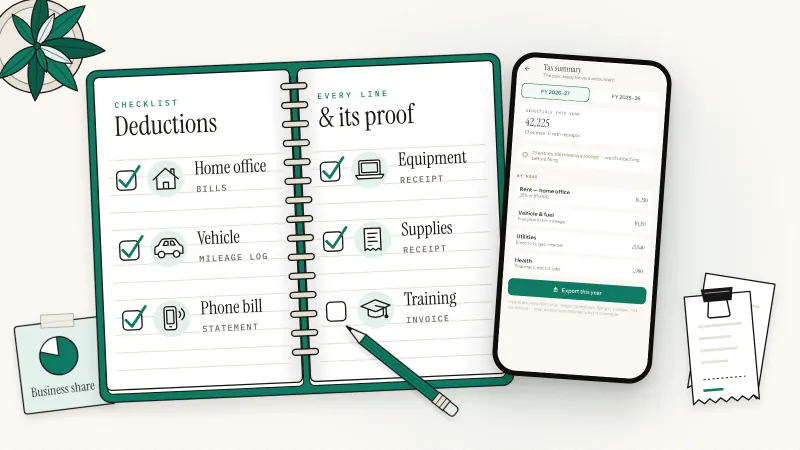
- A tax summary per book for the July–June financial year: deductible spending by head, plus a count of entries still missing a receipt.
- CSV export per book, with your mileage log, for Excel or your accountant.
The honest limits. You can't add or rename books, so two businesses would share Side business. Wallets belong to one book, so owner's pay is two entries, not one transfer. With no equity accounts, an owner's draw shows as money out in the business book's Reports; leave it out when you read profit. The monthly limit behind Safe to spend is shared by both books (category caps are per book). Sprig opens on Personal after a restart, and entries can't move between books. The tax summary uses a fixed July–June year and mileage a fixed 45 per km; Sprig is a ledger, not tax advice, and your accountant decides what is claimable.
Sprig is free for 50 entries, plus 20 more per optional ad (up to four a day), with every feature included; yearly Premium removes the limit and ads. To weigh manual logging against bank sync, read our comparison of bank-linked vs offline expense trackers, or see everything the offline bookkeeping app does.
Sprig for iPhone and Android
Keep your books in four taps.
Private, offline double-entry bookkeeping. No account, no bank login, no cloud. Free to start with 50 entries.
Frequently asked questions
Can I use my personal bank account for my side hustle?
Often, yes, if your bank allows it and your books keep the business separate. UK sole traders aren't legally required to have a business account, but some personal accounts don't allow business transactions. In the US, IRS Publication 583 recommends a separate business checking account. A second account used only for business is a sensible middle step.
What does commingling funds mean?
Commingling means mixing business and personal money, such as paying personal bills from the business account or using one card for both without recording which is which. For a sole proprietor the cost is mostly practical: profit gets hard to see and deductions hard to prove. For an LLC or a company it can also blur the legal line between you and the business.
Is an owner's draw taxed or deductible?
Neither, as a separate item. A sole proprietor or sole trader is taxed on the business's profit, and a draw just takes some of that profit out. IRS Publication 334 says you can't deduct your own salary or personal withdrawals, and GOV.UK excludes money taken for personal use from allowable expenses. Limited companies work differently.
What if I paid for a business expense with my personal card?
Record it, then fix it. For a sole proprietor or sole trader the cost can still count as a business expense; what matters is the record. The simplest clean-up is to have the business pay you back the exact amount, recorded as a business expense in the business books and as money in on the personal side. Keep the receipt with your business records. If it keeps happening, get a card you use only for business.
Can I keep business and personal books in the same app?
Yes, if the app keeps them truly apart. Look for separate accounts, categories and reports, so business totals never include personal spending. Sprig, for example, has two books, Personal and Side business, and the active one scopes every screen, from the Ledger and Reports to the tax summary and CSV export.
Sources and further reading
- IRS Publication 583 (12/2024): Starting a Business and Keeping Records
- IRS Publication 334 (2025): Tax Guide for Small Business
- GOV.UK: Expenses if you're self-employed
- Business.gov.uk: Getting a business bank account
- IRS: Estimated taxes
- FBR: Income tax basics (tax year)
- GOV.UK: Taking money out of a limited company
- GOV.UK: Payments on account
Published 3 October 2026. Feature details were checked against Sprig 1.1 for iPhone and Android. This article is general information, not tax or legal advice; rules differ by country, so confirm anything you file with your accountant or tax authority.