Getting paid
How to Track Unpaid Invoices as a Freelancer
Sending the invoice is the easy part. Here is a simple system for knowing who owes you, when to chase, and when the money counts as income.
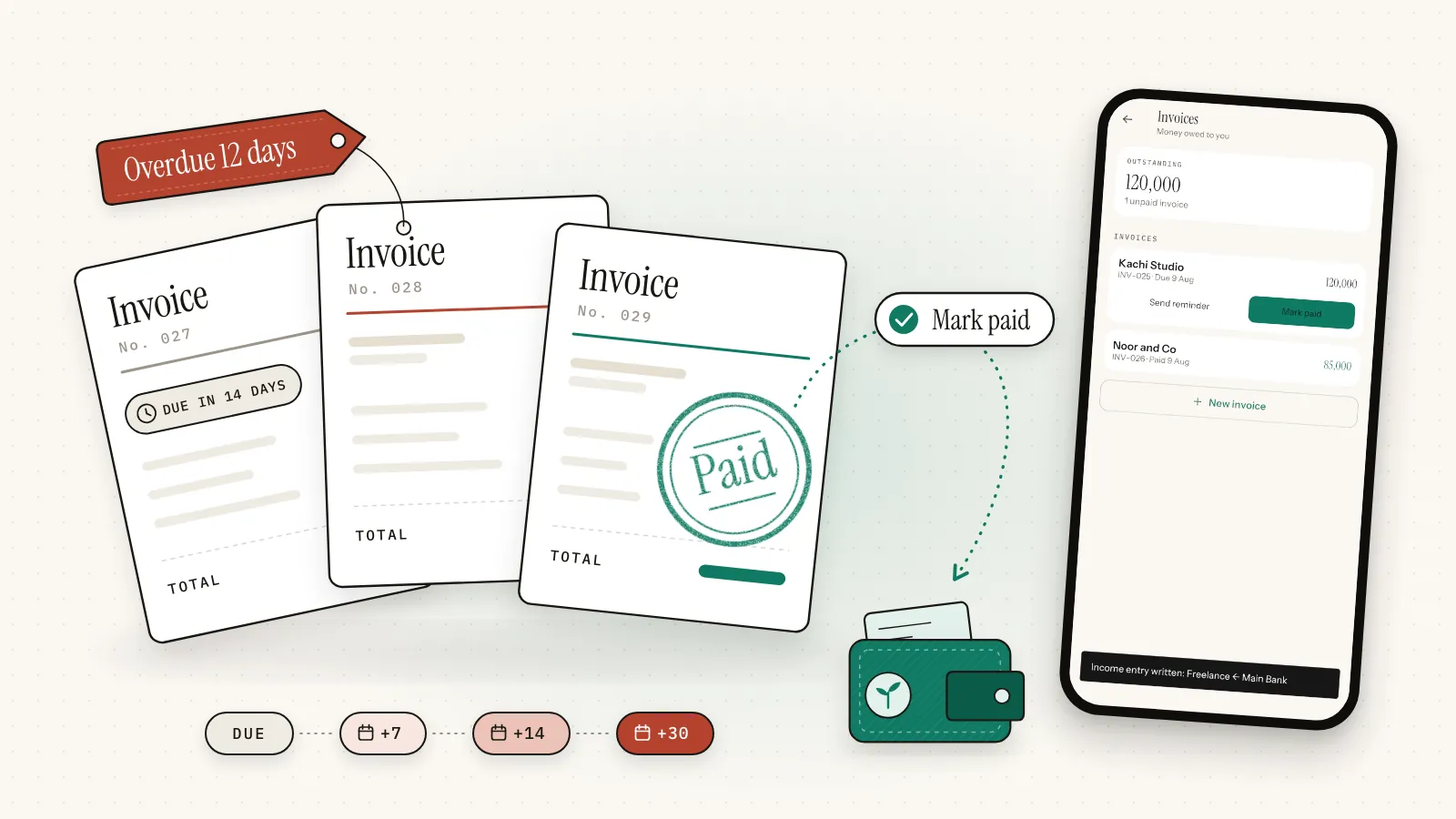
Sending the invoice feels like the finish line. It isn't. The work is done and the money is still somewhere between the client's accounts team and your bank. Multiply that by five clients, and "who still owes me?" becomes a question you answer by scrolling through old emails.
Here's a simple system: one list and a weekly check, what to put on every invoice, terms that get you paid sooner, and when invoice money counts as income.
Why do unpaid invoices hurt freelancers so much?
Unpaid invoices hurt because your costs arrive on time even when clients don't. Rent, software and tax bills won't wait for a slow accounts team. Without one list of what's owed, late invoices get forgotten, and on accrual accounting you can owe tax on money that hasn't reached you yet.
A one-person business can't carry two months of unpaid bills. When invoices live only in your sent folder, you get:
- Cash-flow gaps. On paper you're owed plenty. Your bank balance hasn't heard.
- Forgotten money. An invoice nobody chases slides to the bottom of the client's pile.
- Muddled books. Income gets counted twice (once when billed, again when paid) or not at all.
How do you track unpaid invoices week to week?
Keep one list of every invoice: client, invoice number, amount, invoice date, due date and status. Add each invoice the day you send it, check the list once a week, chase anything past due on a fixed schedule, and mark it paid the day the money lands. The unpaid total is your accounts receivable.
- Accounts receivable
- Money clients owe you for work you've already invoiced. For a freelancer, it's the unpaid invoice list.
- Outstanding
- The total of invoices not yet paid, whether or not they're due.
- Overdue
- Still unpaid after the due date. One day past due counts.
- Log it the day you send it. A spreadsheet, a notebook or an invoice tracker app all work, as long as it's one list.
- Check it weekly. Same day, five minutes. Message anything past due.
- Follow a ladder. Set your follow-up schedule once (below). Same schedule, same wording, every client: nobody takes a calendar personally.
- Record the payment the day it lands. Match it by invoice number and mark it paid. On a cash basis, that's also when the income goes in your books.
- Review the total monthly. If it keeps growing, shorten your terms or ask for deposits.
| When | What to send | Tone |
|---|---|---|
| 3 days before due | A heads-up: invoice number, amount, due date, how to pay | Helpful |
| Due date | "Due today" note with the invoice attached again | Neutral |
| 7 days late | First reminder; ask if anything is holding up payment | Polite, direct |
| 14 days late | Second reminder, plus a call or message to whoever approves payments | Firm |
| 30 days late | Final notice with a deadline; pause new work; mention any late fees your contract or law allows | Formal |
A first reminder can be this short: "Hi Sam, a quick note that invoice INV-031 for 1,200 was due on 14 March. Could you let me know when it's scheduled for payment? Payment details are on the invoice. Thanks, Ayesha." Name the invoice, the amount and the date. Skip the apology. You did the work.
What should every invoice include?
Every invoice should show a unique invoice number, your name or business name, address and contact details, the client's name and address, a clear description of the work, the supply date, the invoice date, the amounts charged and the total owed. Add a due date and how to pay. In the UK, GOV.UK sets the required list.
Two extras help you get paid, even where they aren't required:
- A due date written as a date. "Due 14 March" leaves less room for creative reading than "Net 30".
- How to pay. Bank details or a payment link, with the invoice number as the reference so you can match the money.
UK
GOV.UK's invoice rules require the items above, plus the VAT amount if applicable. Sole traders must also show their own name and any business name, and an address for legal documents if they trade under a business name. If you and your customer are both VAT-registered, you must use a VAT invoice, which needs more detail.
US
The IRS doesn't require a special invoice format. Its guide to business records lists invoices among the documents that support gross receipts, and lets you use any recordkeeping system that clearly shows your income and expenses.
Elsewhere
Registered for sales tax, VAT or GST? Tax invoices usually need extra details, so check with your tax authority (the FBR in Pakistan) or adviser.
Keep a copy of every invoice you send, paid or not. Here's how long to keep business records like invoices.
Payment terms that get you paid faster
Clear terms won't fix a client who can't pay, but they remove every excuse for one who just hasn't gotten around to it.
- Invoice the day you deliver. The payment clock doesn't start until the invoice arrives.
- Pick terms you can live with. If rent is due in 14 days, 30-day terms mean you're lending your client money.
- Ask new clients for a deposit. Part up front, the rest on delivery.
- Send it to the person who pays. Copy the accounts inbox, not just your day-to-day contact.
- Agree late-payment terms up front. A fee in the contract beats one announced after the fact.
UK
If you and a business customer haven't agreed a payment date, the payment is late 30 days after the customer gets the invoice, or 30 days after you deliver the goods or service if that's later. An agreed date should usually fall within 60 days for deals between businesses (longer only if it's fair to both) and within 30 days for public authorities (GOV.UK: late commercial payments).
UK: proposed change
The Commercial Payments Bill, introduced on 19 May 2026, would cap payment terms at 60 days with strictly limited exemptions and make statutory interest mandatory. In October 2026 it was still in the House of Lords (UK Parliament) and not yet law, with a lead-in period promised before it applies.
When does invoice income count for tax?
It depends on your accounting method. On a cash basis, invoice income counts when you're paid, so an unpaid invoice isn't taxed yet. On an accrual (traditional) basis, it counts once you've earned and billed it, paid or not. Cash basis is the UK default for sole traders and the method most US individuals use.
| Cash basis | Accrual (traditional) | |
|---|---|---|
| Invoice income counts | When the money is received | When you invoice or earn it |
| Unpaid invoice at year-end | Not income yet | Already income |
| Client never pays | Nothing to write off: it was never income | May be written off as a bad debt; ask your accountant |
| Who uses it | UK sole traders and partnerships by default; most US individuals | UK limited companies and sole traders who opt out; US businesses that choose it or must use it |
UK
From 6 April 2024, cash basis became the default method for sole traders and partnerships without corporate partners. GOV.UK's cash basis guide notes that you won't pay Income Tax on money you haven't yet received. You can choose traditional accounting instead, which records income by the date you invoiced.
US
Most individuals and many small businesses use the cash method, according to IRS Publication 538. Income counts in the year you actually or constructively receive it, meaning it was credited to your account or made available to you without restriction. A client payment that reaches your account on 31 December belongs to that year, even if you log it in January.
Pakistan
Pakistan's normal tax year is the twelve months ending 30 June (FBR). Under section 32 of the Income Tax Ordinance, 2001 (FBR's text amended up to 30 June 2026), companies account for business income on an accrual basis, while other persons may use cash or accrual unless the FBR prescribes a method for their class. Under section 33, cash-basis income is derived when it is received.
This is general information, not tax advice. Rules change, so confirm your method with your accountant or tax authority.
Recording each payment once also keeps your books balanced. Here's why each payment is recorded on both sides in double-entry bookkeeping.
What can you do when a client still doesn't pay?
Escalate in steps. Send a final written notice with the amount, invoice number and a deadline. Pause new work. Add any late-payment interest or fees your contract or local law allows. Then consider a small-claims court or a debt-recovery service. Keep every message, because your paper trail is your case.
UK
When another business pays late, you can claim statutory interest of 8% plus the Bank of England base rate, unless your contract sets a different rate (GOV.UK: charging interest). The base rate has been 3.75% since 18 December 2025 and was held there on 17 September 2026, which puts statutory interest at 11.75% a year. You can also claim fixed-sum compensation once per payment: £40 for debts up to £999.99, £70 from £1,000 to £9,999.99, and £100 for £10,000 or more. For example, a £2,400 invoice earns £282 a year at 11.75%, or about 77p a day, so 30 days late adds about £23, plus £70 compensation. Check the rate before you claim.
If the money never arrives, your accounting method decides what's next. On a cash basis it was never income, and the IRS says cash method taxpayers "generally can't take a bad debt deduction" for unpaid fees (Topic 453). On accrual, ask your accountant about writing it off. Either way, decide before your year closes: chase or write off unpaid invoices before you hand your books to your accountant.
How Sprig helps you track unpaid invoices
Sprig is a private, offline double-entry bookkeeping app for iPhone and Android, made by Secundum Reality. Its invoice list is a receivables tracker: it shows who owes you and writes the income into your books when they pay.
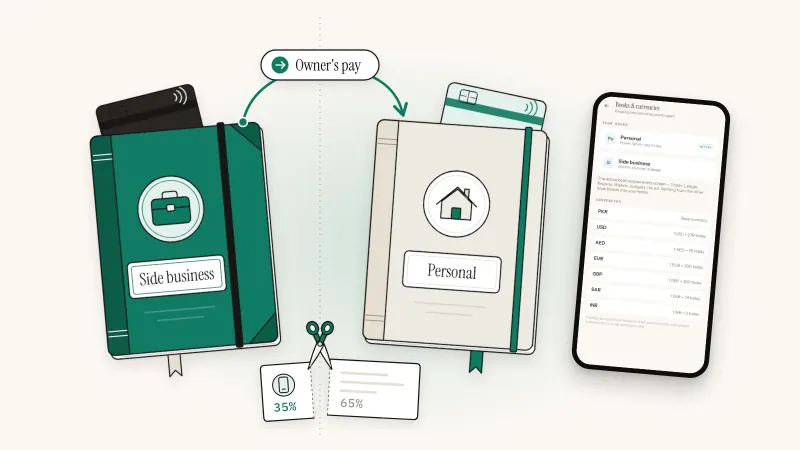
- Open the right book. Invoices belong to the open book, so switch to Side business to keep client income in your business book.
- Add the invoice. In More, then Invoices, tap New invoice, type the client and the amount, and tap Add. Sprig gives it a number like INV-026 and sets the due date 14 days out.
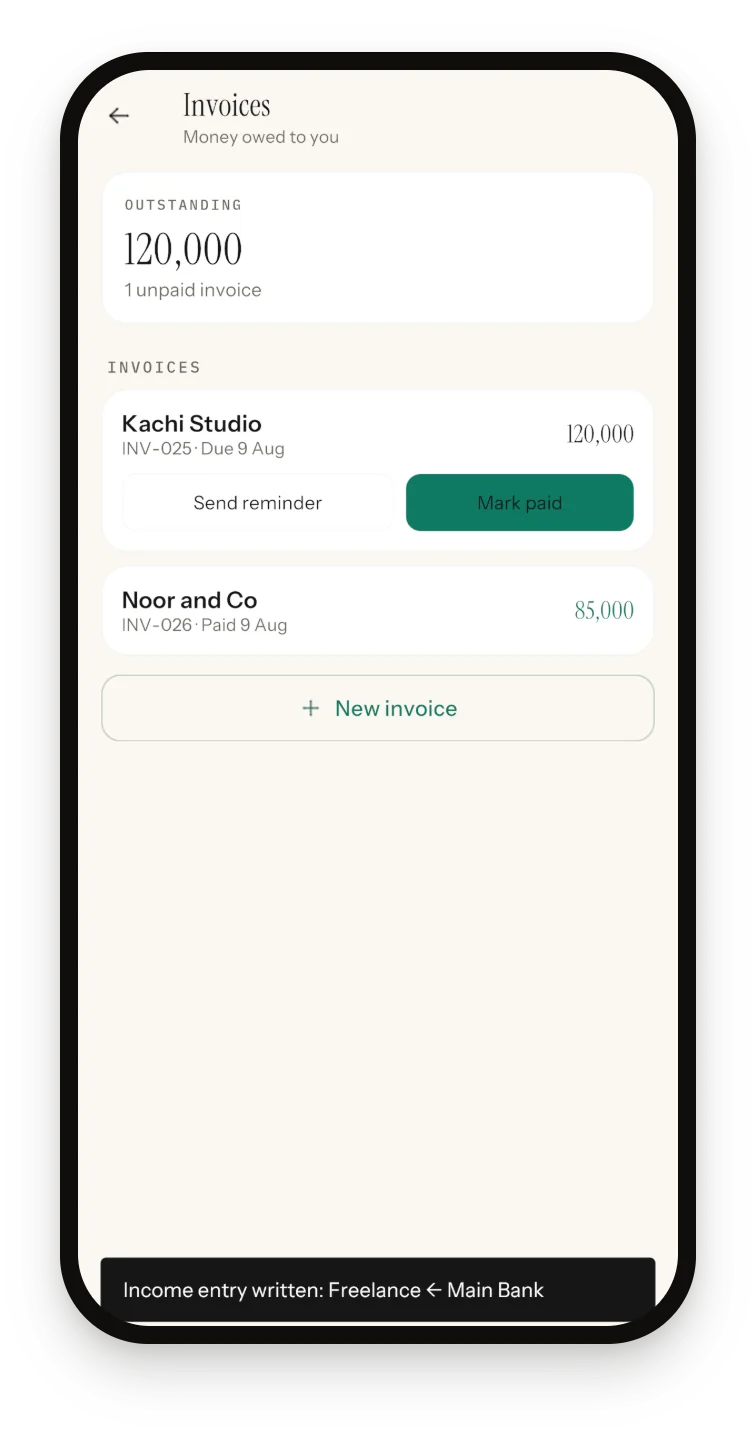
- Watch the total. The Outstanding card shows what you're owed and how many invoices are unpaid. Once a due date passes, the line turns red: "Overdue 6 days".
- Mark paid when the money lands. Sprig writes the income entry for you, in the Freelance category, with a summary like "Kachi Studio · INV-025", dated today. Your wallet balance rises and Reports counts it under Money in.
How Sprig helps
A receivables list that keeps your books honest.
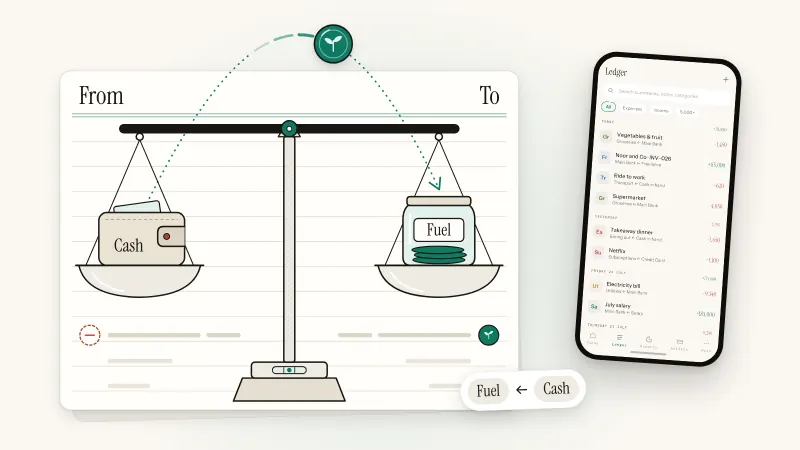
- Both sides recorded: in the ledger the entry reads "Main Bank ← Freelance", money into a wallet from an income category.
- Private: no account, no bank login, no cloud. Client names stay on your phone unless you export or back up, and the passphrase-encrypted backup includes your invoices.
What Sprig's invoices don't do
- No invoice documents. Sprig doesn't create or send invoices, and there's no PDF. Make the invoice in your usual template, then log it.
- "Send reminder" sends nothing. It marks the invoice "Reminder sent" so you know you chased. You write and send the message yourself.
- A fixed 14-day due date. Invoices can't be edited or deleted, so check before tapping Add. On longer terms, read the red label as your first nudge, not a late payment.
- The payment lands in the book's first wallet, dated today. You can't pick the wallet or backdate, so tap Mark paid the day the money arrives, which is also the cash-basis date.
- It counts as an entry. On the free plan, each Mark paid uses one of your entries (50 to start, plus 20 for each optional ad).
- The unpaid list stays in the app. The CSV export carries paid invoices as income entries, not the outstanding list.
Invoices are in the free version, along with every other feature of the offline bookkeeping app.
Sprig for iPhone and Android
Keep your books in four taps.
Private, offline double-entry bookkeeping. No account, no bank login, no cloud. Free to start with 50 entries.
Frequently asked questions
How do I keep track of who owes me money as a freelancer?
Use one list for every invoice you send: client, invoice number, amount, due date and status. A spreadsheet works; an invoice tracker app saves the sorting. Check it the same day each week, send reminders on a fixed schedule, and mark each invoice paid the day the money arrives. On a cash basis, that’s also when you record the income.
When is an invoice considered overdue?
An invoice is overdue once its due date passes without payment. If you never agreed terms, local law may set a default: in the UK, a business customer’s payment is late 30 days after it receives the invoice, or after you deliver the goods or service if that’s later (GOV.UK).
What must an invoice include in the UK?
A unique invoice number, your business name, address and contact details, the customer’s name and address, a description of the work, the supply date, the invoice date, the amounts charged, any VAT and the total owed. Sole traders also show their own name and any business name, plus an address for legal documents if they use a business name (GOV.UK).
Do I record income when I send the invoice or when I get paid?
On a cash basis, you record it when you’re paid; on accrual, when you invoice or earn it. Cash basis has been the default for UK sole traders since 6 April 2024 (GOV.UK), and most US individuals use the cash method (IRS Publication 538). Check with your accountant which applies to you.
Can I charge interest on a late invoice?
In the UK, yes, when the customer is a business: statutory interest is 8% plus the Bank of England base rate (11.75% a year while the base rate is 3.75%, as it was in October 2026), unless your contract sets a different rate. You can add fixed compensation of £40, £70 or £100 depending on the debt (GOV.UK). Elsewhere, it usually depends on your contract and local law, so agree late-payment terms before you start.
Is there an invoice tracker app that works offline?
Sprig tracks what clients owe you entirely on your phone, with no account or bank login. Add a client and amount; Sprig numbers the invoice, sets a 14-day due date, flags overdue ones in red and posts the income when you tap Mark paid. It doesn’t create or send invoices, so pair it with your usual template.
Sources and further reading
- GOV.UK: Invoicing and taking payment from customers, what invoices must include
- GOV.UK: Late commercial payments: charging interest and debt recovery
- GOV.UK: Late commercial payments, charging interest
- GOV.UK: Late commercial payments, claim debt recovery costs
- Bank of England: Bank Rate
- GOV.UK: Commercial Payments Bill overview (19 May 2026)
- UK Parliament: Commercial Payments Bill [HL], bill stages
- GOV.UK: Cash basis
- IRS Publication 538: Accounting Periods and Methods
- IRS: What kind of records should I keep
- IRS Topic no. 453: Bad debt deduction
- FBR: Income tax basics, tax year
- FBR: Income Tax Ordinance, 2001 (amended up to 30 June 2026)
Published 3 October 2026. Feature details were checked against Sprig 1.1 for iPhone and Android. This article is general information, not tax or legal advice; rules differ by country, so confirm anything you file with your accountant or tax authority.