Bookkeeping basics
Double-Entry Bookkeeping Explained for Non-Accountants
Every amount comes from somewhere and goes somewhere. Here is the one rule behind double-entry bookkeeping, with everyday examples, debits and credits translated, and no accounting degree required.
Most people who "do the books" keep a list: money in, money out, a running total. That's single-entry bookkeeping, and it works until it doesn't. A card payment gets counted twice. Savings moved into checking shows up as income. The total stops matching the bank, and nobody can say why. Double entry fixes that with one rule.
Double-entry bookkeeping explained: what is it?
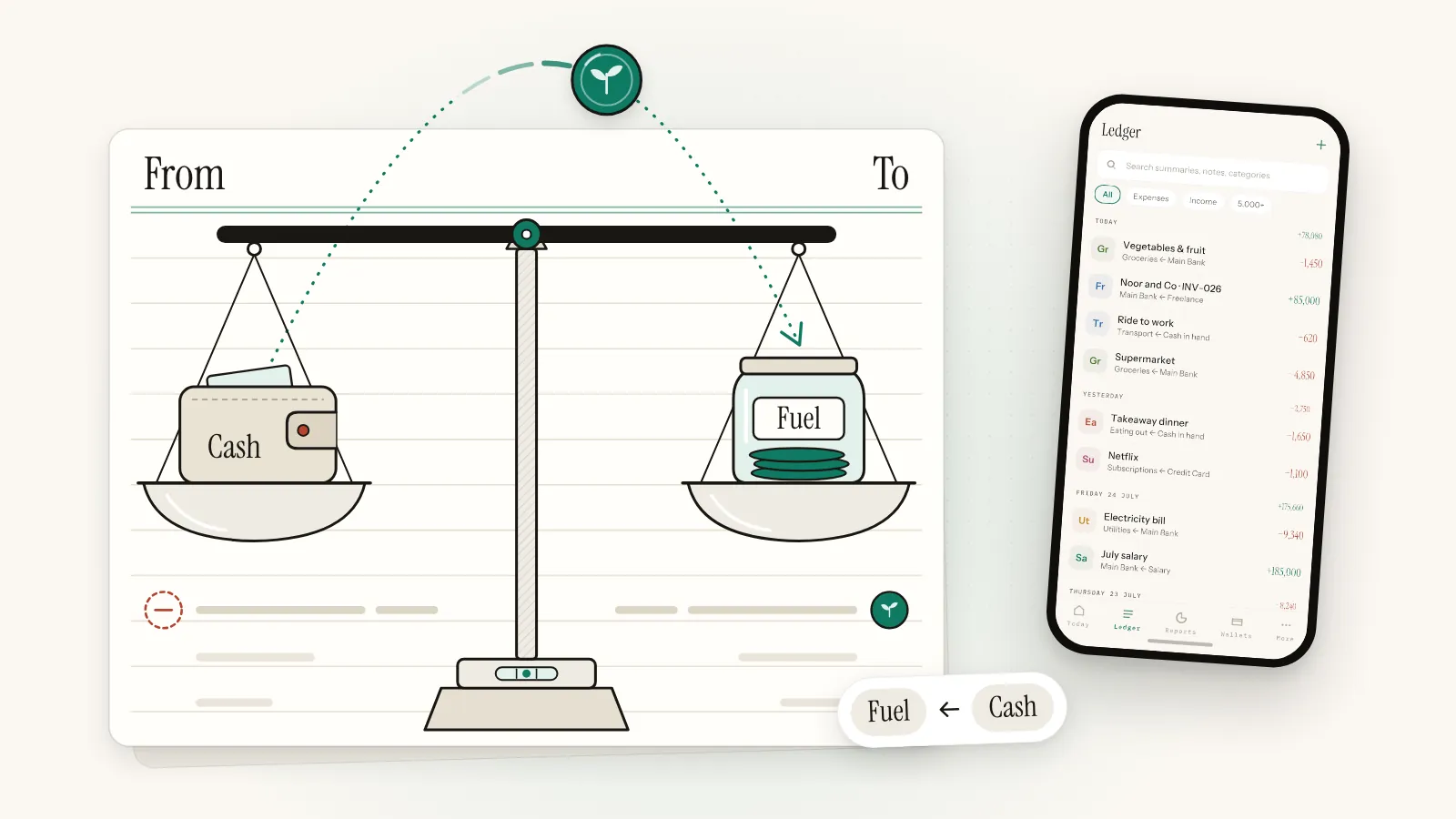
Double-entry bookkeeping records every transaction twice: once where the money came from and once where it went. Paying 3,000 for fuel in cash takes 3,000 out of Cash and adds 3,000 to Fuel. Because both sides always match, the books check themselves, and a mistake shows up as balances that don't agree.
The one rule: every amount comes from somewhere and goes somewhere
Every time money moves, ask two questions. Where did it come from? Where did it go? Write both down with the same amount and you're doing double entry. Each "somewhere" is an account:
- Asset
- Something you have: money in the bank, cash in hand, savings.
- Liability
- Something you owe: a credit card balance, a loan.
- Equity
- What is yours once debts are counted: assets minus liabilities.
- Income and expense accounts
- Labels for why money moved, such as Freelance or Fuel. Income raises equity. Expenses lower it.
Single entry asks "how much?" Double entry also asks "from where, and to where?" That second question is the one that catches mistakes.
The accounting equation, explained in plain words
Double entry rests on one line: Assets = Liabilities + Equity. What you have equals what you owe plus what is yours.
For example, say you have 120,000 in the bank and 8,000 in cash, and you owe 18,000 on a credit card. Assets are 128,000, liabilities 18,000, so equity is 110,000. Now pay 3,000 for fuel in cash. Assets drop to 125,000 and the Fuel expense lowers equity to 107,000. Both sides moved by 3,000, so the equation still balances. It always will, as long as every entry has two sides.
Single-entry vs double-entry: which one do you need?
Single-entry bookkeeping lists each transaction once, as income or an expense, like a checkbook register. Double-entry records two sides per transaction, so balances can be checked against the bank. Single-entry suits a tiny side business with one account. Once you have a card, cash and a bank account, double entry catches errors single-entry misses.
| Single-entry | Double-entry | |
|---|---|---|
| Each line records | One amount, in or out | Two sides: where money came from and where it went |
| Built-in error check | None built in. A typo just changes the total | Yes. Each balance should match its statement or the cash you hold |
| Transfers between your own accounts | Easy to log as income or spending | Recorded as transfers, never income or spending |
| Cards and loans you owe | Usually not tracked | Tracked as liabilities |
| Effort | Lowest on paper | More on paper; about the same in an app that fills in the second side |
| Best for | A hobby or tiny side business with one account | Anyone juggling a bank account, a card and cash |
What tax authorities say
US
The IRS doesn't require double entry. IRS Publication 583 (December 2024 revision) says that, except in a few cases, you can choose any recordkeeping system that clearly shows your income and expenses. It calls single-entry "a simple and practical system" for a new small business, and says double entry has "built-in checks and balances to assure accuracy and control."
UK
GOV.UK's list of records you must keep if you're self-employed includes all sales and income and all business expenses, but it names no bookkeeping method. Cash basis, the standard method for sole traders, records income and expenses when money is received or paid, so date each entry the day the money actually moves.
Pakistan
The FBR defines the normal tax year as twelve months ending on 30 June, named after the year in which it ends, so 1 July 2026 to 30 June 2027 is tax year 2027 (FBR income tax basics). For the books your business must keep, check FBR guidance or ask your tax advisor.
India, UAE and elsewhere
Record-keeping rules depend on your country and type of business, so confirm what your tax authority requires. This guide is general information, not tax advice, and rules change.
Double-entry bookkeeping examples from everyday life
Three transactions most freelancers and shop owners make every month, in plain numbers you can read in your own currency.
Paying for fuel with cash
You pay 3,000 for fuel from your cash. Money came from Cash in hand (an asset, down 3,000) and went to Fuel (an expense, up 3,000). As a pair: Fuel ← Cash in hand. If the cash in your pocket doesn't match the Cash in hand balance tonight, you've missed an entry.
A client pays you into the bank
A client pays an 85,000 invoice by bank transfer. Money came from Freelance income and went to Main Bank. The bank balance rises 85,000, and so does your income, which raises equity. As a pair: Main Bank ← Freelance.
Moving cash into the bank (a transfer, not income)
You deposit 20,000 of cash. Money came from Cash in hand and went to Main Bank, both your own accounts. No income, no expense, no change in equity: you're no richer. As a pair: Cash in hand → Main Bank.
This is where single-entry lists go wrong most often. The deposit appears on the bank statement as money in, gets typed up as income, and the year's income looks 20,000 higher than it was. In double entry, a transfer has your own accounts on both sides, so it can't pass for income.
What do debits and credits mean in plain words?
A debit is the side money goes to; a credit is the side it comes from. Debit and credit don't mean good and bad. They're left and right. Debits increase assets and expenses; credits increase liabilities, income and equity. Every transaction has equal debits and credits, which is why the books balance.
IRS Publication 583 says the same: each account has a left side for debits and a right side for credits, and the system is self-balancing because every transaction is a debit in one account and a credit in another. Here are the examples above, plus two credit card moves.
| Transaction | Debit (goes to) | Credit (comes from) | Amount | Pair line |
|---|---|---|---|---|
| Pay for fuel in cash | Fuel (expense) | Cash in hand (asset) | 3,000 | Fuel ← Cash in hand |
| Client pays into the bank | Main Bank (asset) | Freelance (income) | 85,000 | Main Bank ← Freelance |
| Deposit cash at the bank | Main Bank (asset) | Cash in hand (asset) | 20,000 | Cash in hand → Main Bank |
| Buy groceries on a credit card | Groceries (expense) | Credit Card (liability: you owe more) | 4,850 | Groceries ← Credit Card |
| Pay part of the card from the bank | Credit Card (liability: you owe less) | Main Bank (asset) | 10,000 | Main Bank → Credit Card |
If that feels backwards, blame your bank. When it "credits your account," it is speaking from its own side: it now owes you more. In your books, the same deposit is a debit to your bank account.
Why does double entry matter at tax time?
Double entry makes your year-end numbers trustworthy. Transfers between your own accounts never inflate income, card payments aren't counted twice, and every account balance can be checked against a statement. Clean categories then give you and your accountant a total for each type of expense, which means fewer surprises, fewer questions and fewer missed deductions.
- Nothing is paid for twice. Buy groceries on a card, then pay the card bill, and a single list shows two expenses. In double entry the card payment is a transfer that reduces what you owe.
- Every balance can be explained. Compare each account with its statement, or with the cash in your hand. If they differ, you know where to look before your accountant asks. That check is called reconciling.
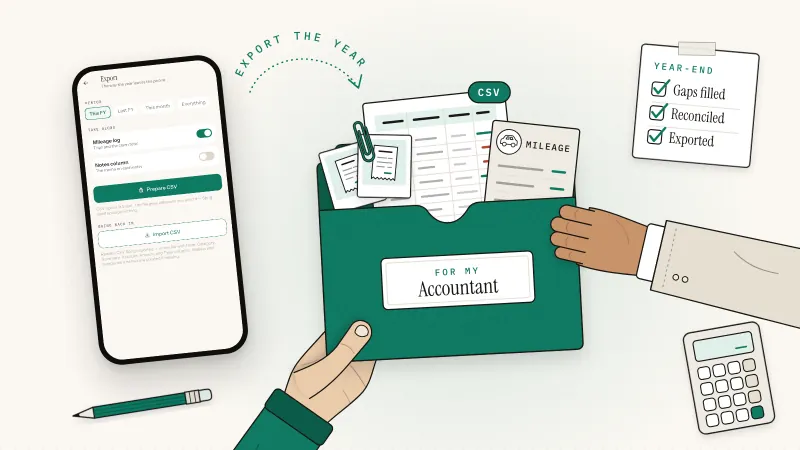
Pub 583 also explains how the year turns over: income and expense accounts close at the end of each tax year, while asset, liability and net worth accounts stay open. Your Fuel total restarts at zero; your bank balance carries on. Our guide on how to prepare your books for your accountant covers the year-end checklist, and if business and personal money share one account, start by learning how to keep separate personal and business books.
How Sprig keeps double-entry books in four taps
Sprig is a private, offline double-entry bookkeeping app for iPhone and Android, made by Secundum Reality.
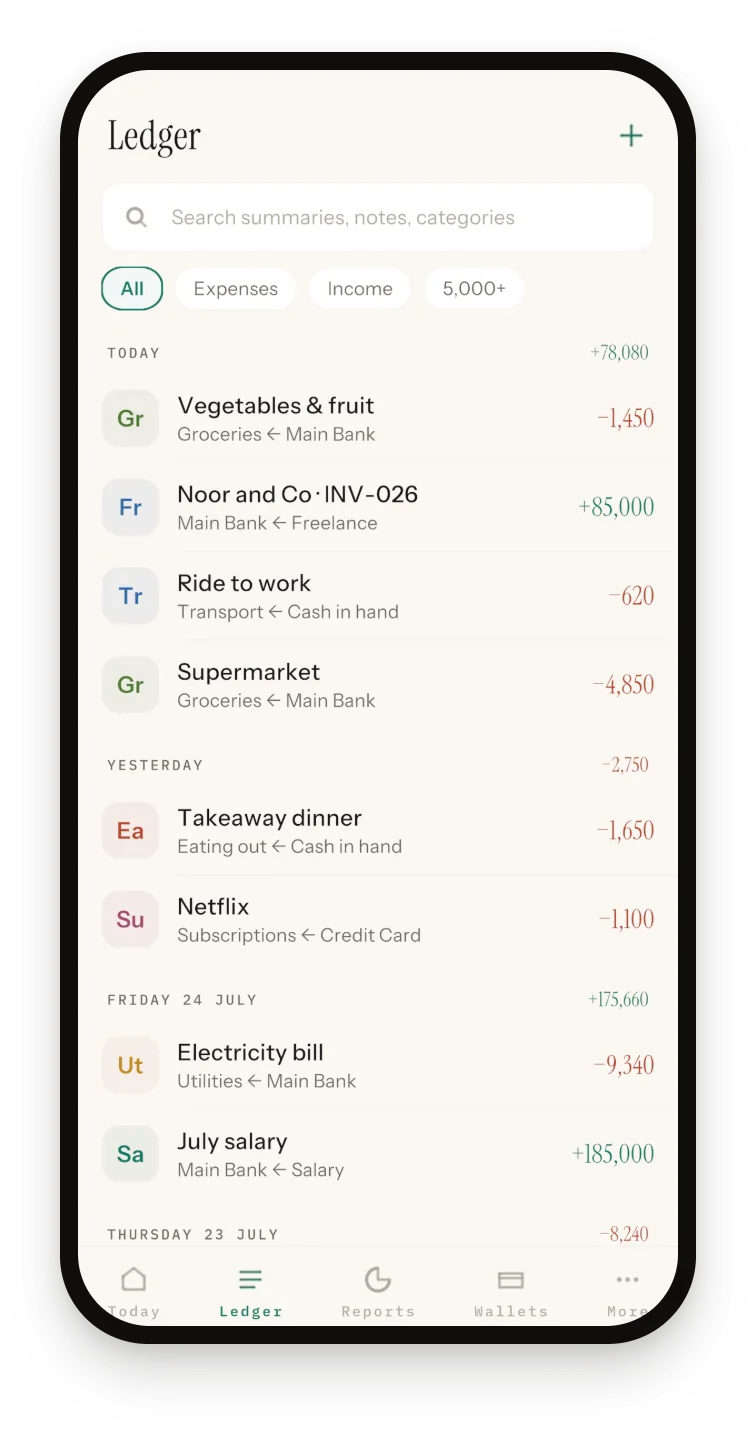
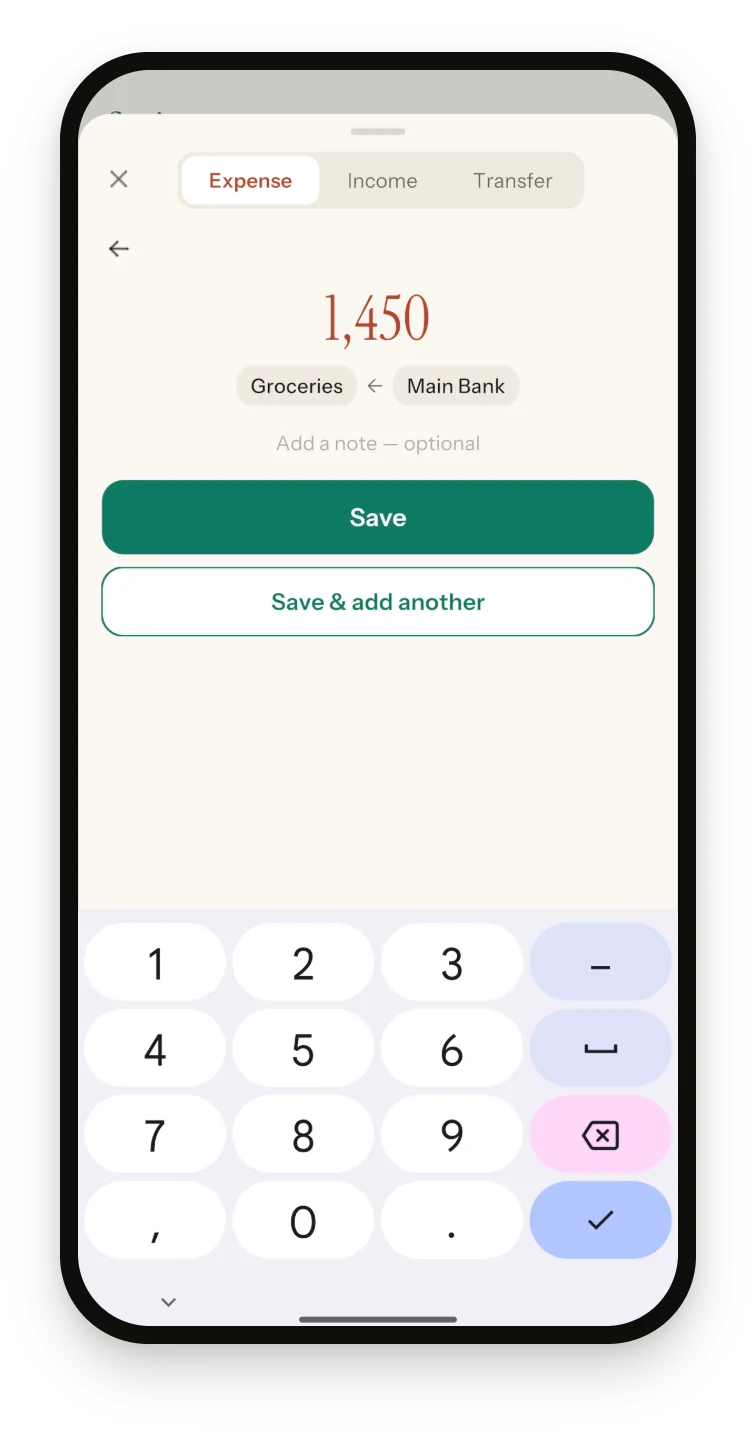
You never see the words debit or credit. With a wallet selected on the Today screen, tap Expense or Income, pick a category, pick what it was (or Skip), type the amount and tap Save. That's four taps and the amount. A transfer asks for the two wallets instead of a category. Sprig records both sides and shows the pair under every entry, just like the examples above: Groceries ← Main Bank for money out, Main Bank ← Salary for money in, Main Bank → Savings for a transfer.
How Sprig helps
- Balances can't drift. A wallet changes only through entries. Edit or delete one and Sprig reverses exactly what it posted.
- Bank, credit card, cash and savings wallets. A card balance is kept as money owed.
- Transfers stay transfers. Reports never count them as income or spending.
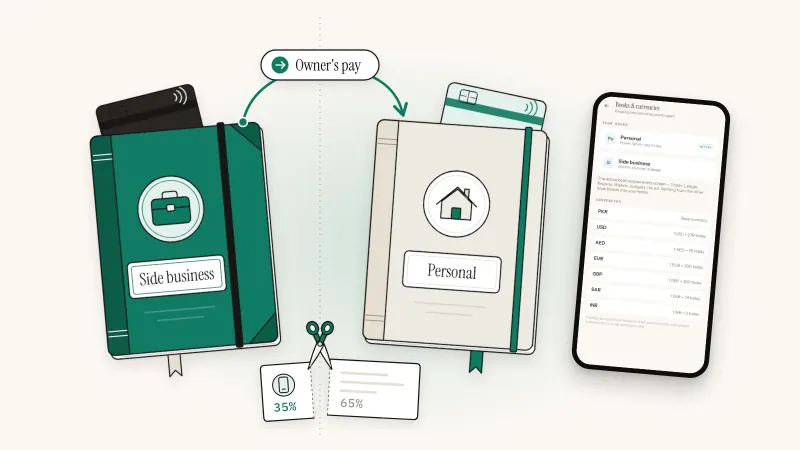
- Two books, Personal and Side business, so home and work never mix.
- CSV export with Date, Category, Summary, Account, Amount and Type for Excel or your accountant.
In the Ledger, swipe right to edit an entry's summary or amount. Swipe left to delete it, and the balance moves back as if the entry was never made. Sprig is free for 50 entries, plus 20 more for each optional ad you choose to watch (up to four a day), with every feature included. Premium is a yearly subscription with unlimited entries and no ads.
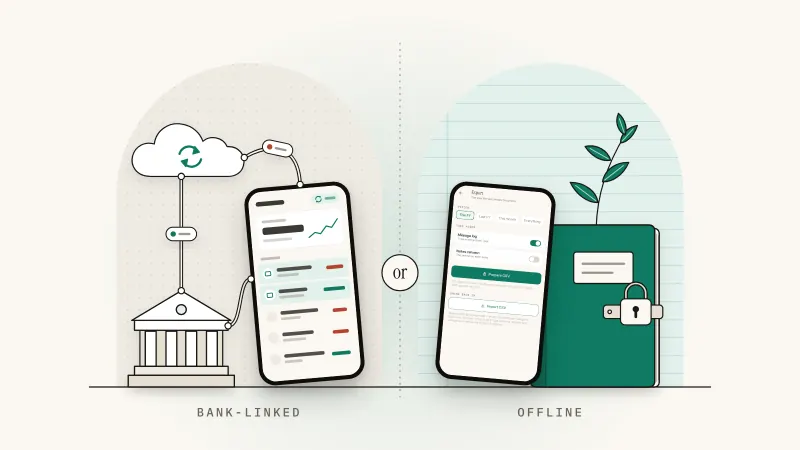
The honest limits: Sprig keeps a simplified model of wallets and categories, not a full chart of accounts, so there's no trial balance, balance sheet or profit-and-loss statement. Entries you type are dated the day you save them, so log as you go. There's no bank feed. The tax summary uses a fixed July–June year, and exports are CSV, not PDF. To weigh a manual app against one that links to your bank, read our comparison of bank-linked vs offline expense trackers and our guide to what a private offline bookkeeping app should do, or see every feature of the Sprig offline double-entry bookkeeping app.
When have you outgrown a simple ledger?
You've outgrown a simple wallet-and-category ledger when your business holds stock, runs payroll, files VAT or GST returns, must report on an accrual basis, or has business loans and equipment to depreciate. At that point you need full accounting software with a chart of accounts, and often an accountant to set it up.
- Inventory: stock you resell needs cost-of-goods tracking, not just spending.
- Employees: payroll brings withholding and filings a simple ledger isn't built for.
- Sales tax, VAT or GST: returns need the tax on each sale and purchase recorded separately.
- Accrual accounting: recording income when you invoice and bills when they arrive needs accounts receivable and payable.
- Loans and big assets: a loan's principal and interest are recorded separately, and equipment and vehicles need balance-sheet accounts and depreciation.
- Several currencies: accurate totals need each transaction converted at the exchange rate on its date. Sprig, for example, uses fixed reference rates for net worth and adds report totals without converting.
Until then, a simple double-entry ledger you keep up to date every day is worth more than a full accounting package you open twice a year.
Sprig for iPhone and Android
Keep your books in four taps.
Private, offline double-entry bookkeeping. No account, no bank login, no cloud. Free to start with 50 entries.
Frequently asked questions
Is double-entry bookkeeping required for a sole proprietor or sole trader?
Usually not. In the US, IRS Publication 583 lets you use any recordkeeping system that clearly shows your income and expenses, except in a few cases. In the UK, GOV.UK lists the records sole traders must keep, including all sales, income and business expenses, but names no bookkeeping method. Elsewhere, check with your tax authority or accountant.
Do I need to understand debits and credits to keep double-entry books?
No. You only need to record where the money came from and where it went. In accounting terms, the account the money goes to is debited and the account it comes from is credited. Apps that record both sides for you, such as Sprig, handle that translation, so you never have to label an entry yourself.
Is a transfer between my own accounts income?
No. Moving money from savings to checking, paying off a credit card or depositing cash at the bank changes where your money sits, not how much you have. In double-entry books both sides of a transfer are your own accounts, so it never counts as income or as an expense.
Can I do double-entry bookkeeping on my phone?
Yes, and logging each transaction as it happens beats catching up at month-end. Sprig, for example, records every expense, income or transfer as a pair across bank, card, cash and savings wallets, with no account or bank login. Because the books live only on your phone, export a CSV copy regularly and keep it somewhere safe.
Who invented double-entry bookkeeping?
No single person. The 1299–1300 ledger of the Farolfi firm, a company of Florentine merchants, already shows the full system. Luca Pacioli, an Italian mathematician, published the first detailed description in Summa de arithmetica (Venice, 1494), which is why he is often called the father of accounting, according to Wikipedia's history of double-entry bookkeeping. The core rule hasn't changed since.
Sources and further reading
Published 3 October 2026. Feature details were checked against Sprig 1.1 for iPhone and Android. This article is general information, not tax or legal advice; rules differ by country, so confirm anything you file with your accountant or tax authority.