Tax time
How Long to Keep Business Records: US, UK, Pakistan and More
The clock starts later than you think and runs longer than most phones last. Here's what the IRS, HMRC and FBR require, and a routine that keeps years of books safe.
Most people look up how long to keep business records while holding a shoebox. The answer is longer than you'd guess, because the clock doesn't start when you buy something. It starts when the tax year closes or its return is filed, and then runs for years. Here are the rules for the US, UK, Pakistan and UAE, with dated examples and official sources.
How long should you keep business records?
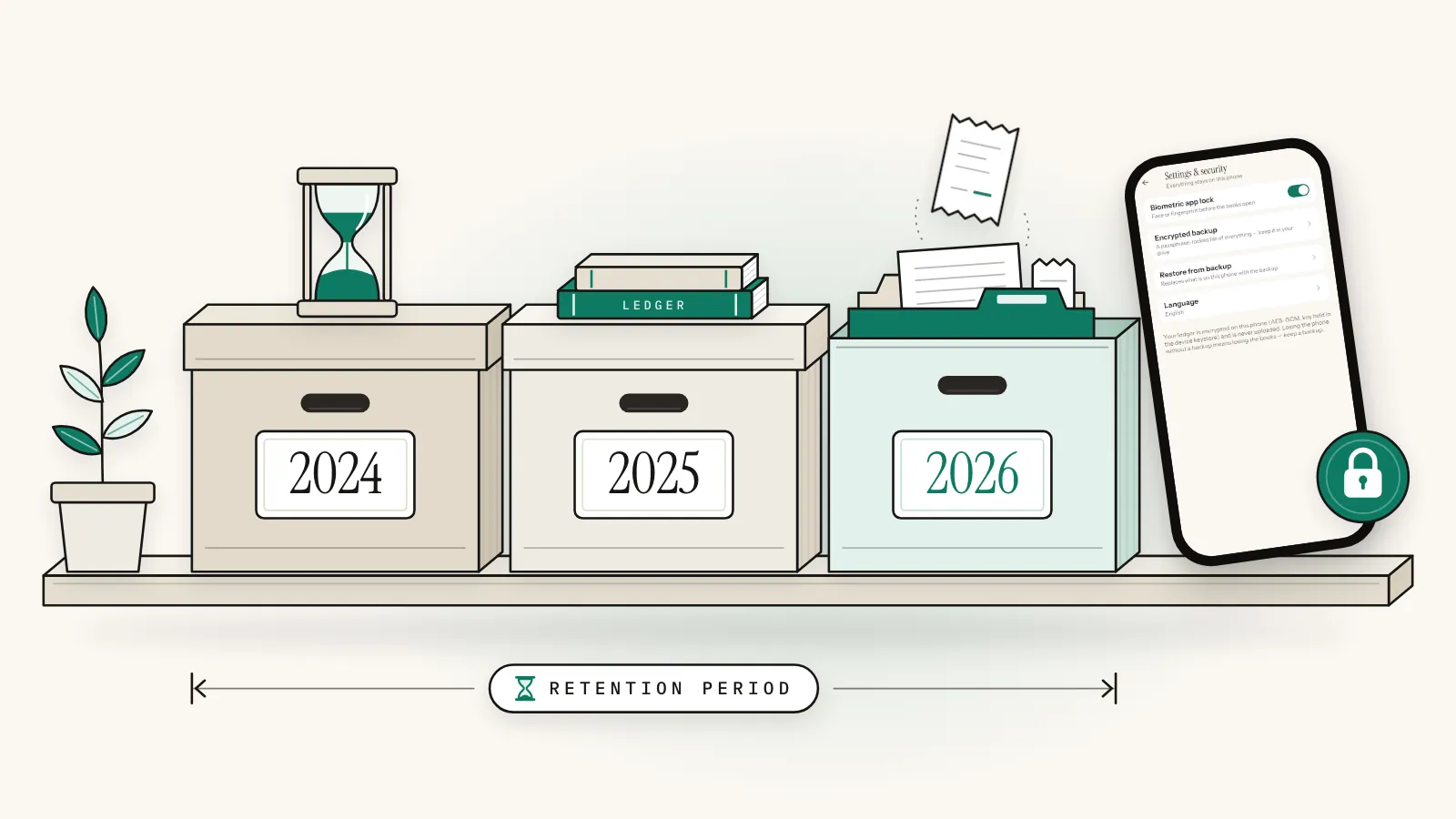
Keep business records for as long as your tax authority can still review the return they support. In the US that's generally three years after you file. In the UK it's at least five years after the 31 January filing deadline. In Pakistan it's six years after the tax year ends. Some situations need longer.
| Where | Basic rule | Clock starts | Exceptions | Source |
|---|---|---|---|---|
| US | 3 years | When you file (early returns count as filed on the due date) | 6 years if you left out over 25% of your gross income; 7 years for a bad-debt or worthless-securities loss; indefinitely if you file no return or a fraudulent one | IRS |
| UK | 5 years | After the 31 January online deadline for that tax year | Filed over 4 years late: 15 months after you file | GOV.UK |
| Pakistan | 6 years | After the tax year ends (30 June) | Until the final decision if proceedings are pending; no time limit for records of foreign assets, foreign spending or concealed foreign-source income (s.111) | Income Tax Ordinance 2001, s.174 |
| UAE (Corporate Tax) | 7 years | After the tax period ends | Exempt persons also keep 7 years; VAT records follow separate rules | Decree-Law 47 of 2022, Art. 56 |
| India and elsewhere | Check local rules | Varies | Varies | Your tax authority |
The IRS calls its window the period of limitations: the time in which you can amend a return, or the IRS can assess more tax. Employment tax records stay at least 4 years after the tax is due or paid, whichever is later. Equipment records stay until the period ends for the year you sell it, so a laptop bought in 2024 and sold in 2028 keeps its receipt into the 2030s.
Rule of thumb
Keep each year's records until seven years after that year's filing deadline, or after the day you filed if you were late. That covers the normal case under all four rules above, but not asset records, unfiled returns, open disputes or Pakistan's foreign-asset exception.
This is general information, not tax advice. Rules change, and your accountant or tax authority has the final word on your situation.
The rules by country, on a calendar
The trigger date matters more than the number of years.
US
For example, if you filed your 2025 return on time in April 2026, the basic window runs to April 2029, or April 2032 if you had left out more than 25% of your gross income. Filing in February doesn't start the clock sooner (IRS).
UK
The 2025–26 tax year ended on 5 April 2026 and its online return is due by 31 January 2027, so keep its records until at least the end of January 2032 (GOV.UK).
Pakistan
Section 174(3) of the Income Tax Ordinance, 2001 (FBR text amended up to 30 June 2026) requires accounts and documents to be kept for six years after the end of the tax year they relate to. Tax year 2026 ended on 30 June 2026, so keep its records until at least 30 June 2032. Under section 174(2), the Commissioner can disallow or reduce a deduction if you can't, without reasonable cause, produce a receipt or other record. The six-year limit doesn't apply to records of assets or spending outside Pakistan, or concealed foreign-source income, that section 111 can bring into tax.
UAE
If you're registered for Corporate Tax, Article 56 of Federal Decree-Law No. 47 of 2022 requires records that support your return to be kept for seven years after the end of the tax period. The Federal Tax Authority repeated the seven-year rule for taxable and exempt persons in an August 2025 notice. Check its current guidance for VAT records.
India and elsewhere
Rules vary by country and business, and some require more than seven years. Check your tax authority's guidance, or ask your CA or accountant, before you shred anything.
What records should you keep if you're self-employed?
Keep anything that proves a number on your return: what came in, what went out, and why. That means invoices and payment records for income, receipts and statements for expenses, a mileage log if you claim vehicle costs, purchase records for equipment, and a copy of every return you file.
Any system works if it clearly shows income and expenses (IRS); HMRC says your records must be accurate and must let you identify business transactions (GOV.UK).
| Record | Examples | What it proves |
|---|---|---|
| Income | Invoices, platform payout statements, 1099 forms, deposit records | Every payment you received |
| Expenses | Receipts, supplier invoices, bills, card and bank statements | What you spent, and that it was for the business |
| Vehicle | A mileage log: date, destination, purpose, distance | Your mileage or vehicle claim |
| Assets | Purchase invoices, proof of payment, sale records | Depreciation, and the gain or loss on sale |
| Returns | A copy of each return you filed | Amendments and next year's figures |
For what a mileage log must show, see mileage log rules and 2026 rates.
Can you keep business records digitally?
Yes, in both the US and the UK, as long as the digital version is complete, legible and easy to retrieve. The IRS accepts electronic records and images of paper records that meet its standards. Since 6 April 2026, Making Tax Digital has required digital records from UK sole traders and landlords with qualifying income over £50,000.
- Electronic storage system
- IRS term for a system that stores images of records so they can be indexed, retrieved and printed.
- Digital record
- Under Making Tax Digital, an entry in software with at least the amount, the date and a category.
- Digital link
- An electronic transfer between programs, such as CSV export and import. Copy and paste doesn't count.
US
Under Rev. Proc. 97-22, images of paper records kept in a compliant electronic storage system count as records under section 6001 of the tax code. The images must be complete, highly legible, indexed, protected from loss or alteration, and printable on request. You can destroy paper originals only after testing the system and setting up procedures to keep it compliant.
UK
Making Tax Digital for Income Tax applies from 6 April 2026 if your qualifying income was over £50,000 in 2024–25, from 6 April 2027 if it was over £30,000 in 2025–26, and from 6 April 2028 if it was over £20,000 in 2026–27 (GOV.UK). Create each digital record as close to the transaction as possible, and before the quarterly update that covers it. You still keep original records or supporting documents, or copies of them (GOV.UK: Keep digital records).
In practice that means a sharp photo of the whole slip, findable by date and backed up. Our guide to organizing receipts for taxes covers the photo part.
Do you need records for income that never shows up on a tax form?
Yes. Income is taxable whether or not anyone sends you a form, and your own records are often the only proof of it. The IRS says gig and side income must be reported even when no 1099-K, 1099-NEC or W-2 arrives, and even when you're paid in cash, property, goods or virtual currency.
Payment apps and online marketplaces only have to file a Form 1099-K for you when your payments top $20,000 across more than 200 transactions (IR-2025-107). A designer paid $15,000 through an app may get no form at all. The money is still income, and an invoice plus the matching deposit is the record that proves it.
A records routine that lasts seven years
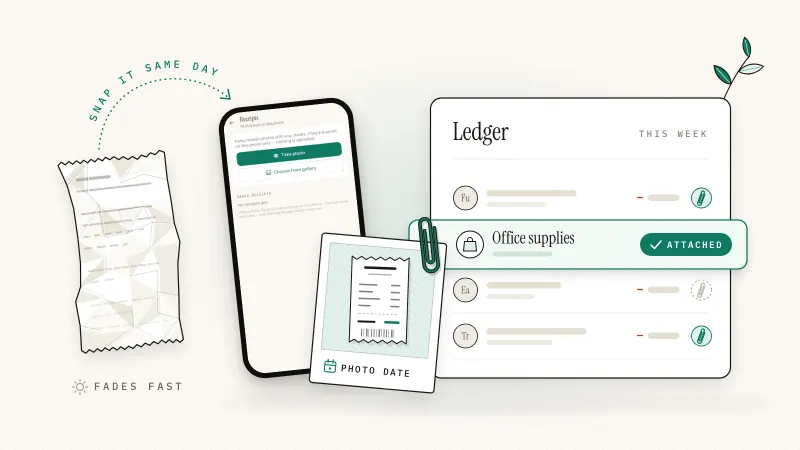
- On the day. Record each sale and expense when it happens, and photograph the receipt before it fades.
- Monthly. Check your records against bank and card statements, fill gaps, and save the statements. They're records too.
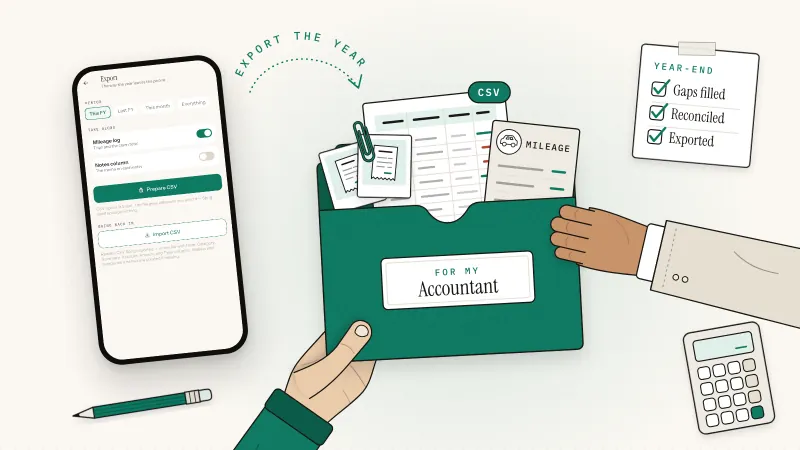
- At year end. Export the year to an open format such as CSV, save a copy of your return, and put it all in one dated folder, for example
Records/2025-26, kept in two places. Our year-end handoff to your accountant walks through the export. - Once a year, prune. Delete a year only when its retention period has ended, nothing is under review, it holds no records for assets you still own, and no insurer, lender or contract needs it. The IRS warns that insurers or creditors may want records kept longer than it does.
Seven years outlasts most phones. Plan your records to outlive the device you keep them on.
Archive in formats that will still open in the 2030s, such as CSV, PDF and JPEG, not a file only one app can read.
How Sprig keeps your records together
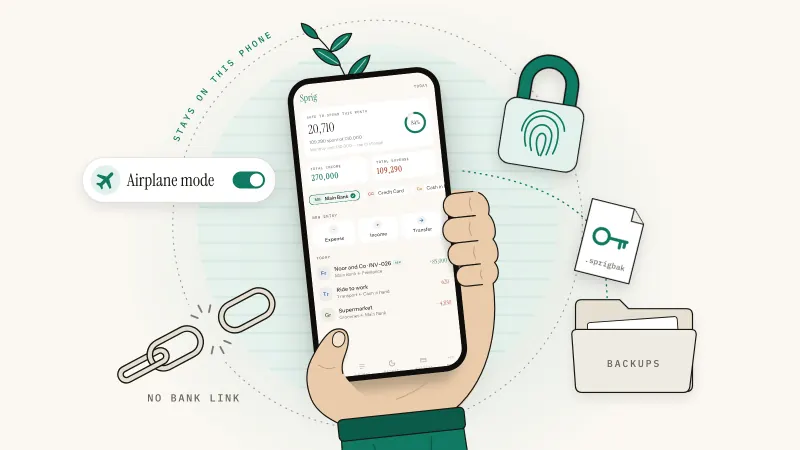
Sprig is a private, offline double-entry bookkeeping app for iPhone and Android, made by Secundum Reality. Your books stay on your phone: no account, no server, no bank link, no cloud. For the long haul, you move copies off the phone in a format that doesn't need Sprig.
How Sprig helps
Records that are complete on the day, and copies that leave the phone at year end.
- Complete entries. Date, amount, category, what it was for and the wallet, shown as a pair like
Groceries ← Main Bank. - Receipts on the entry. Take or pick a photo, add the type, category and amount, and Save writes an entry dated the photo's day with the photo attached. You type the amount; Sprig doesn't read receipts for you.
- A missing-receipt count. The tax summary shows how many expense entries still lack a receipt.
- A CSV archive. Export This FY, Last FY, This month or Everything with Date, Category, Summary, Account, Amount and Type columns, optional Notes and your mileage log. CSV import, with a preview and duplicate skipping, brings rows back.
- An encrypted backup. A passphrase-locked file (AES-256, PBKDF2 with 100,000 iterations) you save wherever you choose.
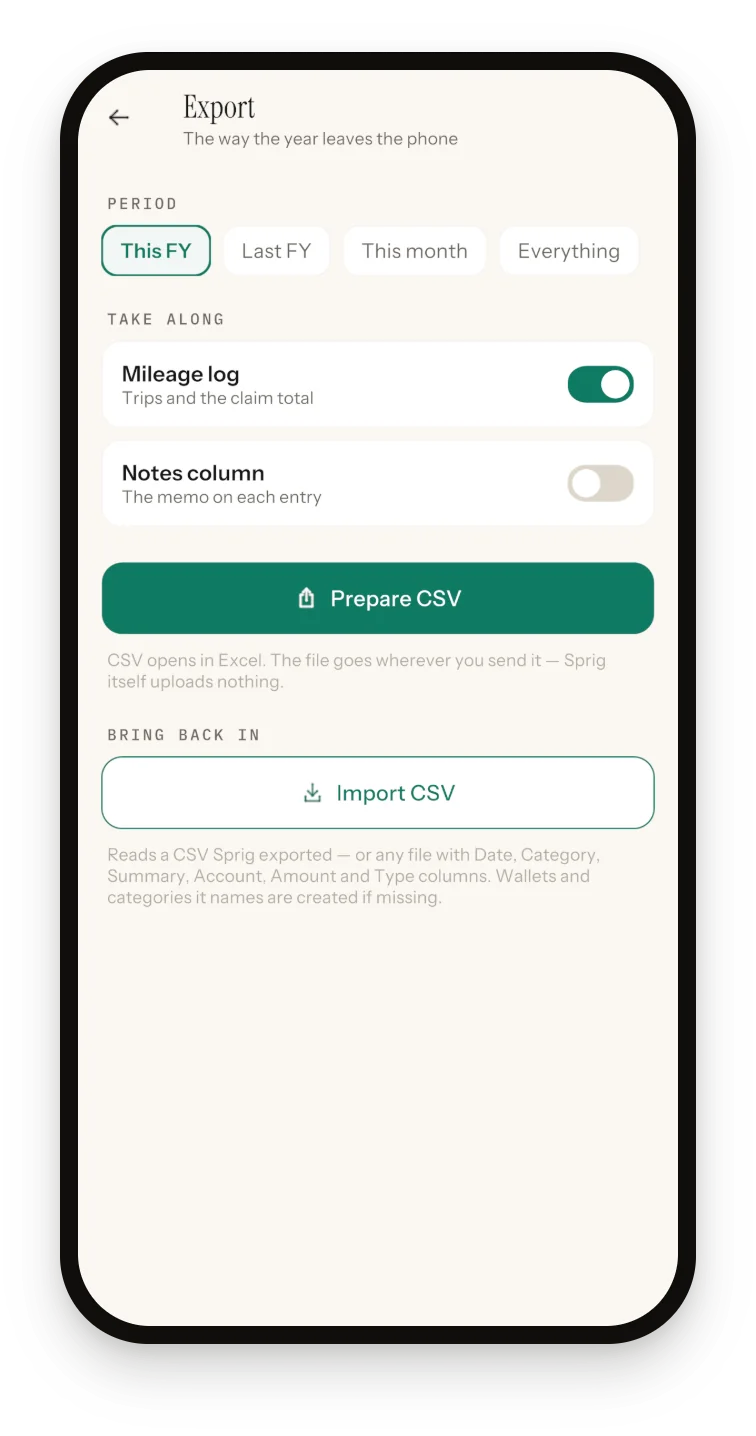
What Sprig won't do for you
- Keep a second copy. Sprig keeps no copy of your books anywhere else. Lose the phone without a backup file saved elsewhere and assume the books are gone. Nobody, including us, can recover a forgotten passphrase.
- Back up receipt photos. They aren't in the backup or the CSV; share the important ones to a backed-up folder.
- Restore from anywhere. The Restore screen lists only backups already in Sprig's own folder; it can't browse Files or Google Drive. Treat the CSV as your archive and the backup as your undo button.
- Backdate a typed entry. The entry sheet always uses today's date, so log on the day. Receipt entries take the photo's date, and CSV import keeps the dates in the file.
- Match every tax year. The tax summary and FY exports run July to June, Pakistan's tax year (tax year 2026 shows as FY 2025–26). On another year, export Everything and filter by date.
- Make PDFs or file MTD updates. Export is CSV only, one book at a time, and Sprig isn't HMRC-recognized MTD software.
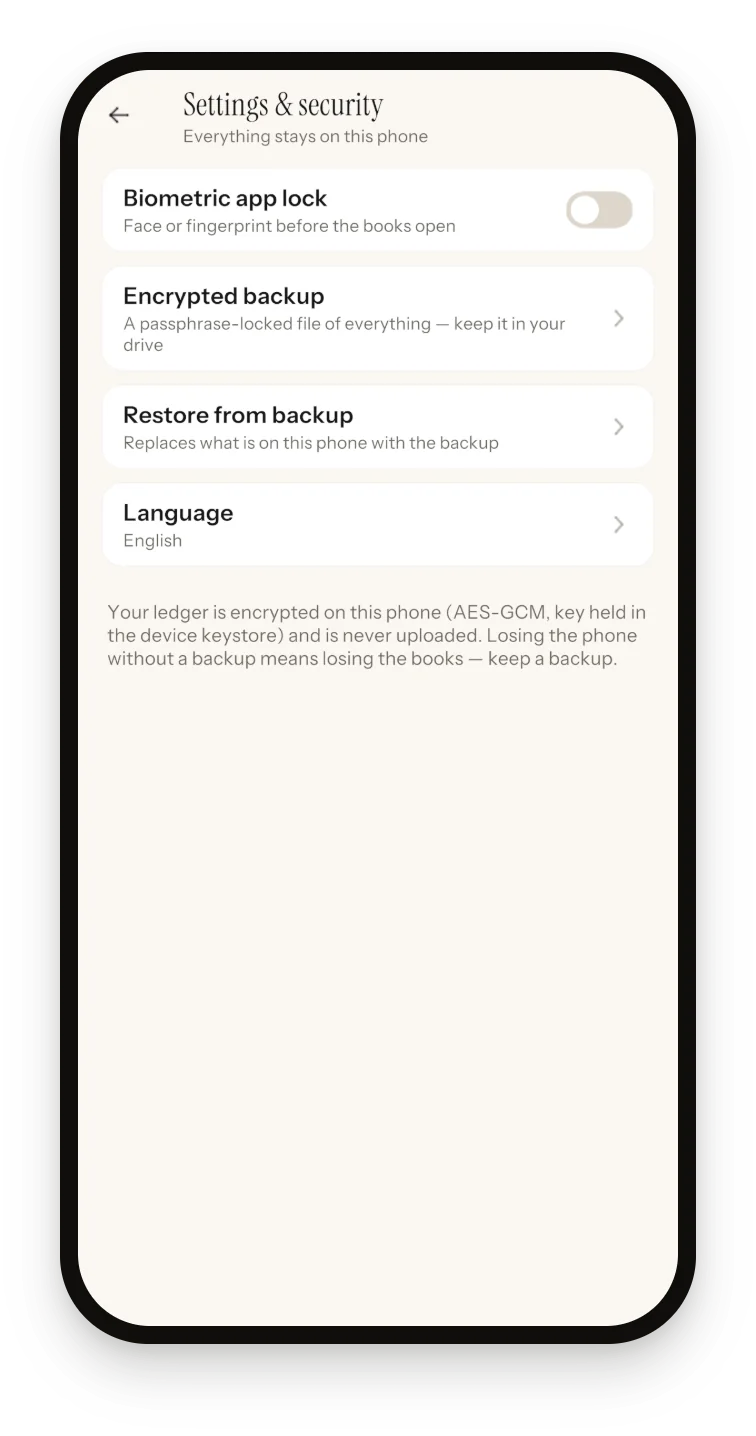
For the privacy side, read our guide to private offline bookkeeping and encrypted backups, or see how the offline bookkeeping app works.
Sprig for iPhone and Android
Keep your books in four taps.
Private, offline double-entry bookkeeping. No account, no bank login, no cloud. Free to start with 50 entries.
Frequently asked questions
How long should I keep receipts for taxes?
Keep each receipt for as long as the return it supports can be reviewed: generally 3 years after filing in the US (6 or 7 in some cases), at least 5 years after the 31 January deadline in the UK, and 6 years after the tax year ends on 30 June in Pakistan. Keep equipment receipts longer.
How long does HMRC require sole traders to keep records?
At least 5 years after the 31 January online filing deadline for the tax year. For 2025–26, due by 31 January 2027, that means until at least the end of January 2032. File more than 4 years late and you keep them for 15 months after sending the return (GOV.UK).
Can I throw away paper receipts after taking a photo?
In the US, often yes. Under Rev. Proc. 97-22, images in a compliant electronic storage system count as records if they're complete, legible, indexed and printable, and you can destroy originals after testing that system and setting up procedures to keep it compliant. HMRC's Making Tax Digital guidance accepts original supporting documents or copies of them. Elsewhere, check local rules first.
Do I have to report income if I didn't get a 1099?
Yes. The IRS says gig and side income must be reported even if no Form 1099-K, 1099-NEC, 1099-MISC or W-2 arrives, including payments in cash, property, goods or virtual currency. Many freelancers get no form at all, so keep your invoices and deposit records as proof.
What does a digital record need for Making Tax Digital?
HMRC says each digital record needs the amount, the date the income was received or the expense incurred, and a category. Create records as close to the transaction as you can, and move data between programs by a digital link such as CSV import and export, not copy and paste (GOV.UK).
What happens if I lose my phone and my business records?
Rebuild what you can from bank statements, invoices and emails. HMRC says that if records can't be replaced, you give your best figures and say whether they're estimated or provisional. With an offline app like Sprig, a yearly CSV export and a backup file kept off the phone let your records outlive the device.
Sources and further reading
- IRS: How long should I keep records?
- GOV.UK: Business records if you're self-employed, how long to keep your records
- GOV.UK: Making Tax Digital for Income Tax, keep digital records
- IRS: Rev. Proc. 97-22, electronic storage of books and records (IRB 1997-13)
- FBR: Income Tax Ordinance, 2001 (amended up to 30 June 2026), section 174
- IRS: Gig Economy Tax Center
- GOV.UK: Check if you're eligible for Making Tax Digital for Income Tax
- UAE Federal Decree-Law No. 47 of 2022 on Corporate Tax, Article 56 (Ministry of Finance)
- UAE Federal Tax Authority: Corporate Tax record retention notice (August 2025)
- IRS: FAQs on the Form 1099-K threshold (IR-2025-107)
Published 3 October 2026. Feature details were checked against Sprig 1.1 for iPhone and Android. This article is general information, not tax or legal advice; rules differ by country, so confirm anything you file with your accountant or tax authority.