Tax time
How to Track Mileage for Taxes: 2026 Rates & Log Rules
Two rate changes landed in 2026, so the date on each trip now affects what it's worth. Here's what to record, which rate applies, and how to keep a log you'll stick with.
Every business mile you drive is worth money at tax time, but only if you can prove it with a mileage log: a plain record of when you drove, where, why and how far. In 2026 the log matters more: the IRS raised its rate halfway through the year, and the UK raised its car and van rate and backdated it to April.
This guide covers US and UK rules. It isn't tax advice; check specifics with your accountant.
How to track mileage for taxes in five steps
To track mileage for taxes, record every business trip at or near the time, with its date, destination, business purpose and distance. Keep a running total of business miles for the tax year. At filing time, multiply those miles by your tax authority's rate for each trip's date, or claim the business share of actual car costs.
- Pick one place for the log: a notebook, spreadsheet or phone app.
- Note the odometer on the first and last day of your tax year to show total miles.
- Log each trip as it happens, or at least weekly, as business or personal.
- Keep parking and toll receipts, which are claimed on top of a per-mile rate. See how to organize receipts for taxes.
- Close the year: fill gaps from your calendar and invoices, then send the log with your books and keep it with your other business records.
What are the mileage rates for 2026?
For 2026, the IRS business standard mileage rate is 72.5 cents a mile for trips from 1 January to 30 June and 76 cents a mile from 1 July to 31 December. In the UK, the 2026/27 flat rate for cars and vans is 55p a mile for the first 10,000 business miles and 25p after that.
| Where | Vehicle | Applies to | Rate |
|---|---|---|---|
| US (IRS) | Car | Business miles, 1 Jan to 30 Jun 2026 | 72.5¢ |
| US (IRS) | Car | Business miles, 1 Jul to 31 Dec 2026 | 76¢ |
| UK (HMRC) | Car or van | First 10,000 business miles, 2026/27 | 55p |
| UK (HMRC) | Car or van | Business miles over 10,000 | 25p |
| UK (HMRC) | Motorcycle | All business miles | 24p |
Sources: IRS standard mileage rates; GOV.UK simplified expenses for vehicles. The 2025 IRS rate was 70 cents; the UK car and van rate was 45p before 6 April 2026.
Why the trip date now decides the rate
The IRS raised its 2026 rate from 72.5 to 76 cents for driving on or after 1 July. Announcement 2026-11 says the change "results from recent increases in the price of fuel." Earlier miles stay at 72.5 cents, so split your 2026 business miles at 30 June.
In the UK, the rise was announced on 21 May 2026. HMRC's policy paper of 17 June 2026 confirms the rise from 45p to 55p for the first 10,000 business miles, backdated to 6 April 2026, the start of the tax year. The government says it will set out a review of rates beyond 2026/27 at Budget 2026.
UK
Employer mileage allowance payments use the same car and van rates, 24p for motorcycles and 20p for bicycles. Self-employed flat rates are optional and open to sole traders and partnerships with no company partners, not limited companies.
What does a mileage log need to include?
A mileage log should record, for each business trip, the date, where you went, why you went and how far you drove. The IRS also wants your total miles for the year and the date the car started being used for business. Write trips down at or near the time; a weekly log counts.
US: the elements in Publication 463
Table 5-1 of IRS Publication 463 lists the mileage for each business use, the date, the destination and the business purpose, plus total miles for the year and the date the car went into business use. A record made at or near the time carries more weight than one rebuilt from memory; a weekly log counts as timely, and a round trip with several business stops can be one record.
| Date | Destination | Business purpose | Miles |
|---|---|---|---|
| 3 Mar 2026 | Client office, Oak Street | Kickoff meeting with a new client | 18 |
| 12 Mar 2026 | Office supply store | Printer ink and paper | 7 |
| 2 Jul 2026 | Supplier warehouse | Collect sample stock | 26 |
| 31 Dec 2026 | Odometer check | Total miles for the year, all use | 11,240 |
UK: records behind the claim
Sole traders must keep records of business income and expenses. HMRC's Business Income Manual says the flat rate covers only journeys made wholly for business, backed by a contemporaneous mileage record. The same four columns work. Keep a running total for the tax year (6 April to 5 April), because the car rate drops to 25p after 10,000 business miles.
Pakistan and elsewhere
Pakistan's tax year runs to 30 June and takes the name of the year it ends in, so July 2026 to June 2027 is tax year 2027 (FBR). Elsewhere, some authorities publish a per-kilometer rate and others expect the business share of actual costs; check local guidance.
Standard mileage rate or actual expenses: which should you use?
The standard rate is simpler: multiply business miles by the rate and keep a log. Actual expenses mean adding up fuel, repairs, insurance and the car's cost (depreciation in the US, capital allowances in the UK), then claiming the business share. In the US, an owned car must start on the standard rate to keep that option.
| Standard or flat rate | Actual expenses | |
|---|---|---|
| What you claim | Business miles × the rate | Business share of running costs and the car's cost |
| Records | A mileage log | A mileage log plus receipts and bills |
| Fuel | Built into the rate | Claimed at cost |
| Parking and tolls | Claimed on top | Claimed with other costs |
| US rules | Choose it in an owned car's first business year; a leased car keeps it for the lease; not for five or more cars at once | An owned car can switch later, with straight-line depreciation |
| UK rules | Keep it while the vehicle stays in the business; not if you've claimed capital allowances on it | Running costs plus capital allowances |
IRS Topic 510 puts business parking and tolls on top of the standard rate; HMRC does the same for parking, tolls and congestion charges. If you qualify for both methods, Pub 463 suggests working out the deduction both ways.
Worked examples: what a year of driving is worth
US: a split year
For example, a freelance photographer drives 4,000 business miles from January to June 2026 and 5,000 from July to December.
| Period | Business miles | Rate | Deduction |
|---|---|---|---|
| 1 Jan to 30 Jun | 4,000 | $0.725 | $2,900 |
| 1 Jul to 31 Dec | 5,000 | $0.76 | $3,800 |
| Total | 9,000 | $6,700 |
Fuel isn't added on top, because the rate already covers it.
UK: crossing 10,000 miles
For example, a sole trader drives 12,000 business miles by car in 2026/27: 10,000 × 55p = £5,500, plus 2,000 × 25p = £500, for £6,000. At the 2025/26 rate of 45p, the same driving was worth £5,000.
If your log is in kilometers
Convert first: miles = km × 0.621371. For example, 1,000 business km is 621.4 miles, about $472 at 76 cents or £342 at 55p.
Can you deduct your commute?
No. In both the US and the UK, driving between home and your regular place of work is personal commuting, and it isn't deductible. Trips from your regular workplace to a client or supplier are business trips. In the US, a home office that is your principal place of business can make trips from home to other work locations deductible.
Pub 463 says commuting stays personal however far you live, even if you make business calls on the way, and parking at your workplace is a commuting cost. GOV.UK lists travel between home and work as a cost the self-employed can't claim.
- Usually business: workplace to a client, client to client, workplace to a supplier.
- Personal: home to your regular workplace, errands and detours. Drive 30 miles to a client with a 4-mile gym detour, and you log 30.
- It depends: trips from a home office, and trips to a temporary work site.
US
If you have a regular work location away from home, daily trips from home to a temporary work location in the same business are deductible. Pub 463 treats work that is expected to last, and does last, a year or less as temporary. Home office rules are in the self-employed tax deductions checklist.
Should you use a GPS tracker or a manual mileage log?
A GPS tracker logs drives automatically, which helps if you drive a lot and forget to write trips down, but it needs location access and you still have to sort business from personal. A manual log takes a few seconds per trip, uses no location data, and is just as valid if kept on time.
| Automatic (GPS) tracker | Manual log | |
|---|---|---|
| Capture | Records drives in the background | You add each trip after it |
| Location access and battery | Needs location, uses some battery | Neither |
| Missed trips | Few, while the app runs | Any you forget |
| Business vs personal | You still classify each drive | You decide as you log |
| Often suits | Delivery and rideshare work | Occasional business trips |
Either way, the record must be made at or near the time. Logging by hand? Add each trip as soon as you park.
How to keep a business mileage log in Sprig
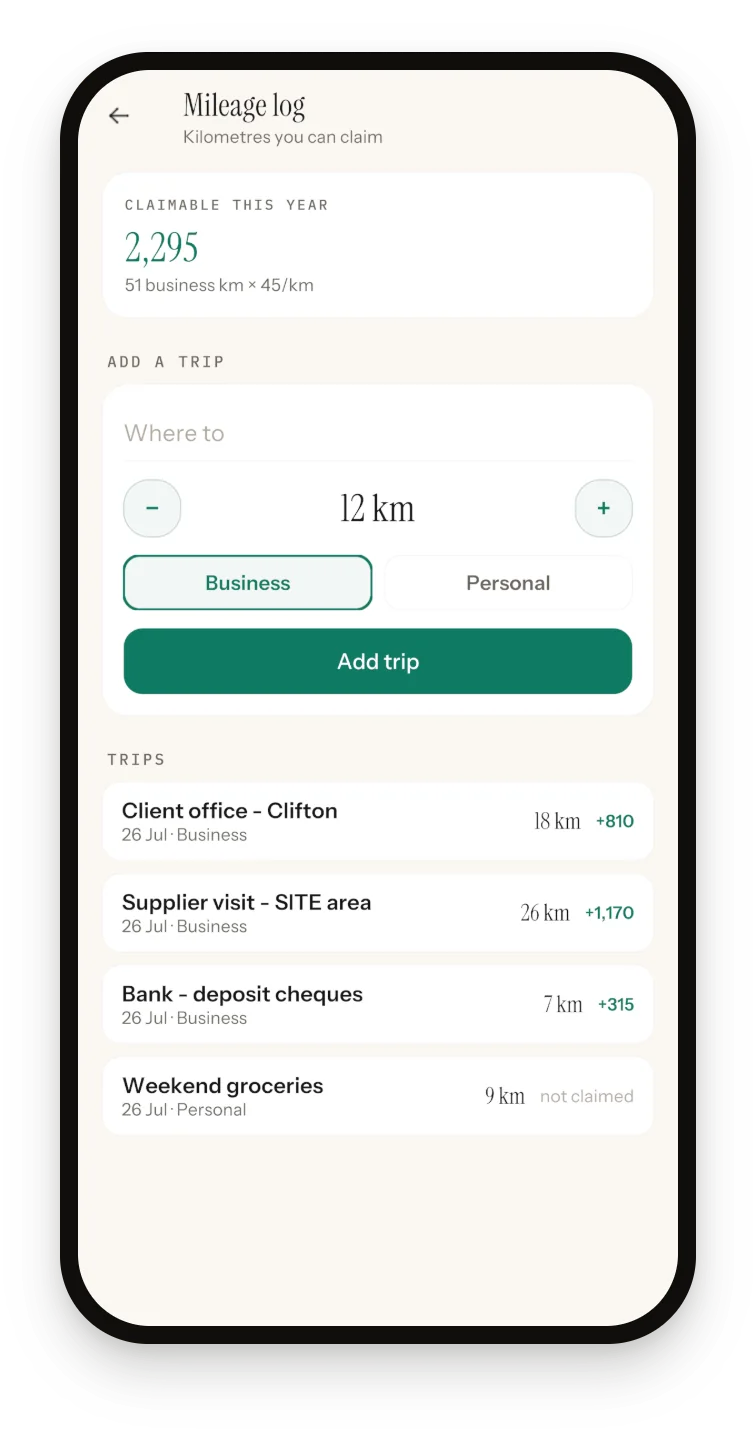
Sprig is a private, offline double-entry bookkeeping app for iPhone and Android, made by Secundum Reality. Its mileage log sits beside your expenses, receipts and invoices, with no account, no bank link and no location tracking.
- Pick the book. Trips belong to the open book, Personal or Side business (More, then Books & currencies).
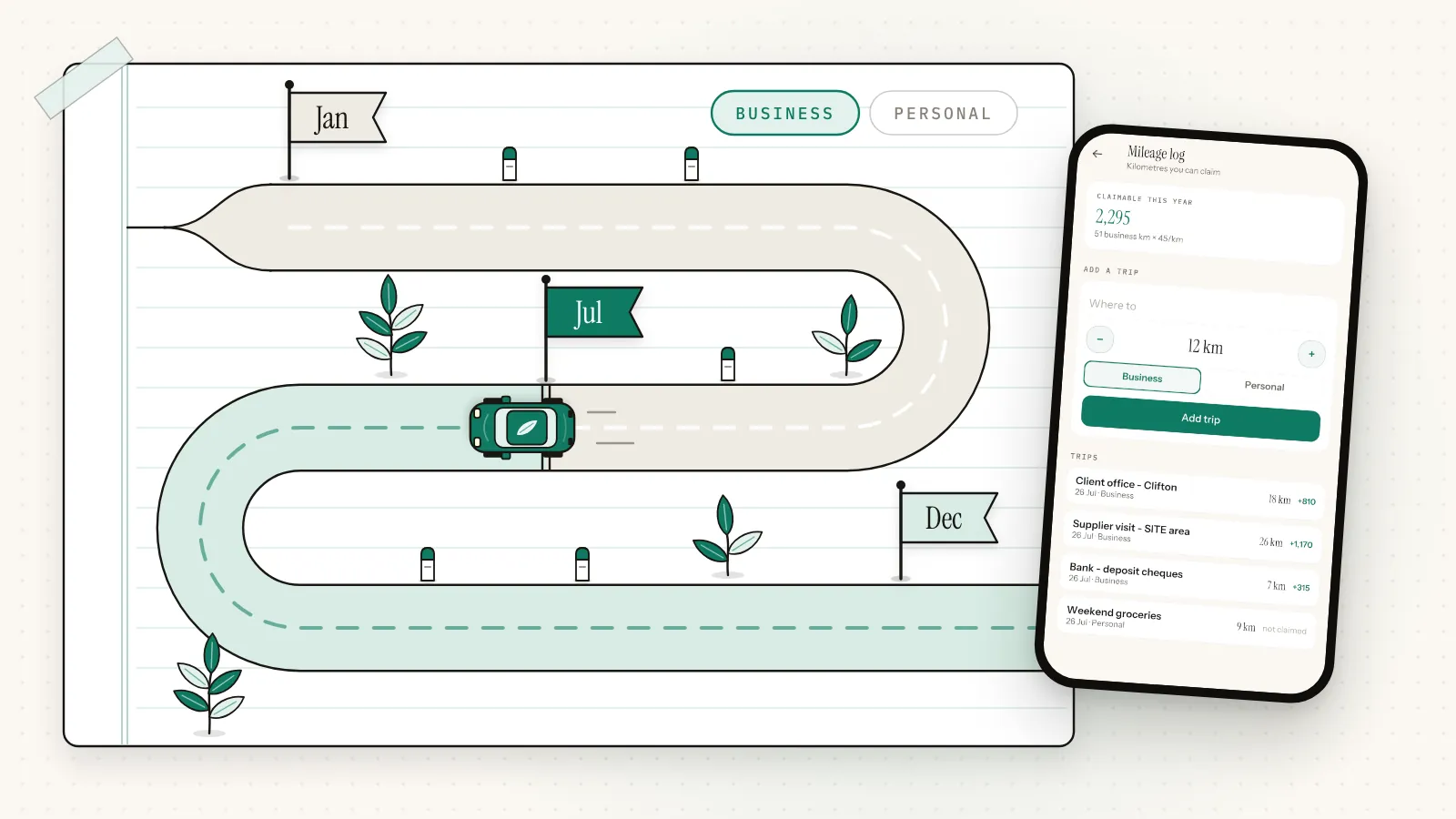
- Add the trip. In More, then Mileage log, type the trip in "Where to" (32 characters, so fit the reason in: "Oak St client, kickoff"), set the km, choose Business or Personal and tap Add trip. It's dated the day you add it.
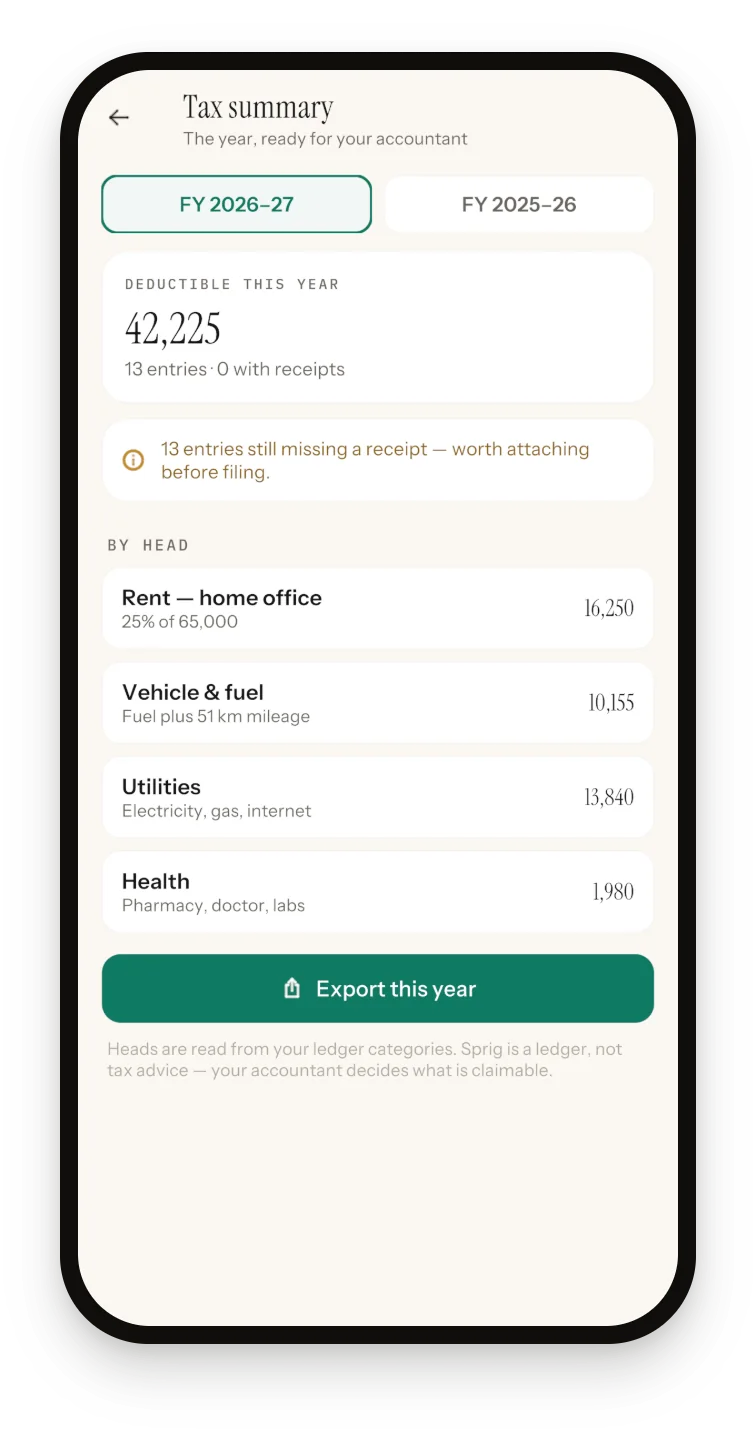
- Check the tax summary. In More, then Tax summary, business km for this or last July–June financial year are valued at 45 per km and added to Vehicle & fuel.
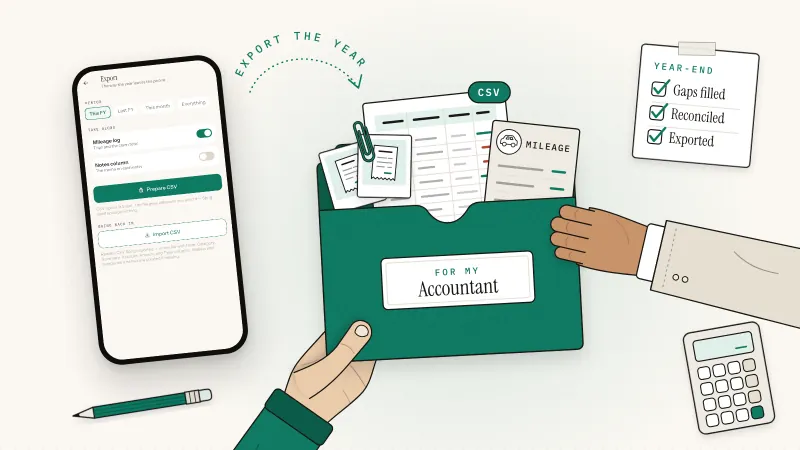
- Export. In More, then Export, pick a period, leave Mileage log on and tap Prepare CSV. The file covers the open book and adds a section with Date, Trip, Purpose (Business or Personal), Km and Claim.
How Sprig helps
A log that takes seconds and stays on your phone.
- One file for your accountant: your entries and the mileage log in a single CSV that opens in Excel.
- Private: no location permission, no account, no cloud. On Android your books are encrypted with AES-256 using a hardware keystore key.
What Sprig's mileage log doesn't do
- Kilometers only, at a fixed 45 per km, set with Pakistani rupees in mind. In the US or UK, ignore the Claim column, convert Km to miles and apply the official rate for each trip's date.
- No automatic tracking or edits. Add each trip yourself, and check the distance first: trips can't be edited or deleted.
- Fuel and mileage share a head. Vehicle & fuel adds Fuel and Transport spending to the mileage claim, though a per-mile rate already covers fuel. Sprig is a ledger, not tax advice.
- A July–June year. The tax summary uses July–June years, and the Claimable card totals business trips from every year. For a US or UK tax year, export Everything and filter by date.
The mileage log is in the free version. See every feature of the offline bookkeeping app.
Sprig for iPhone and Android
Keep your books in four taps.
Private, offline double-entry bookkeeping. No account, no bank login, no cloud. Free to start with 50 entries.
Frequently asked questions
What is the IRS mileage rate for 2026?
The IRS business standard mileage rate for 2026 is 72.5 cents a mile for driving from 1 January to 30 June, and 76 cents a mile from 1 July to 31 December. The mid-year rise followed higher fuel prices. See the IRS standard mileage rates page.
What is the HMRC mileage rate for 2026/27?
For cars and vans, the 2026/27 rate is 55p a mile for the first 10,000 business miles and 25p a mile after that. Motorcycles are 24p. The 55p rate replaced 45p and is backdated to 6 April 2026. It applies to employer mileage allowances and to self-employed people using simplified expenses.
Do I need fuel receipts if I use the standard mileage rate?
Not for the mileage claim. In the US, the standard rate stands in for gas, oil, repairs, insurance and depreciation, so your mileage log is the record that matters. Business parking and tolls are deductible on top, so keep those receipts. UK flat rates also cover fuel, insurance, repairs and servicing, with parking and tolls claimed separately.
Can I switch from the standard mileage rate to actual expenses?
In the US, yes, for a car you own, if you used the standard rate in its first business year; later years can use either method, with straight-line depreciation after a switch. A leased car keeps the standard rate for the whole lease. In the UK, not for the same vehicle: flat rates stay with it while it's in the business.
Do I need odometer readings in my mileage log?
Not for every trip. IRS Publication 463 asks for the miles of each business use, the date, destination and purpose, plus your total miles for the year. Its sample log has odometer columns, but only as an example. Noting the odometer on the first and last day of the year is the simplest way to show the total.
Can I keep a mileage log on my phone without GPS tracking?
Yes. IRS Publication 463 accepts records kept on a computer, so a phone log works if it has each trip's date, destination, purpose and miles and you make it at or near the time. HMRC also expects a contemporaneous record. Sprig, for example, logs trips in kilometers as Business or Personal, without location access, and exports them to CSV.
Sources and further reading
- IRS: Standard mileage rates
- IRS: Announcement 2026-11, Internal Revenue Bulletin 2026-29
- IRS Publication 463: Travel, Gift, and Car Expenses
- IRS Topic no. 510: Business use of car
- GOV.UK: Simplified expenses if you're self-employed, vehicles
- HMRC policy paper: Increasing mileage rates (17 June 2026)
- GOV.UK: Travel, mileage and fuel rates and allowances
- HMRC Business Income Manual BIM75005: simplified expenses, motor vehicles
- GOV.UK: Expenses if you're self-employed, travel
- FBR: Income tax basics (tax year)
Published 3 October 2026. Feature details were checked against Sprig 1.1 for iPhone and Android. This article is general information, not tax or legal advice; rules differ by country, so confirm anything you file with your accountant or tax authority.