Tax time
Self-Employed Tax Deductions Checklist for 2026 (US, UK & More)
Every deduction on this list comes with the record that proves it, with US and UK rules side by side and pointers for Pakistan, India, the UAE and elsewhere.
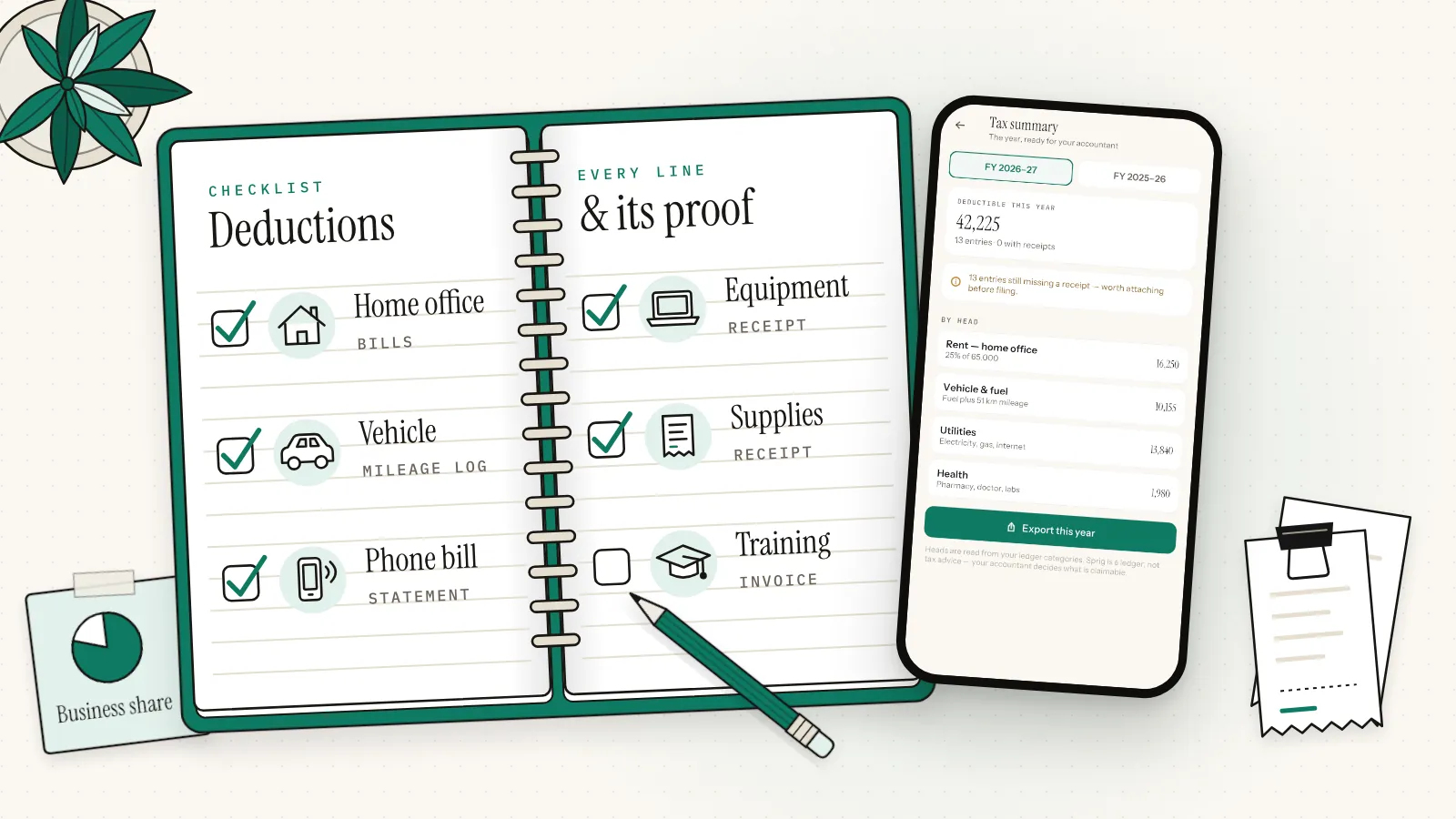
A deduction is only as strong as the record behind it. This checklist covers the write-offs freelancers, 1099 contractors and sole traders claim most often, how the IRS and HMRC treat each one, and the proof to keep.
Everything here is summarized from official guidance checked on 3 October 2026. It is general information, not tax advice, so confirm the details with an accountant or your tax authority before you file.
How do self-employed tax deductions work?
A deduction is a business cost you subtract from your income before tax is worked out. It lowers your taxable profit, not your tax bill pound for pound or dollar for dollar. In the US the cost must be ordinary and necessary for your business. In the UK it must be wholly and exclusively for business.
GOV.UK's example: turnover of £40,000 with £10,000 of allowable expenses means you pay Income Tax on £30,000 of taxable profit.
US: ordinary and necessary
Under IRS Publication 334, the Tax Guide for Small Business, a deductible expense must be ordinary (common and accepted in your field) and necessary (helpful and appropriate for your business). It does not have to be indispensable. Sole proprietors and 1099 contractors report them on Schedule C, and you must file a return if your net self-employment earnings are $400 or more.
UK: wholly and exclusively
HMRC's Business Income Manual states the core test: spending cannot be deducted from trading profits unless it is incurred wholly and exclusively for the trade. GOV.UK's guide to allowable expenses lists what sole traders can claim. If your costs are small, the £1,000 trading allowance may beat claiming actual costs, but you cannot use it and claim expenses too.
Other countries
Pakistan
FBR defines the tax year as the twelve months ending 30 June (Income Tax Basics). Under the Income Tax Ordinance, 2001 (amended to 30 June 2026), fines for breaking a law and personal expenditure are not deductible (section 21), and spending that serves more than one purpose is apportioned on a reasonable basis (section 67). Check details with FBR or a tax advisor.
India
Presumptive schemes let some small businesses and professionals declare a set share of receipts as profit instead of deducting actual costs. Check current rules and limits with the Income Tax Department or a chartered accountant.
UAE
Under UAE Corporate Tax, a resident person, including an individual doing business, with revenue of AED 3,000,000 or less in the current and all previous tax periods can elect Small Business Relief and be treated as having no taxable income for that period. On 7 August 2026 the Ministry of Finance announced its extension to tax periods ending on or before 31 December 2029. Check scope with the FTA.
Elsewhere
The pattern is usually the same: business costs count, personal costs do not, mixed costs get split. Ask your tax authority which flat rates exist.
Key numbers for 2026
| Item | Figure | Source |
|---|---|---|
| US simplified home office | $5 per sq ft, up to 300 sq ft ($1,500 max) | IRS |
| US business meals | Generally 50% of the cost | IRS Pub 334 |
| US de minimis safe harbor (no applicable financial statement) | Up to $2,500 per item or invoice | IRS Pub 334 |
| UK working-from-home flat rate | £10 / £18 / £26 a month for 25–50 / 51–100 / 101+ hours | GOV.UK |
| UK trading allowance | £1,000 a year, instead of claiming expenses | GOV.UK |
The self-employed tax deductions checklist
Each row gives the US and UK treatment and the record that proves the claim. Undocumented costs are hard to defend.
Home and workspace
| Cost | US | UK | Proof to keep |
|---|---|---|---|
| Home office | Simplified method or actual costs on Form 8829; the space must be used regularly and exclusively for business | A reasonable share of heating, power, Council Tax and rent or mortgage interest, split by rooms or time; or a flat rate | Measurements, bills, a log of hours at home |
| Separate office or studio | Rent paid for business property | Rent, rates, utilities and insurance | Lease and payment records |
GOV.UK's own example: four rooms, one used only as an office, and a £1,120 electricity bill. If every room uses the same power, you claim £280.
Vehicle and travel
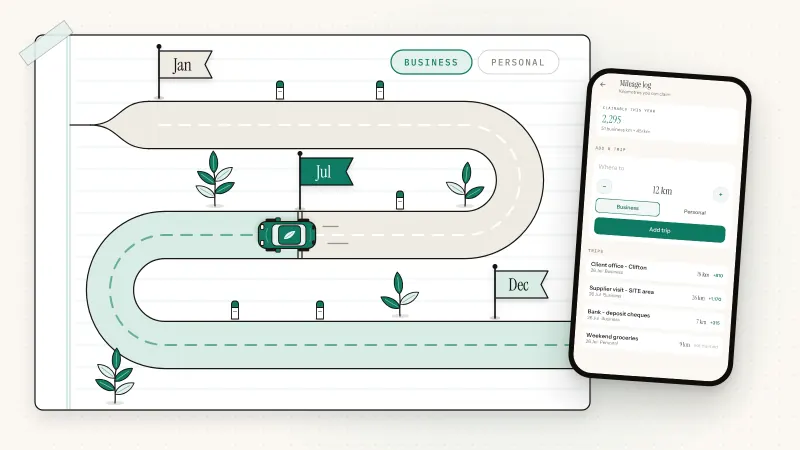
Business trips count in both countries. The drive between home and a regular workplace does not. For 2026 the IRS rate is 72.5 cents a mile to 30 June and 76 cents from 1 July, and HMRC's simplified rate for cars and goods vehicles rose to 55p a mile for the first 10,000 business miles from 6 April 2026. Log rules and worked examples are in our guide to tracking mileage for taxes in 2026.
| Cost | US | UK | Proof to keep |
|---|---|---|---|
| Fares, parking and tolls | Business parking and tolls, even on the standard mileage rate | Train, bus, air and taxi fares, parking, hotel rooms | Tickets or receipts, plus the purpose |
| Meals while traveling | Generally 50% deductible | Meals on overnight business trips | Receipt and a note of why |
Phone, internet and software
| Cost | US | UK | Proof to keep |
|---|---|---|---|
| Phone and internet | Business share only | Business part only | Bills and how you set the share |
| Software and subscriptions | Subscriptions are deductible; software bought outright is depreciated over 36 months or expensed under Section 179 | Allowable if used under 2 years or paid by regular license renewals; otherwise capital allowances, unless on cash basis | Invoices or renewal emails |
Equipment and supplies
| Cost | US | UK | Proof to keep |
|---|---|---|---|
| Laptop, camera, tools | Depreciate it, or elect Section 179 to deduct it in the first year; an elected de minimis safe harbor covers up to $2,500 per item or invoice | Cash basis: allowable expense. Traditional: capital allowances | Receipt, date, business-use share |
| Stationery, postage, ink, supplies | Supplies and materials are deductible | Allowable | Receipts |
Professional fees, insurance and bank charges
| Cost | US | UK | Proof to keep |
|---|---|---|---|
| Accountant and legal fees | Deductible if business-related, including the business part of tax prep | Business accountancy and legal fees; not the cost of preparing your Self Assessment return | Invoices |
| Business insurance | Liability, malpractice, fire and theft cover | Any business policy, such as public liability | Policy schedule and payments |
| Bank charges and interest | Bank fees and interest on business debts | Bank and card charges, loan interest, not repayments | Statements |
Marketing and website
| Cost | US | UK | Proof to keep |
|---|---|---|---|
| Ads, website, hosting | Advertising is deductible | Advertising and website costs | Invoices |
| Branded giveaways | Business gifts capped at $25 per person a year; widely given items costing $4 or less with your name on them do not count (Pub 463) | Logo items up to £50 per person per tax year; no food, drink or tobacco | Receipts and a recipient list |
Training and subscriptions
| Cost | US | UK | Proof to keep |
|---|---|---|---|
| Courses | Deductible if it maintains or improves skills for your current work, not if it qualifies you for a new trade (Pub 970) | Training that improves current skills or keeps you up to date; not for starting a new business or an unrelated field | Invoice and a note on relevance |
| Memberships and journals | Trade publications if ordinary and necessary; dues to business, social or athletic clubs, no | Trade journals and professional bodies yes; gym no | Receipts |
US only: deductions outside Schedule C
US
Three valuable items are not Schedule C expenses. They are adjustments on Schedule 1 (Form 1040), 2025 line numbers: one-half of your self-employment tax (line 15), contributions to a SEP, SIMPLE or qualified plan for yourself (line 16), and the self-employed health insurance deduction (line 17, figured on Form 7206 or the Form 1040 worksheet).
Our guide to organizing receipts for taxes covers photos and lost receipts, and our guide to how long to keep business records covers retention periods.
How do you claim a cost that's partly personal?
Claim only the business part. Pick a fair basis, such as time, rooms or usage, write it down, and apply it the same way to every bill. GOV.UK's example is a £200 yearly phone bill with £70 of business calls, so you claim £70. The IRS says the same: separate the personal part, which generally is not deductible.
- Choose a basis. Calls for a phone, hours for a laptop, rooms or floor area for a home office.
- Measure it once. Review a typical month of phone use; say 35% was business.
- Apply it to every bill. A 60-a-month internet bill at 35% puts 21 in your business books each month.
- Keep your notes. A one-line note beats a reconstruction two years later.
A shared account makes this harder; see how to split mixed-use bills and keep separate books.
Should you use flat rates or actual costs?
Work out both and claim the larger figure you can prove. Flat rates save paperwork: the US simplified home office method pays $5 per square foot up to 300, and HMRC's simplified expenses for working from home run from £10 to £26 a month. Actual costs often win with a large workspace or high bills, but they need more records.
| Shortcut | How it works | The catch |
|---|---|---|
| US simplified home office | $5 × up to 300 sq ft, no depreciation | Same use test; you can switch methods between years, not within one |
| UK working from home | £10, £18 or £26 a month, from 25 hours a month | Excludes phone and internet; claim their business share separately |
| UK vehicle flat rate | 55p, then 25p after 10,000 miles, for cars and goods vehicles | Once you use it for a vehicle, you keep using it for that vehicle |
What can't you deduct when you're self-employed?
Personal spending, fines for breaking the law and the commute between home and a regular workplace are out in both the US and the UK. Entertaining clients usually is, too. Your own pay or drawings are not a business expense, and in the UK everyday clothing is out even if you wear it only for work.
- Entertainment. Not deductible under Pub 334 (US business meals follow a separate 50% rule). In the UK, usually not, including client lunches.
- Everyday clothing (UK). Protective gear, uniforms and costumes can count.
- Loan repayments (UK). The interest can count. The capital you pay back does not.
- Political contributions and charity donations, as business expenses, in both countries.
How Sprig helps you track deductions all year
Sprig is a private, offline double-entry bookkeeping app for iPhone and Android, made by Secundum Reality. Your books stay on your phone, with no account, no bank login and no cloud.
How Sprig helps
- Four taps and the amount. Expense, category, what it was, amount, Save, so you categorize at the checkout, not in April.
- A separate Side business book, so business costs stay apart from groceries, plus your own categories such as Software or Marketing.
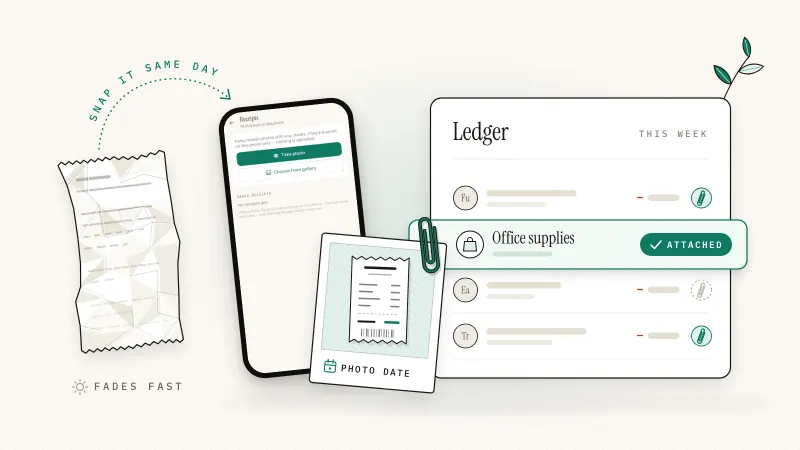
- Receipts with entries. Take or pick a photo, add type, category and amount, and Save writes an entry dated the day the photo was taken, with the receipt attached. You type the amount; nothing is scanned or uploaded.
- Totals for your own tax year. Reports take a custom date range, with a category donut and biggest-first bars.
- A tax summary that groups deductible spending by head and counts entries missing a receipt.
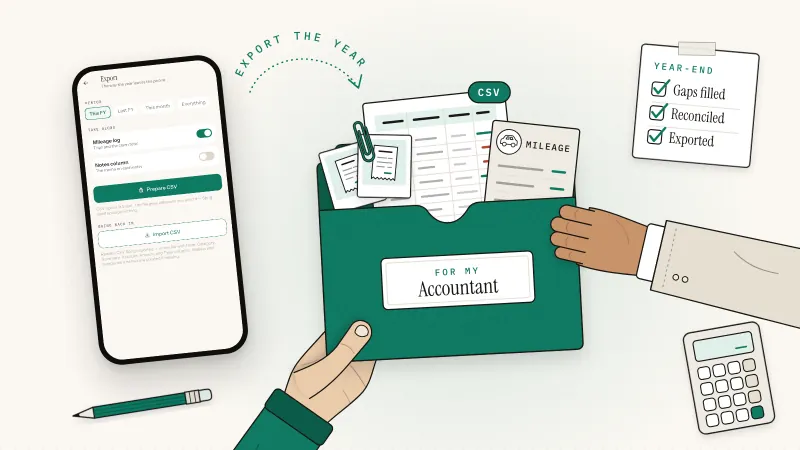
- CSV export for your accountant, with a mileage log section.
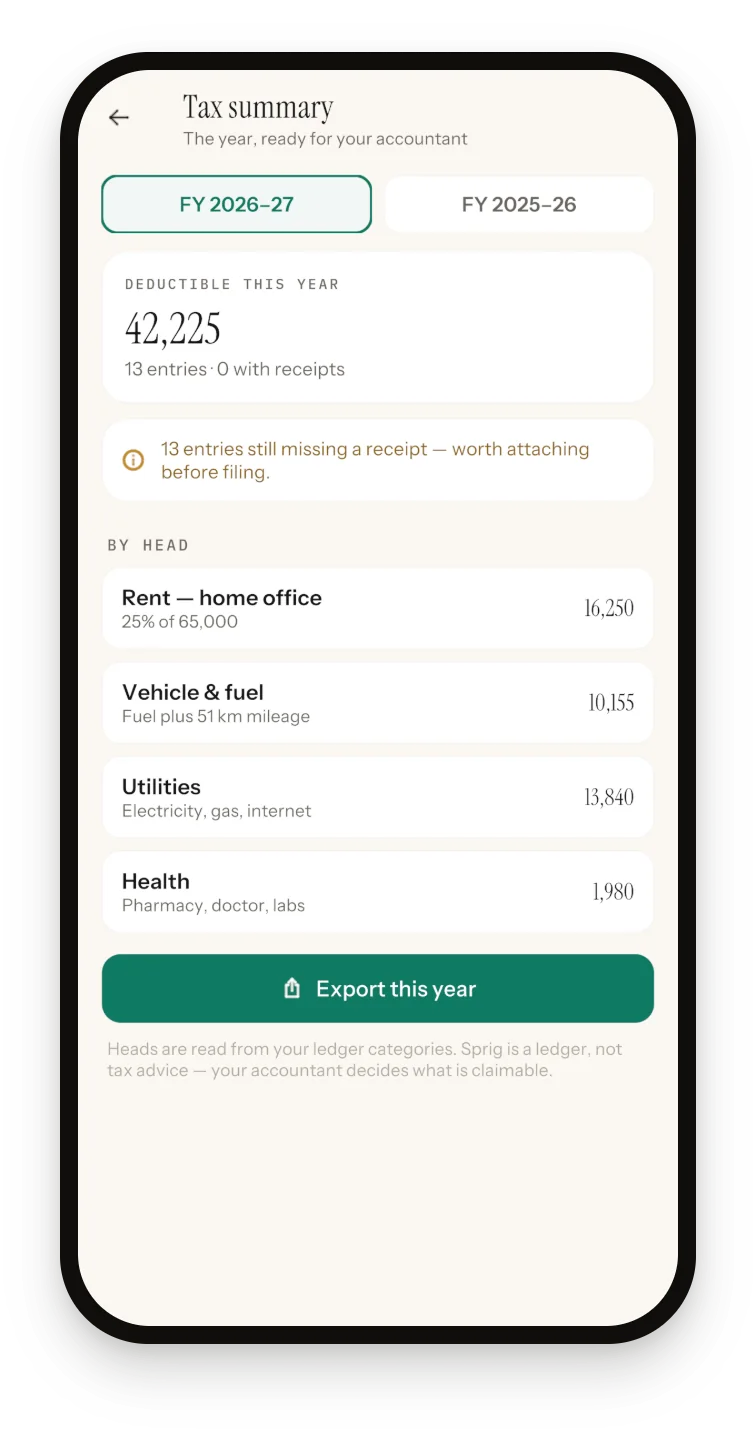
Know its limits. The tax summary uses a fixed July–June year (Pakistan's tax year), and its heads are a starting point, not any country's rules: 25% of Rent as home office; Fuel, Transport and business mileage as Vehicle & fuel; Utilities; Health; and Education. Health and Education may not be business costs where you live, custom categories never count, and there is no taxable-profit estimate. Mileage is logged in kilometers at a fixed 45 per km, so apply your country's official rate instead. Export is CSV only, without receipt photos. As the app says, Sprig is a ledger, not tax advice; your accountant decides what is claimable.
Tip
Different tax year? Set Reports to a custom range (1 January to 31 December, or 6 April to 5 April), or export Everything and filter by date. Our guide to preparing your books for your accountant walks through the handoff.
The offline bookkeeping app is free to start with 50 entries and every feature; each optional ad adds 20 more, up to four a day. Yearly Premium removes the limit and the ads.
Sprig for iPhone and Android
Keep your books in four taps.
Private, offline double-entry bookkeeping. No account, no bank login, no cloud. Free to start with 50 entries.
Frequently asked questions
What can I write off as self-employed?
Costs you take on to run the business: workspace, business travel, the business share of phone and internet, software, equipment, supplies, insurance, accountant fees, bank charges, marketing and training. The US test is ordinary and necessary (IRS Publication 334); the UK test is wholly and exclusively for business. Keep proof for every claim.
Can I deduct my phone bill if I also use it for personal calls?
Yes, but only the business part. GOV.UK's example is a £200 yearly phone bill with £70 of business calls, so you claim £70. The IRS also tells you to separate the personal part of any mixed cost. Set a fair percentage from a typical month and apply it to every bill.
Is the £1,000 trading allowance better than claiming expenses?
It is better when your real costs are under £1,000. The trading allowance lets UK individuals deduct up to £1,000 from trading income, and if gross trading income is £1,000 or less you usually do not need to tell HMRC. Above that, claiming expenses saves more. You cannot use the allowance and claim expenses or capital allowances together.
Do I need a receipt for every deduction?
You need proof for every deduction, and a receipt is the usual proof. Bills, invoices, bank statements and a mileage log are records too. GOV.UK says you do not send proof with your return but should keep it to show HMRC if asked. See how to organize receipts and how long to keep them.
Are health insurance and pension contributions business expenses?
Not usually, and the rules differ. In the US, the self-employed health insurance deduction and contributions to a SEP, SIMPLE or qualified plan for yourself are adjustments on Schedule 1 (Form 1040), not Schedule C expenses. In the UK, pension tax relief comes through the pension: your provider adds basic-rate relief, and higher-rate taxpayers claim the rest through Self Assessment.
How does the simplified home office deduction work?
In the US, you multiply $5 by the square footage used regularly and exclusively for business, up to 300 square feet, for at most $1,500 (IRS). In the UK, the working-from-home flat rate is £10, £18 or £26 a month for 25 to 50, 51 to 100, or 101 or more hours, with phone and internet claimed separately.
Sources and further reading
- IRS Publication 334 (2025), Tax Guide for Small Business
- IRS: Simplified option for home office deduction
- IRS Publication 463 (2025), Travel, Gift, and Car Expenses
- IRS Publication 970 (2025), Tax Benefits for Education
- IRS: About Form 7206, Self-Employed Health Insurance Deduction
- GOV.UK: Expenses if you're self-employed
- GOV.UK: Simplified expenses if you're self-employed
- GOV.UK: Tax-free allowances on property and trading income
- HMRC Business Income Manual BIM37000: wholly and exclusively
- FBR: Income Tax Basics (tax year definition)
- FBR: Income Tax Ordinance, 2001 (amended up to 30 June 2026)
- UAE FTA: Small Business Relief
- UAE Ministry of Finance: Small Business Relief extended to 31 December 2029
Published 3 October 2026. Feature details were checked against Sprig 1.1 for iPhone and Android. This article is general information, not tax or legal advice; rules differ by country, so confirm anything you file with your accountant or tax authority.