Tax time
How Much to Set Aside for Taxes When You're Self-Employed (US, 2026)
The 2026 sums, done in the open from IRS figures, for a full-time freelancer and a salaried side hustler, plus a simple way to move your share aside from every payment.
Self-employment income usually arrives with no tax taken out, so the bill lands later, in lumps, unless you set money aside as you go. Every tax figure below is federal and checked against IRS sources.
| Item | 2026 figure | Source |
|---|---|---|
| Self-employment tax | 15.3% on 92.35% of net earnings, about 14.1% of profit | IRS, Topic 554 |
| Social Security part (12.4%) | Stops at $184,500 of wages plus self-employment earnings | Form 1040-ES |
| Standard deduction | $16,100 single, $32,200 joint, $24,150 head of household | IR-2025-103 |
| Single tax brackets | 10% to $12,400, 12% to $50,400, 22% to $105,700, 24% to $201,775 | IR-2025-103 |
| QBI deduction | Up to 20% of qualified business income, capped at 20% of taxable income | IRS |
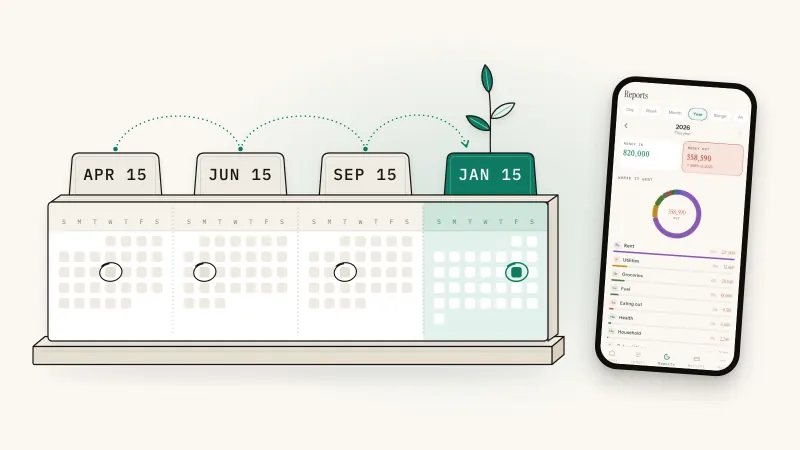
| Next estimated payment | January 15, 2027 | Form 1040-ES |
UK
UK sole trader? Income Tax, National Insurance and payments on account work differently: read the UK version. Not tax advice; rules change; check GOV.UK, IRS.gov or your accountant.
How much should you set aside for taxes when you're self-employed?
In our 2026 examples, a single full-time freelancer owed 18.6% of profit in federal tax at $40,000 and 20.8% at $80,000. Someone also earning a $60,000 salary owed 24–27% of their side profit. Add your state's income tax on top, and work from profit, not from what clients pay.
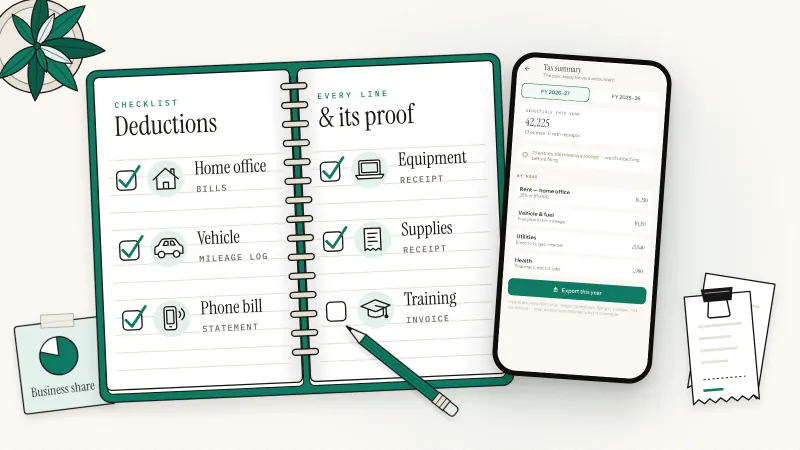
There's no single 1099 tax percentage: the share depends on your profit and on the other income underneath it. Profit is what's left after business expenses (line 31 of Schedule C for a sole proprietor), so deductions lower the profit you're taxed on, and the amount you need to save.
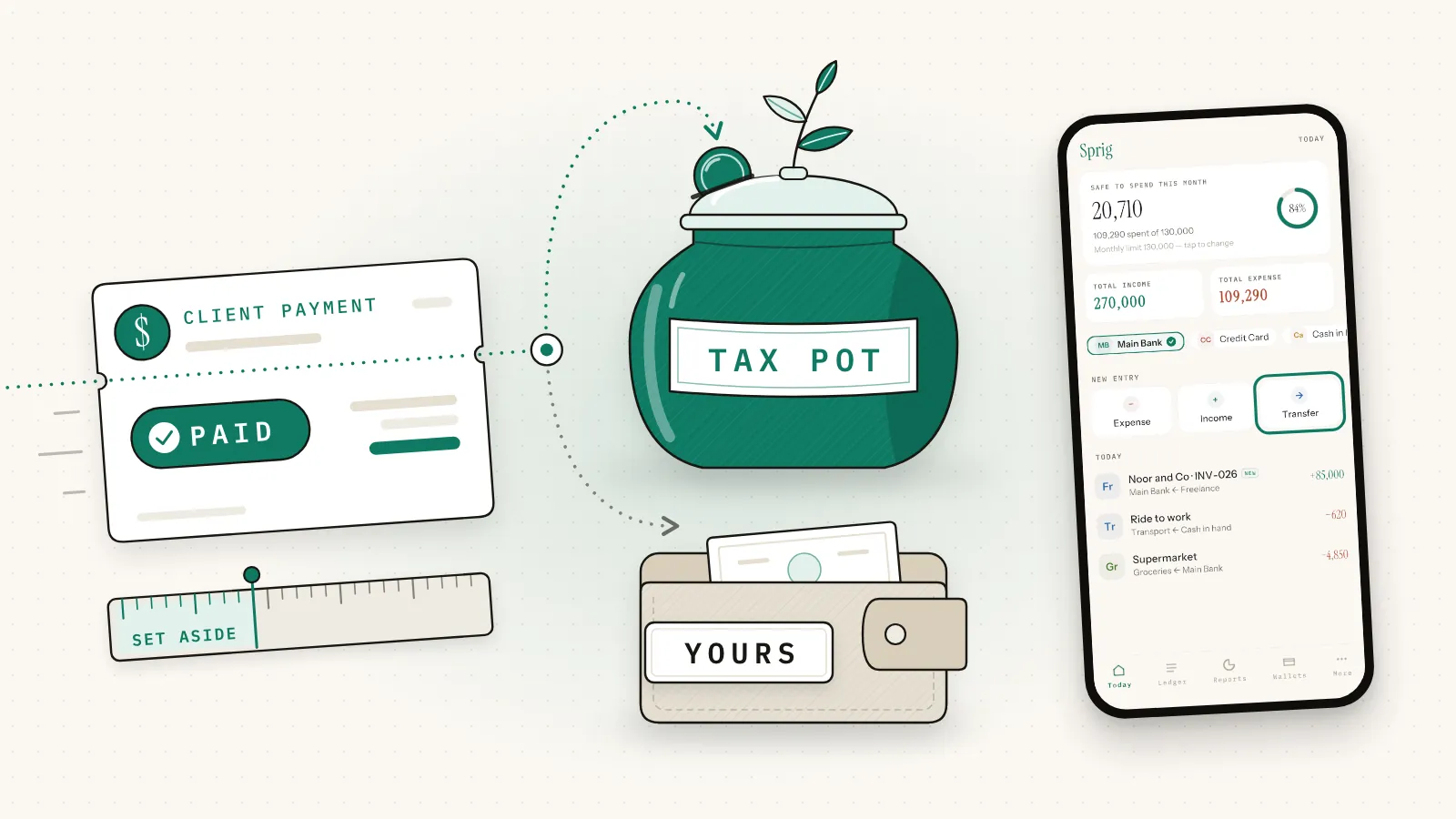
Clients pay you revenue, though. To turn a share of profit into a share of each payment, multiply it by the part of each dollar you keep after costs. For example, if costs eat a quarter of what clients pay and you're saving 20% of profit, move 15% of every payment (20% × 75%).
What taxes do self-employed people pay in the US?
Two federal taxes, plus any state income tax. Self-employment tax funds Social Security and Medicare at 15.3% of 92.35% of your net earnings. Federal income tax applies to what's left after deducting half your self-employment tax, the standard deduction and, for many sole proprietors, the qualified business income deduction.
Self-employment tax
The self-employment tax rate for 2026 is 15.3%: 12.4% for Social Security and 2.9% for Medicare. You usually owe it once net earnings reach $400, and it's charged on 92.35% of them (IRS Topic 554), so it comes to about 14.1% of profit.
- The 12.4% part stops at $184,500 of wages plus self-employment earnings in 2026, and wages use up that limit first (Form 1040-ES).
- The 2.9% part has no cap, and a 0.9% Additional Medicare Tax applies above $200,000 for single filers.
- Half is deductible when you figure adjusted gross income, which trims your income tax.
Federal income tax
For 2026, the IRS's inflation adjustments set the standard deduction at $16,100 for single filers ($32,200 joint) and the single brackets in the table above, rising to 32%, 35% and 37% beyond $201,775. Joint thresholds are double, except for the 37% bracket.
- Marginal rate
- The rate on your next dollar of taxable income: your bracket.
- Effective rate
- Total tax divided by income. For a tax pot, divide total federal tax by profit.
The qualified business income (QBI) deduction
Many sole proprietors can deduct up to 20% of qualified business income, capped at 20% of taxable income (minus net capital gain), even with the standard deduction; recent legislation made it permanent (Form 1040-ES). Qualified business income is reduced by the deductible half of self-employment tax, and the deduction cuts income tax only: net earnings from self-employment aren't reduced by it. In 2026, above $201,750 of taxable income for single filers ($403,500 joint), extra limits can apply (Rev. Proc. 2025-32).
State and local income tax
State income tax varies by state and isn't covered here. Add your state's tax to your federal percentage, and check whether your state also expects payments during the year.
How do you work out your own percentage?
Estimate this year's profit and its self-employment tax. Subtract half that tax, the standard deduction and any QBI deduction, then run the rest through the 2026 brackets. Add the two federal taxes, add state tax, and divide by profit. Here it is with our $80,000 example, single filer.
- Estimate profit. Business income minus business expenses for 2026: $80,000.
- Self-employment tax. $80,000 × 92.35% × 15.3% = $11,304.
- Subtract half of it. $80,000 − $5,652 = $74,348 of adjusted gross income.
- Subtract the standard deduction. $74,348 − $16,100 = $58,248.
- Subtract the QBI deduction. 20% of qualified business income ($74,348 here) is $14,870, but the cap is 20% of $58,248, or $11,650. Taxable income: $46,598.
- Apply the brackets. $1,240 on the first $12,400, plus 12% of the other $34,198 ($4,104): $5,344 of income tax.
- Add them up. $11,304 + $5,344 = $16,648, or 20.8% of profit: about $1,387 a month.
- Add state tax, and take off anything already withheld from a paycheck.
Short on time? Start from last year's total tax if your income is similar; it's also the yardstick for the IRS safe harbor, which our guide on when to send it to the IRS explains.
2026 worked examples: full-time and side income
The same sums for four single filers. For the two with a salary, the figures are the extra tax the side income adds to the $5,020 a $60,000 salary alone would owe.
| Case | Self-employment tax | Income tax | Total federal | Share of profit | Without QBI | Per month |
|---|---|---|---|---|---|---|
| $40,000 profit, no other income | $5,652 | $1,775 | $7,427 | 18.6% | 19.8% | $619 |
| $80,000 profit, no other income | $11,304 | $5,344 | $16,648 | 20.8% | 23.5% | $1,387 |
| $10,000 side profit, $60,000 salary | $1,413 | $986 | $2,399 | 24.0% | 28.1% | $200 |
| $20,000 side profit, $60,000 salary | $2,826 | $2,621 | $5,447 | 27.2% | 31.3% | $454 |
Assumptions: single filer; standard deduction; a sole proprietorship that qualifies for the QBI deduction; no other income, credits or deductions, including retirement, health insurance and the 2025–2028 ones for tips, overtime and seniors; no state tax. Figured with the 2026 rate schedule in Form 1040-ES; the salaried cases assume withholding covers the salary's own tax. Totals add the rounded amounts.
These are illustrations, not tax advice; a CPA or enrolled agent can check your own figures.
Is the 25–30% rule of thumb right for you?
The "save 25–30%" advice comes from commercial tax sites and apps, not the IRS. In our examples, 25% more than covered federal tax for a full-time freelancer at $40,000 or $80,000 of profit. For a side hustler on a $60,000 salary, federal tax alone took 24–27%, so 25% can fall short.
Against a flat 25%, our figures leave 6.4 points for state tax at $40,000 and 4.2 at $80,000, just 1.0 point for the $10,000 side hustle, and a 2.2-point shortfall at $20,000. A flat rate overshoots when profit is modest or deductions and credits are large. It can undershoot on top of a salary, in the 24% bracket and above, past $200,000 (the 0.9% Medicare tax), in high-tax states and without the QBI deduction. Unsure? Save the higher figure; any leftover is a bonus.
What if you also have a W-2 job?
Your side profit stacks on top of your salary, so it's taxed from your top bracket up, plus self-employment tax once net earnings reach $400. That's why our side-hustle examples needed 24–27% of side profit. Instead of saving cash, you can have more tax taken from your paycheck by filing a new Form W-4.
How much to save for taxes on a side hustle depends on the bracket your salary already reaches. In our examples, the first $10,000 of side profit cost $2,399, partly taxed at 12%; the second cost $3,048, about 30%, all of it in the 22% bracket.
The IRS says extra paycheck withholding can replace estimated payments, and its Tax Withholding Estimator has you gather self-employment and gig work payment records to size it. Withholding suits steady side income; a tax pot adjusts more easily.
Where should you keep the money you set aside?
In a separate savings account you never spend from, at an FDIC-insured bank. As of October 2026, FDIC insurance covers $250,000 per depositor, per insured bank, for each account ownership category. Keeping tax money out of your everyday account stops it quietly turning into groceries or a weekend away.
A tax savings account for freelancers needn't be a special product; any savings account works if you treat it as untouchable. FDIC insurance covers deposits, not stocks or mutual funds. Call it Tax pot, and pay yourself after the tax pot, never before.
How often should you move money into your tax pot?
Every time a client pays you, or in one weekly sweep if payments are small and frequent, so the money never sits in your spending account. Then pay the IRS from the pot: people in business for themselves generally must make estimated tax payments if they expect to owe $1,000 or more.
The last 2026 payment is due January 15, 2027 (Form 1040-ES), and the IRS lets you pay weekly or monthly, as long as you've paid enough in by the end of the quarter. Our guide to quarterly estimated taxes covers dates and catching up. Record each payment's date so you can list your estimated payments for your accountant.
How Sprig helps you keep a tax pot
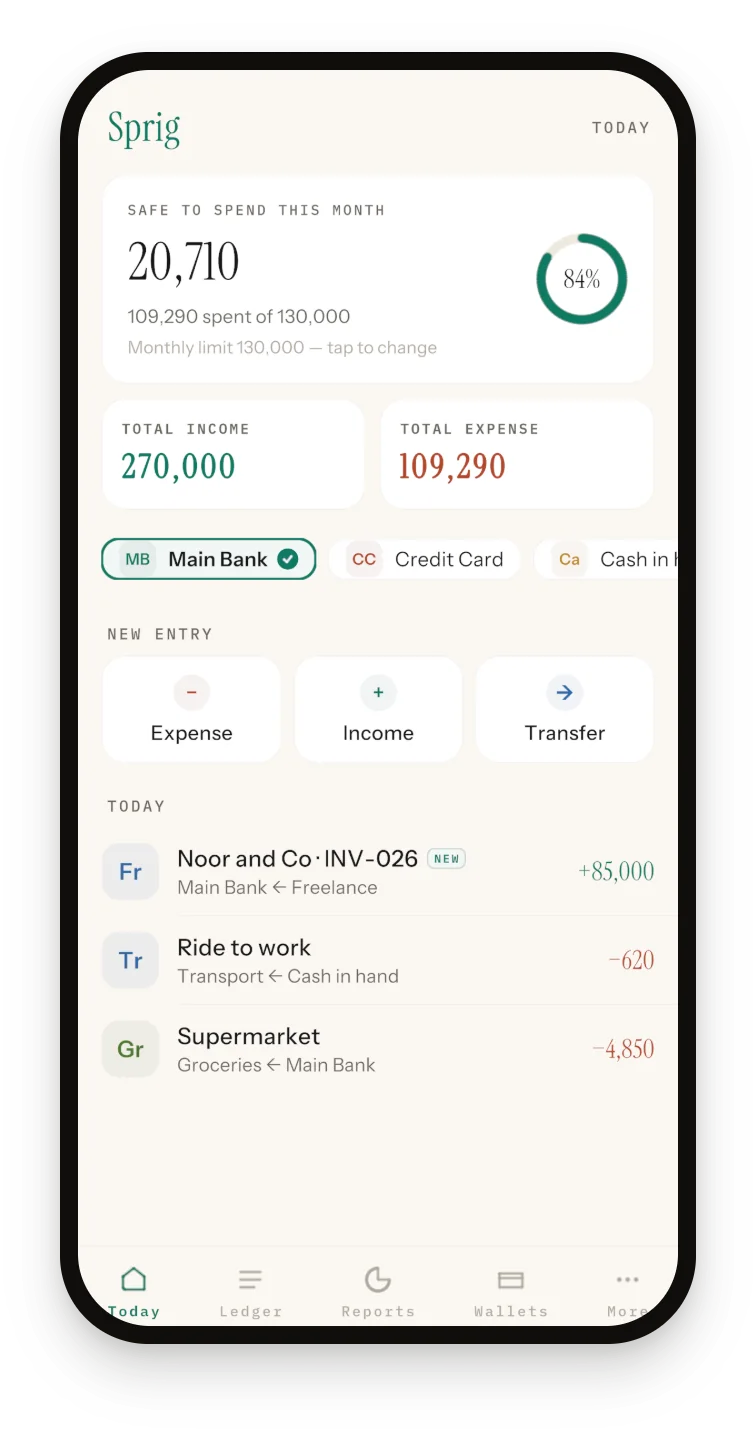
Sprig is a private, offline double-entry bookkeeping app for iPhone and Android, made by Secundum Reality. With no account, bank link or cloud, you log each payment yourself, and moving your share into a tax pot is one transfer.
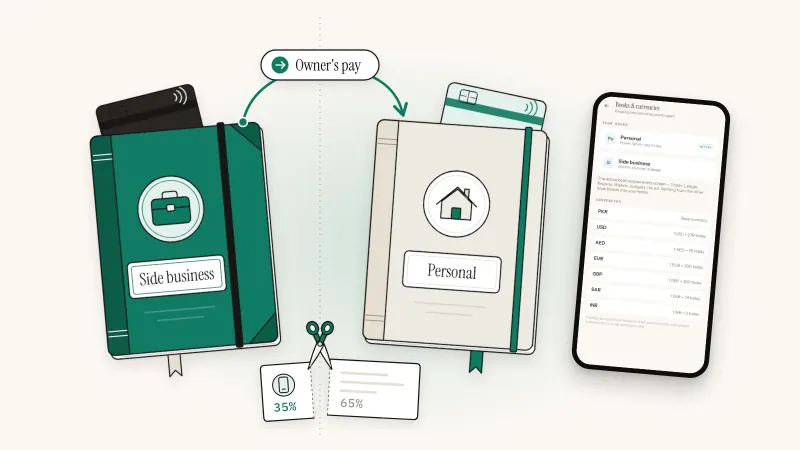
- Switch to Side business under More → Books & currencies. Sprig opens on Personal after a restart.
- Add two wallets with Wallets → Add an account: your business bank first (invoices pay into a book's first wallet), then a Savings wallet named Tax pot. Amounts are plain numbers without a currency symbol; keep every wallet in the same currency (the default).
- Log each payment as Income, or tap Mark paid on an invoice to post it.
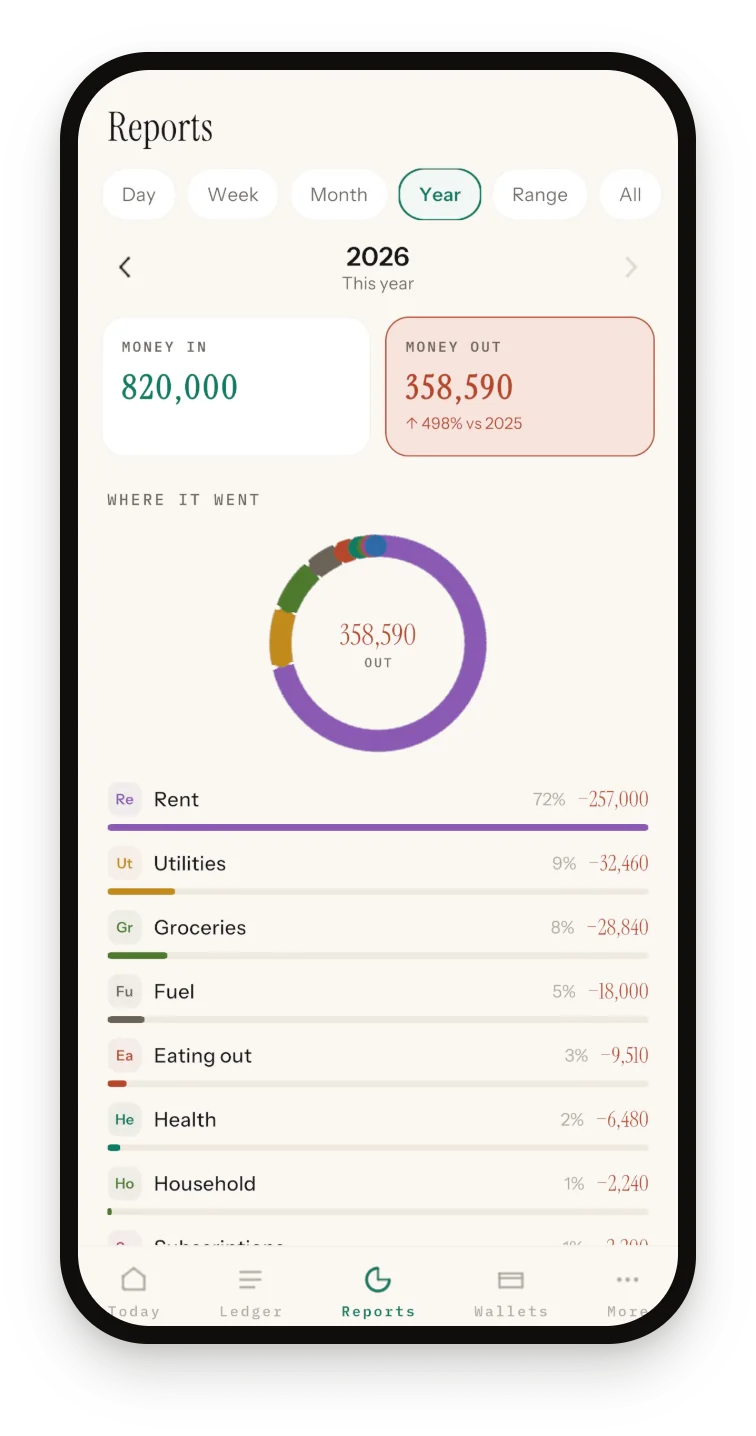
- Move your share with the Transfer tile on Today, out of the business wallet and into Tax pot. Transfers never count as income or spending, so Money in and Money out in Reports stay accurate.
- Record IRS payments as expenses from Tax pot in a custom category, Tax payments, with a note such as "Q4 2026 1040-ES". Leave it out when you read profit: IRS Publication 334 says not to deduct federal income tax.
- Check the totals in Reports → Year, which runs January to December, or Range for any quarter.
How Sprig helps
A tax pot you can see, with real double entry underneath: each transfer shows both sides, such as Business Bank → Tax pot, and balances can't drift.
- Two books keep business and personal money apart.
- Invoices turn red when overdue, and Mark paid posts the income.
- CSV export for your accountant: choose Everything, then filter to 2026 in a spreadsheet.
The limits: Sprig doesn't calculate any tax or estimated payment, and doesn't connect to the IRS or your bank. Its Tax summary and This FY and Last FY exports run July to June, so use Reports → Year or Export → Everything for a US return. There are no due-date reminders, and entries are dated the day you log them. It's free for 50 entries, plus 20 per optional ad (up to four a day), with every feature included; each transfer counts as one entry. Yearly Sprig Premium (from US$9.99) removes the limit and the ads. See what else the Sprig expense tracker does.
Sprig for iPhone and Android
Keep your books in four taps.
Private, offline double-entry bookkeeping. No account, no bank login, no cloud. Free to start with 50 entries.
Frequently asked questions
What percentage of my income should I save for taxes if I'm self-employed?
Work from profit, not income. In our 2026 examples for a single filer, federal tax came to 18.6% of profit at $40,000 and 20.8% at $80,000 with no other income, and 24–27% of side profit on top of a $60,000 salary. Add your state's income tax, and save more as income rises.
What is the self-employment tax rate for 2026?
It's 15.3%: 12.4% for Social Security and 2.9% for Medicare, charged on 92.35% of net earnings, so about 14.1% of profit. The 12.4% part stops at $184,500 of wages plus self-employment earnings in 2026, and half of the tax is deductible (IRS Topic 554).
Do I pay self-employment tax on a side hustle if I have a W-2 job?
Yes, if your net earnings from self-employment are $400 or more, salary or not. Your employer withholds based on your Form W-4, so either save for the side income yourself or file a new W-4 to have more withheld. Your wages count toward the $184,500 Social Security limit first.
Should I set aside taxes from revenue or profit?
Profit. Self-employment tax and income tax are both based on net profit after business expenses, so a percentage of revenue overstates the bill when costs are high. To save from each payment, multiply your profit percentage by the share of each payment you keep after costs.
Do I still owe taxes if I didn't get a 1099?
Yes. For payments made in 2026, a client generally files Form 1099-NEC only if it paid you at least $2,000 (IRS instructions), and payment apps only have to send a Form 1099-K above $20,000 in more than 200 transactions. Those are reporting thresholds, not tax-free allowances: the IRS says that whether or not you receive a Form 1099-K, you must still report any income on your tax return.
Can I raise my paycheck withholding instead of saving for taxes?
Yes. If you have a W-2 job, the IRS says you can avoid estimated tax payments by asking your employer to withhold more: file a new Form W-4. To size the extra, run the IRS Tax Withholding Estimator with your side-income records. A tax pot is easier to adjust if side income swings.
Sources and further reading
- IRS: Tax inflation adjustments for tax year 2026 (IR-2025-103, October 9, 2025)
- IRS: 2026 Form 1040-ES, Estimated Tax for Individuals (worksheets, $184,500 wage base, due dates)
- IRS: Self-employment tax (Social Security and Medicare taxes)
- IRS: Topic no. 554, Self-employment tax
- IRS: Qualified business income deduction
- FDIC: Understanding deposit insurance
Published 3 October 2026. Feature details were checked against Sprig 1.1 for iPhone and Android. This article is general information, not tax or legal advice; rules differ by country, so confirm anything you file with your accountant or tax authority.