Budgeting & saving
50/30/20 Rule vs Zero-Based Budget: Which Method Fits You?
One method splits your pay three ways in a minute; the other gives every dollar or pound a job before the month starts. Here's how each works on the same month, and who each suits.
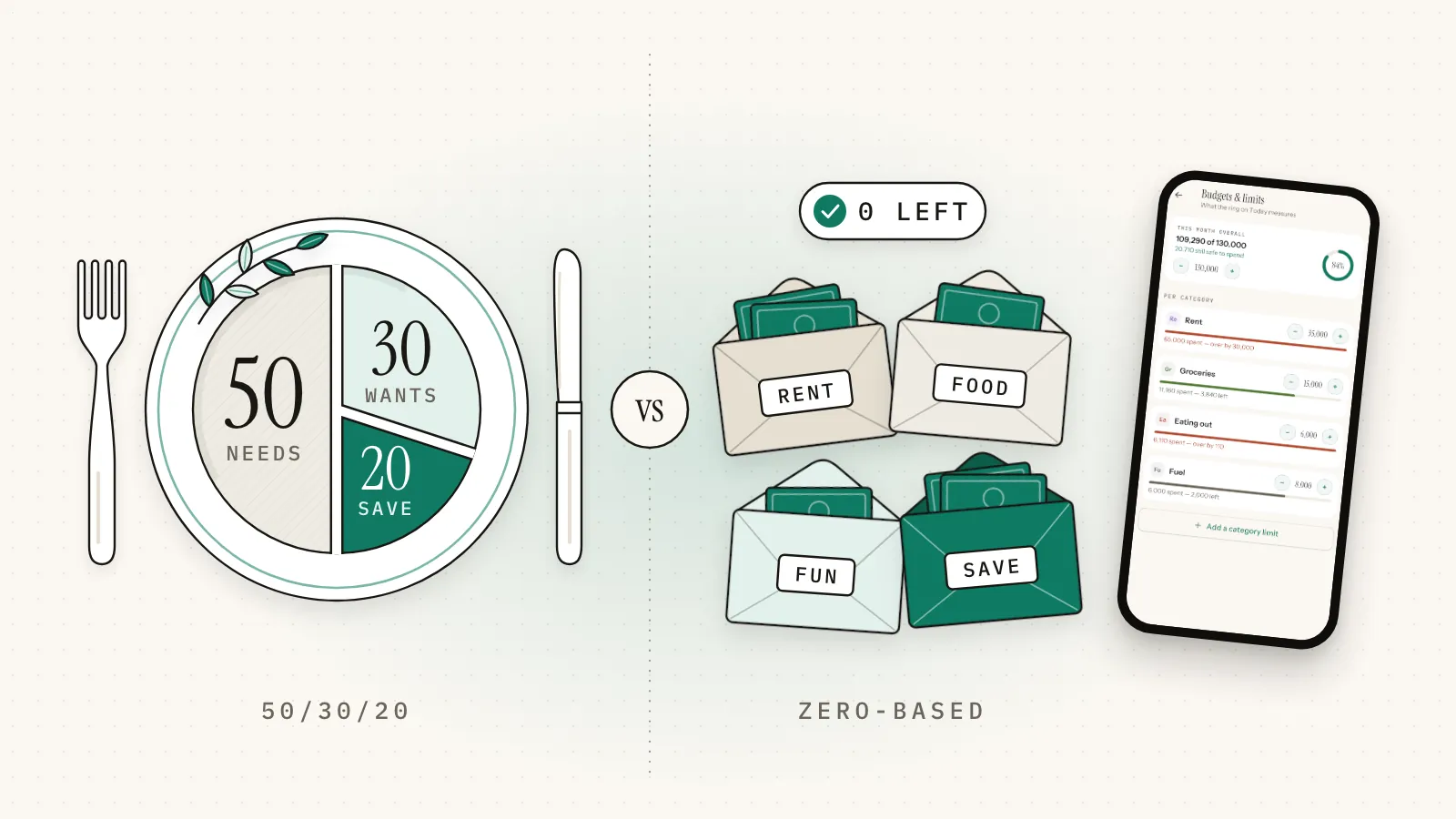
What is the 50/30/20 rule?
The 50/30/20 rule splits your take-home pay three ways: 50% for needs, 30% for wants and 20% for savings, including paying down debt. The Consumer Financial Protection Bureau (CFPB) presents it as one budgeting rule, not the only one, and bases it on net income: the money that reaches you after taxes and deductions.
In a classroom guide dated Summer 2022, the CFPB puts it plainly: "use 50 percent of your income for needs, 30 percent for wants, and 20 percent for savings for financial goals." Its table is headed "Percentage of net income" (CFPB: Learning about budgets), and its examples draw the lines:
- Needs (50%)
- Rent or mortgage payments, groceries, utilities and transportation.
- Wants (30%)
- Dining out, vacations and entertainment.
- Savings (20%)
- Emergency savings, paying down debt, and saving for education or retirement.
- Take-home pay
- Pay after taxes and deductions. Self-employed? Use what's left after business costs and the tax you set aside (an accountant can size that; this isn't tax advice).
| Monthly take-home pay | Needs (50%) | Wants (30%) | Savings and debt (20%) |
|---|---|---|---|
| $4,000 | $2,000 | $1,200 | $800 |
| £2,500 | £1,250 | £750 | £500 |
The guide adds a caveat worth keeping: "Not everyone can follow it." If rent alone takes 40% of your pay, bills and transportation can push needs past 50% before you've bought groceries. That means the split needs adjusting, not that budgeting has failed.
Debt sits in two places. The CFPB files paying down debt under savings, while MoneyHelper's UK savings-pots guide counts keeping up card and loan repayments as a need. Read together: minimum payments are needs, and anything extra comes out of the 20%.
The same split is described in All Your Worth, a 2005 book by Elizabeth Warren and Amelia Warren Tyagi. Its publisher's description, quoted in a Library of Congress research guide, calls it "a very simple formula: must haves: 50%, wants: 30%, and savings: 20%."
What is zero-based budgeting?
Zero-based budgeting gives every dollar or pound of your take-home pay a job before the month starts: bills, groceries, fun money, savings and extra debt payments. You keep assigning until income minus the plan equals zero. Zero means nothing is left unassigned, not an empty account. It takes longer than 50/30/20 but plans exactly where everything goes.
The FTC's budget steps on consumer.gov get you most of the way. Subtract monthly bills and expenses from income, and the result "should be more than zero." The page then suggests making savings "one of the expenses you include in your budget" (consumer.gov: Making a budget, August 2024). Give that leftover its own line and you have a zero-based budget. Here's the same month:
| Line | Type | US example | UK example |
|---|---|---|---|
| Rent | Need | $1,300 | £780 |
| Bills and debt minimums (UK: with council tax) | Need | $250 | £320 |
| Groceries | Need | $400 | £210 |
| Transportation | Need | $250 | £65 |
| Eating out | Want | $250 | £150 |
| Fun money, hobbies and subscriptions | Want | $450 | £275 |
| Trips and gifts fund | Want | $300 | £200 |
| Emergency fund | Savings | $500 | £350 |
| Extra debt payment | Savings | $300 | £150 |
| Left to assign | $0 | £0 |
Now run the 50/30/20 check: needs come to 55% of take-home pay, wants 25%, and savings and debt 20%. Needs ran past half, so the plan trimmed wants to protect savings. That's the practical difference: 50/30/20 gives a budget its shape, and zero-based fills in the lines.
What is envelope (jam jar) budgeting?
Envelope budgeting splits your money into separate containers, one for each spending line, and you spend only what's inside. MoneyHelper, the free UK guidance service, calls it the jam jar method, "also known as piggybanking or using savings pots". The containers can be cash envelopes, separate bank accounts or pots inside one account.
Envelopes are less a third method than a way to enforce the other two: the jars can hold 50/30/20 shares or zero-based lines. MoneyHelper weighs up the options (MoneyHelper: Managing your money using savings pots):
- Cash in jars or envelopes works well "if your money comes in once a week but your bills are monthly", and seeing the cash may help you spend less. But cash isn't always convenient, it's a security risk at home, and you miss Direct Debit perks such as cheaper tariffs.
- Separate accounts fill by standing order and spread once-a-year costs such as holidays, Christmas and car tax. Some banks offer pots that do this inside one account. Watch each account for fees; MoneyHelper warns that opening several might affect your credit score.
Tip
One envelope may be enough. For small purchases that add up, the CFPB suggests "setting aside cash for these purchases at the beginning of the week and not spending more than you set aside" (CFPB: Consumer tips for managing spending, 2017).
50/30/20 rule vs zero-based budget vs envelopes, side by side
None of the three wins every row.
| Point | 50/30/20 rule | Zero-based budget | Envelopes or jam jars |
|---|---|---|---|
| How it works | Three shares of take-home pay | A line for every dollar or pound until zero is left | Money split into envelopes, accounts or pots |
| Effort each month | Lowest: check three totals | Highest: plan the month, then track every line | Medium: refill the jars each payday |
| Flexibility | Fixed shares; a rough fit where costs are high | Fits any income and any month | Firm limits; moving money means moving cash or pots |
| Best for | Beginners, steady pay, a quick health check | Tight months, irregular income, paying off debt | One or two categories that keep running over |
| Typical failure | Needs pass 50% and the rule feels impossible | Too many lines, abandoned by week three | Cash runs out or is awkward to use; account fees |
Which budgeting method should you choose?
If you're new to budgeting, start with 50/30/20 as a quick check on a month of real spending. Choose zero-based if money is tight, your income varies or you're paying off debt. Add envelopes or jam jars only for the categories that keep running over. If needs pass 50%, plan around your real costs, not the rule.
| Your situation | Try | Why |
|---|---|---|
| New to budgeting | 50/30/20, after a few weeks of tracking | Three numbers to watch |
| Rent or other needs above 50% | Zero-based, or protect the 20% and shrink wants | The CFPB says not everyone can follow the rule |
| Income that changes month to month | Zero-based on a cautious baseline | You plan on money you can count on |
| Paying off debt | Zero-based | Extra payments get their own line |
| One category keeps running over | An envelope for that category | A visible limit where the leak is |
| Paid weekly, billed monthly | Jam jars | MoneyHelper's best case for cash jars |
| A couple sharing bills | Zero-based for joint costs, fun money each | Shared money is agreed in advance |
Asking for the best budgeting method for beginners? Ours: track first, use 50/30/20 as the check, and add detail only where a category leaks. If your pay swings, read how to budget on an irregular income before you pick a baseline.
How do you set up your first month?
Track your spending for a few weeks, work out your take-home pay and pick one method. On payday, move savings out before you spend. Check your totals weekly, and at month end compare the plan with what happened and adjust. The first month's job is to show you where the plan is wrong.
- Track before you plan. The CFPB suggests tracking "for a week or a month" to see where money goes. Here's how to track daily spending for a month.
- Find your take-home pay. Use what lands in your account. If you don't get paid every month, the FTC suggests dividing last year's income by 12.
- Write the plan. Three numbers for 50/30/20, or a line per category for zero-based, each based on what you tracked.
- Pay yourself first. The CFPB's advice is to "pay yourself first by putting a portion of it automatically into savings" (CFPB: An essential guide to building an emergency fund).
- Check weekly. The CFPB says to compare spending with your budget "monthly or more frequently".
- Adjust at month end. As the FTC puts it, "see if you spent what you planned", then plan next month with what you learned.
US
Paid by direct deposit? The CFPB notes you "may have an option to split your paycheck between your checking and savings accounts", which automates step 4.
UK
The same MoneyHelper guide suggests standing orders into separate accounts, emergency savings among them, "one or two days after you've been paid".
Why do budgets fail, and what should you try next?
A budget usually breaks for an ordinary reason: limits copied from someone else, bills that arrive once a year, no cushion for surprises, or tracking that stops after two weeks. Fix the cause, not your willpower. Plan from tracked numbers, save monthly for irregular bills, build a small buffer, and switch methods if the effort doesn't suit you.
| What went wrong | Try next |
|---|---|
| Limits were wishful, so every week ran over | Rebuild them from a month of tracked spending |
| A once-a-year bill wrecked the month | Save for it monthly in a sinking fund |
| One surprise cost wiped out the plan | Build an emergency fund, starting small |
| Side-business money blurred the household numbers | Keep business money separate and budget only what you pay yourself |
| Zero-based felt like a second job | Drop to 50/30/20, with one envelope for the worst category |
| 50/30/20 was too loose to change anything | Go zero-based for your wants, or give them cash envelopes |
One more trap: counting money moved to savings as spending. Savings moves are transfers, not spending, so record them as moves and your spending totals stay true.
How to run any of these methods in Sprig
Sprig is a private, offline double-entry bookkeeping app for iPhone and Android, made by Secundum Reality. It doesn't impose a method. Three plain tools cover all three: a monthly limit, transfers that never count as spending, and wallets that work as envelopes. Your books stay on your phone, with no account and no bank link (see bank-linked vs offline expense trackers).
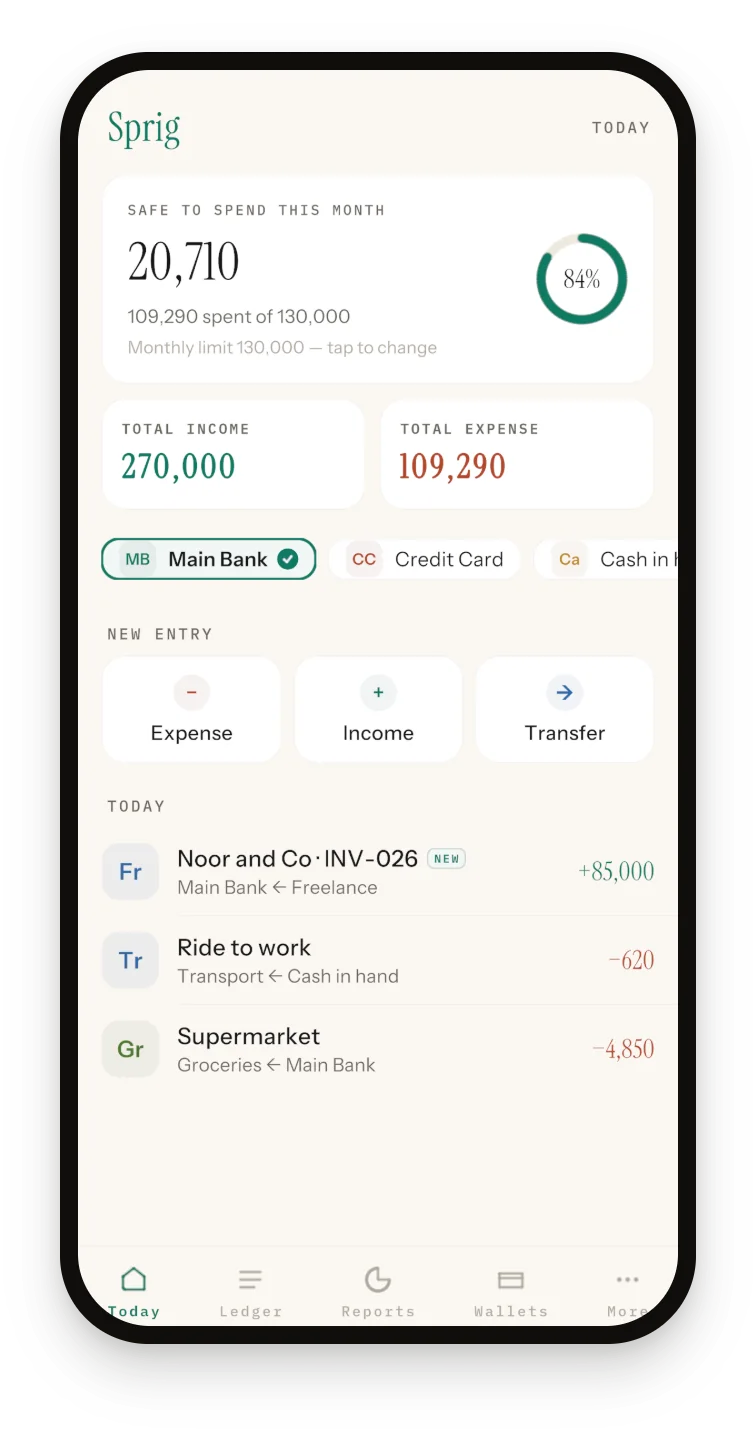
How Sprig helps
Set up each method like this:
- 50/30/20: tap the Safe to spend card on Today and type needs plus wants as your monthly limit: 3,200 for a $4,000 take-home, or 2,000 for £2,500. On payday, Transfer the 20% to a Savings wallet. Transfers never count as spending, so Safe to spend stays honest.
- Zero-based: type your planned spending as the limit and move savings with Transfers. Paying off a credit card is a Transfer too, from bank wallet to card wallet, because the spending counted when you used the card. Reports → Month lists category totals biggest first, so you can check each line.
- Envelopes or jam jars: add a Cash wallet for each envelope you really carry. A cash withdrawal is a Transfer from bank to cash, and the wallet's balance is what's left. A bank pot gets its own Savings wallet.
- Category caps (More → Budgets & limits) come in whole thousands: they start at 10,000 and move in steps of 1,000, down to 1,000, so a $300 or £150 cap isn't possible. Use them only for big lines you can round to a thousand. Caps are informational: no alerts, and they don't change Safe to spend.
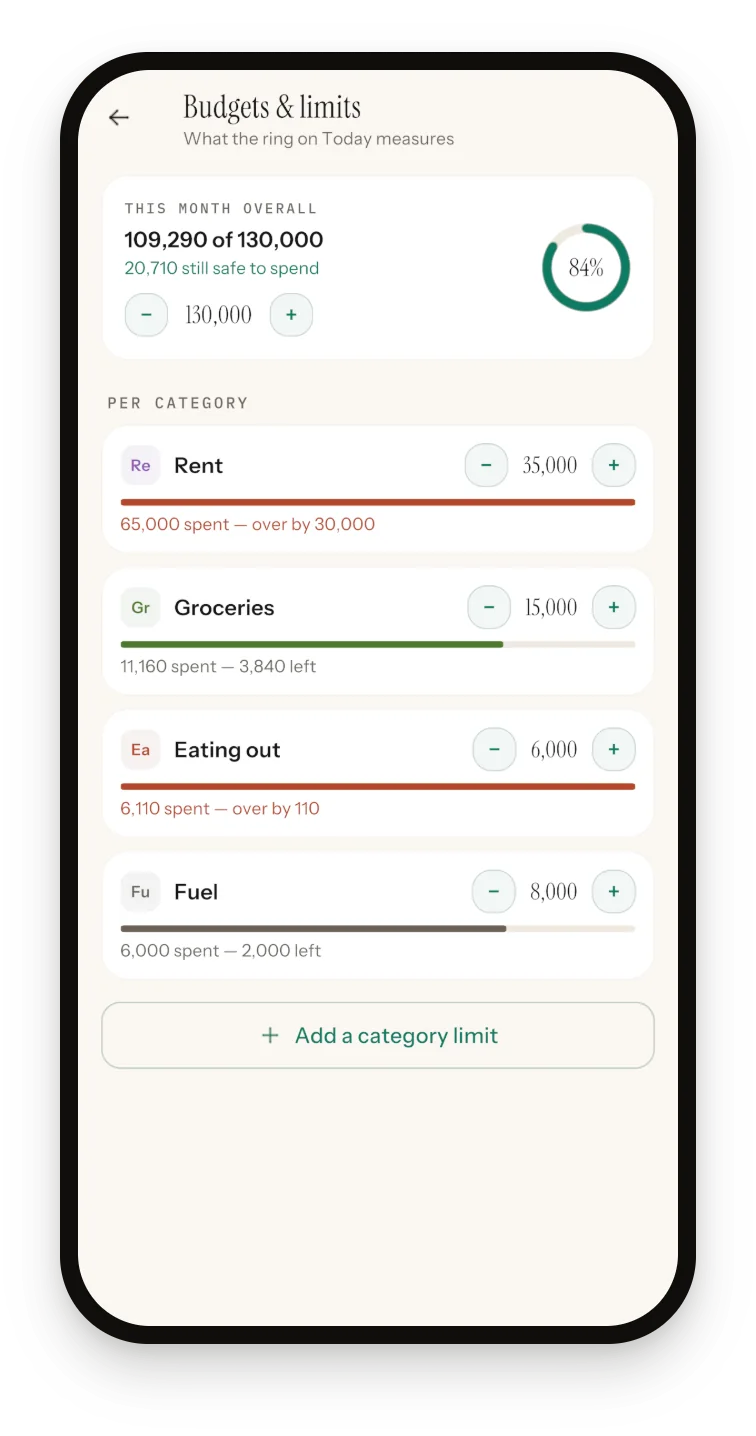
Know the limits. Sprig has no needs-or-wants tags (categories do that job), no rollover, no savings goals, no alerts or reminders and no automatic transfers, so the weekly check is yours. A category cap can't be removed once added. Amounts are plain numbers with no currency symbol: keep every wallet in the same currency (the default) and type dollars or pounds as they are.
Sprig is free for 50 entries, plus 20 more per optional ad (up to 4 a day), with every feature included; each Transfer uses one entry. Sprig Premium is a yearly subscription with unlimited entries and no ads (US$9.99 or £9.99 on the App Store; your store shows the local price). See every feature on the Sprig budgeting and bookkeeping app page.
Sprig for iPhone and Android
Keep your books in four taps.
Private, offline double-entry bookkeeping. No account, no bank login, no cloud. Free to start with 50 entries.
Frequently asked questions
Is the 50/30/20 rule realistic?
For some budgets, not all. The CFPB, which teaches the rule, says not everyone can follow it. Where rent is high, needs can pass 50% before groceries. Treat the split as a target shape: keep savings near 20%, trim wants first, and redo the numbers when your income or costs change.
Is the 50/30/20 rule based on gross or net income?
Net income. The CFPB's 50/30/20 table is headed "Percentage of net income": the pay you bring home after taxes and other deductions. On a $4,000 or £2,500 take-home month, that's $2,000 or £1,250 for needs. Self-employed? Start from what's left after business costs and the tax you set aside.
Which budgeting method is best for irregular income?
Usually zero-based, built on a cautious baseline. Plan the month on income you can count on, then give each extra dollar or pound a job when it arrives: savings, a buffer or tax. The FTC suggests estimating monthly income as last year's total divided by 12. Our irregular income guide goes deeper.
What counts as a need vs a want in a budget?
The CFPB lists rent or mortgage payments, groceries, utilities and transportation as needs, and dining out, vacations and entertainment as wants. MoneyHelper's savings-pots guide adds keeping up card and loan repayments to needs. For gray areas such as a phone plan, a fair rule is that the basic version is a need and the upgrade is a want.
Does putting money into savings count as spending?
No. Moving money from a checking or current account into savings is a transfer between your own accounts, so it stays out of your spending totals. Plan it like a bill, as the FTC suggests, but record it as a move. In 50/30/20 it fills the 20%; in a zero-based budget it gets its own line.
Is the jam jar method the same as envelope budgeting?
Yes, in all but name. MoneyHelper's savings-pots guide describes the jam jar method as dividing your money into separate pots for different expenses: real jars or envelopes, separate bank accounts, or the savings pots some banks offer. Envelope budgeting is the more common US name. When a pot is empty, that spending stops until payday.
Sources and further reading
- CFPB: Learning about budgets (Building Blocks teacher guide, Summer 2022)
- CFPB: An essential guide to building an emergency fund (page last modified 29 October 2025)
- CFPB: Consumer tips for managing spending (2017)
- FTC, consumer.gov: Making a budget (August 2024)
- MoneyHelper: Managing your money using savings pots (the jam jar method; checked via the Internet Archive copy of 15 October 2025)
- Library of Congress: Personal Finance: A Resource Guide, Budgeting (All Your Worth entry)
Published 3 October 2026. Feature details were checked against Sprig 1.1 for iPhone and Android. This article is general information, not tax or legal advice; rules differ by country, so confirm anything you file with your accountant or tax authority.