Budgeting & saving
Sinking Funds: How to Save for the Bills You Can See Coming
Car insurance, holiday gifts and annual renewals aren't emergencies; they're bills with a date on them. Here's how to turn each into a small monthly transfer, with US and UK examples and a catch-up formula.
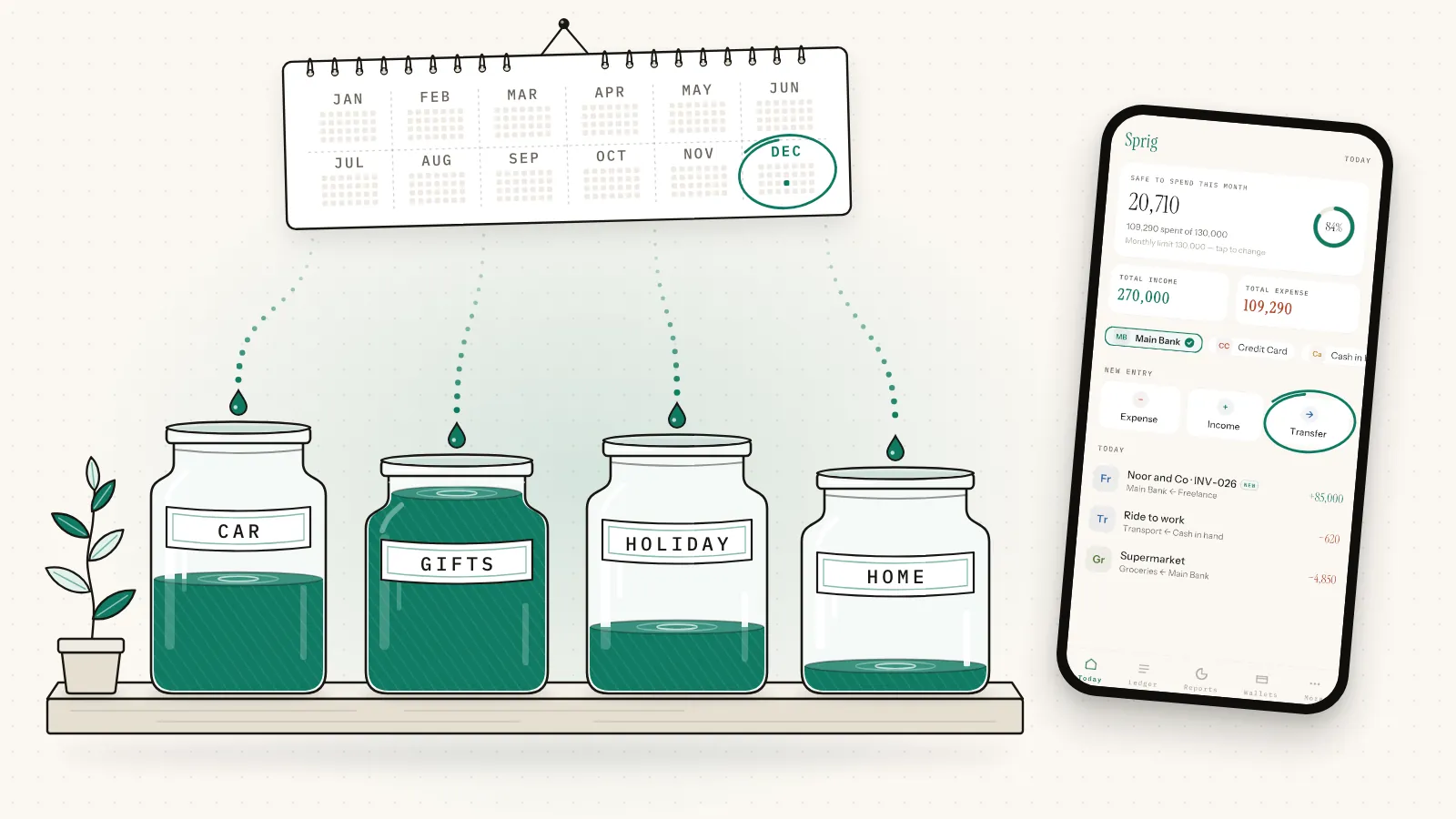
Car insurance renews on the same date every year. The holidays arrive every December. That annual subscription renews whether you remember it or not. None of these bills is a surprise, yet each one can wreck the month it lands in. A sinking fund turns one big, predictable bill into small monthly transfers.
What is a sinking fund?
A sinking fund is money you save for one known future expense, such as an insurance renewal, holiday gifts or new tires. You choose a target and a due date, divide the target by the months left, and move that amount each month, ideally on payday. When the bill arrives, you spend the fund and start again.
The Consumer Financial Protection Bureau's Improving cash flow tool (Your Money, Your Goals toolkit, 2020) suggests automatically depositing a monthly amount into savings "so when a large lump-sum payment is due the money is already saved." Its examples of such payments are car insurance and school tuition.
Sinking fund vs emergency fund: what's the difference?
A sinking fund is for a cost you can predict: you know roughly how much it will be and when it's due. An emergency fund is for what you can't predict, like a sudden repair or a lost job. You spend a sinking fund on schedule and refill it; an emergency fund waits until something goes wrong.
The CFPB's emergency fund guide (updated October 2025) defines an emergency fund as "a cash reserve that's specifically set aside for unplanned expenses or financial emergencies." The key word is unplanned. If you can put a date on a cost, it belongs in a sinking fund.
| Sinking fund | Emergency fund | |
|---|---|---|
| Pays for | Planned costs: renewals, gifts, trips | Unplanned costs: a breakdown, lost income |
| Amount and date | Known, or easy to estimate | Unknown |
| When you spend it | On schedule, often once a year | Rarely, ideally never |
| After you spend it | Restart it for the next bill | Rebuild it |
| How many | One per bill, or per group of small bills | Usually one |
The same car can need both: the insurance renewal is a sinking-fund bill, while the breakdown on the way to work is an emergency. Keep the two apart so a planned bill can't drain your safety net, and see how big your emergency fund should be.
Which sinking funds should you start with?
Start with the two or three biggest bills that don't arrive every month, often insurance, car costs and the holidays. To find them, scan the last 12 months of bank and card statements for anything that isn't monthly. Add more funds later, once the first few run every payday without a second thought.
A CFPB tool called Planning for the year (2021), written for military families, makes a good checklist for anyone. It aims to help you "plan to have financial resources on hand to cover occasional expenses" and asks about:
- insurance and taxes paid quarterly, twice a year or annually;
- vacations, religious or cultural celebrations, and family birthdays;
- school clothing, supplies and activity fees;
- major purchases, such as appliances or a new vehicle.
Work through a year of statements, or your own records if you track your daily spending, and group small items into one fund. Here are common sinking fund categories, without prices, since yours will differ.
| Fund | US examples | UK examples |
|---|---|---|
| Car | Insurance, registration, service, tires | Insurance, car tax, MOT and service, tires |
| Home | Homeowners or renters insurance, property tax (if not in escrow) | Home insurance, boiler service |
| Gifts and celebrations | Holiday gifts, birthdays, weddings | Christmas, birthdays, weddings |
| Travel | Summer vacation, trips home for the holidays | Summer holiday, school-holiday trips |
| Kids and school | Back-to-school clothes, supplies, activity fees | School uniform, school trips, clubs |
| Yearly subscriptions | Memberships and apps billed once a year | TV Licence, memberships, apps |
| Health and pets | Dental work, glasses, vet visits | Dental treatment, glasses, vet visits |
US
If your mortgage includes escrow, your servicer already runs a sinking fund for you. The CFPB explains that an escrow account is funded from part of each monthly mortgage payment and pays bills such as property taxes and homeowners insurance, so you don't face "a big bill once or twice a year." No escrow? The CFPB says you'll have to plan to pay those large expenses yourself. This is general information, not tax advice.
How do you calculate a sinking fund's monthly amount?
Divide what you still need by the months left before the bill is due: (target − already saved) ÷ months left. For example, a £600 car insurance renewal 12 months away needs £50 a month. If you start late, the same formula gives a higher catch-up figure, but only until this bill is paid.
- Target
- The bill's cost: the latest quote, or last year's bill.
- Already saved
- What's in the fund today.
- Months left
- The monthly transfers you can still make before the due date.
| Fund | Target | Already saved | Months left | Monthly amount |
|---|---|---|---|---|
| Car insurance renewal | £600 | £0 | 12 | £50 |
| Holiday gifts, started in October | $600 | $0 | 3 | $200 |
| Holiday gifts, started a year ahead | $600 | $0 | 12 | $50 |
| Car insurance, started late | £600 | £150 | 5 | £90 |
The gift rows show why timing beats willpower: the same $600 costs $50 a month from a year out but $200 a month from October. Reading this in October 2026 with nothing saved for December? The $200 row is your Christmas savings plan for this year. Start next year's in January.
If you started late: the catch-up formula
A late start and a raided fund use the same sum. In the last row, a £600 renewal is five months away with £150 saved: (£600 − £150) ÷ 5 = £90 a month until the renewal, then £50 a month for the year after. If that won't fit, the CFPB's cash-flow tool suggests paying lump-sum bills such as car insurance monthly instead, though that may cost extra.
Add up your monthly total
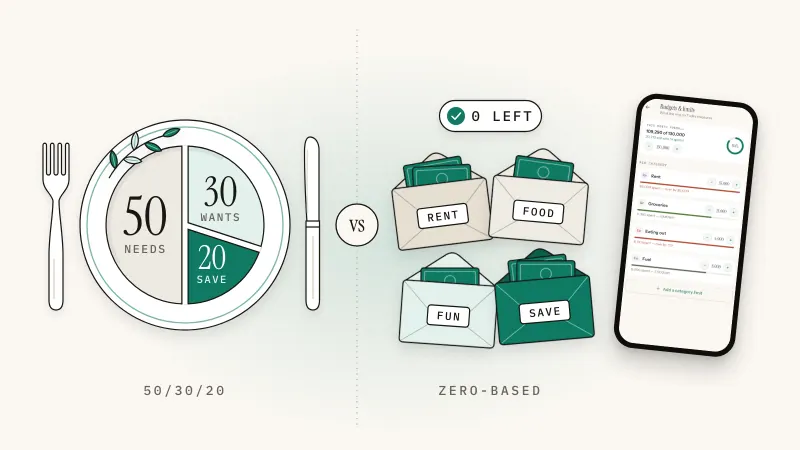
Together, your funds make one budget line: for example, £40, £50 and £100 a month is a £190 monthly transfer. Too much? Run fewer funds or push smaller goals out a year. Whatever budget method you use, set this line aside first; here's how 50/30/20 and zero-based budgets compare.
Where should you keep sinking funds?
Keep sinking funds away from your everyday spending, in a savings account at a bank, building society or credit union. Open one account per fund, use your bank's savings pots, or keep every fund in one savings account and track each one's share in a spreadsheet or ledger. All three work if your records match the balance.
The CFPB's emergency fund guide calls saving automatically "one of the easiest ways" to save consistently, for example with recurring transfers from checking to savings. Schedule yours for the day after payday, before the money drifts into the week's shopping.
| Separate savings accounts | Pots in your bank app | One account plus a ledger | |
|---|---|---|---|
| How it works | One account per fund, each with its own automatic transfer | Named pots inside one account | One savings account, split into named funds in your records |
| Good for | Seeing every balance at a glance | Anyone whose bank offers pots | Any bank, with one account to manage |
| Watch out for | More accounts and statements to manage | Pots don't move if you switch banks | You must log every move and check the total monthly |
If your bank offers saving pots for annual bills, use them. If it doesn't, the third option works with any account: the bank holds the money, and a spreadsheet or app used for manual tracking records which bill each dollar or pound is for.
UK
MoneyHelper, run by the Money and Pensions Service, calls this the jam jar method, or using savings pots. It suggests standing orders that move money into separate accounts a day or two after payday, and says this helps spread once-a-year costs such as holidays, Christmas and car tax. Its cautions: keep each account in credit to avoid fees and charges, and opening several accounts might affect your credit score. Features and fees vary, so check your bank's terms.
How do you use a sinking fund when the bill arrives?
Pay the bill with the money in the fund, either directly or by moving it to your checking (current) account first, and record it as spending in its usual category. It isn't overspending: the money was set aside for exactly this. Then restart the monthly transfer, using the new price to set next year's amount.
- Move the money. Many savings accounts can't pay bills directly, so move the amount to your checking (current) account a few days early.
- Record the bill once. Use its usual category, such as Insurance or Gifts. That's the only moment it counts as spending.
- Settle the difference. Bill under target? Keep the extra as a head start. Over? Cover the gap and raise next year's target.
- Restart the transfer. Run the formula again with the new price.
The monthly transfers into the fund were never spending, just money moving between your own accounts (here's why a transfer isn't spending). Count them as spending as well as the bill, and the same cost shows up twice.
What are the most common sinking fund mistakes?
The common mistakes are starting too many funds at once, dipping into them for everyday spending, saving for last year's price, and forgetting to restart a fund after the bill is paid. Each has a simple fix: start with a few, set borrowing rules in advance, update targets at renewal time, and keep the transfer running.
- Too many funds. Twelve funds of $10 mean twelve transfers and twelve balances to check. Start with two or three. That's our suggestion, not an official rule.
- Raiding them. Decide in advance what a fund may lend to and when it gets paid back. The CFPB gives similar advice for emergency funds: set guidelines for what counts as an emergency.
- Saving for last year's price. The CFPB's escrow guidance notes that property taxes and insurance premiums can change from year to year. Run the formula again at each renewal.
- Letting a fund lapse. Restart the transfer the week the bill is paid.
How to run sinking funds in Sprig
Sprig is a private, offline double-entry bookkeeping app for iPhone and Android, made by Secundum Reality. It has no savings-goal feature, but its wallets and transfers handle the "one account plus a ledger" method well.
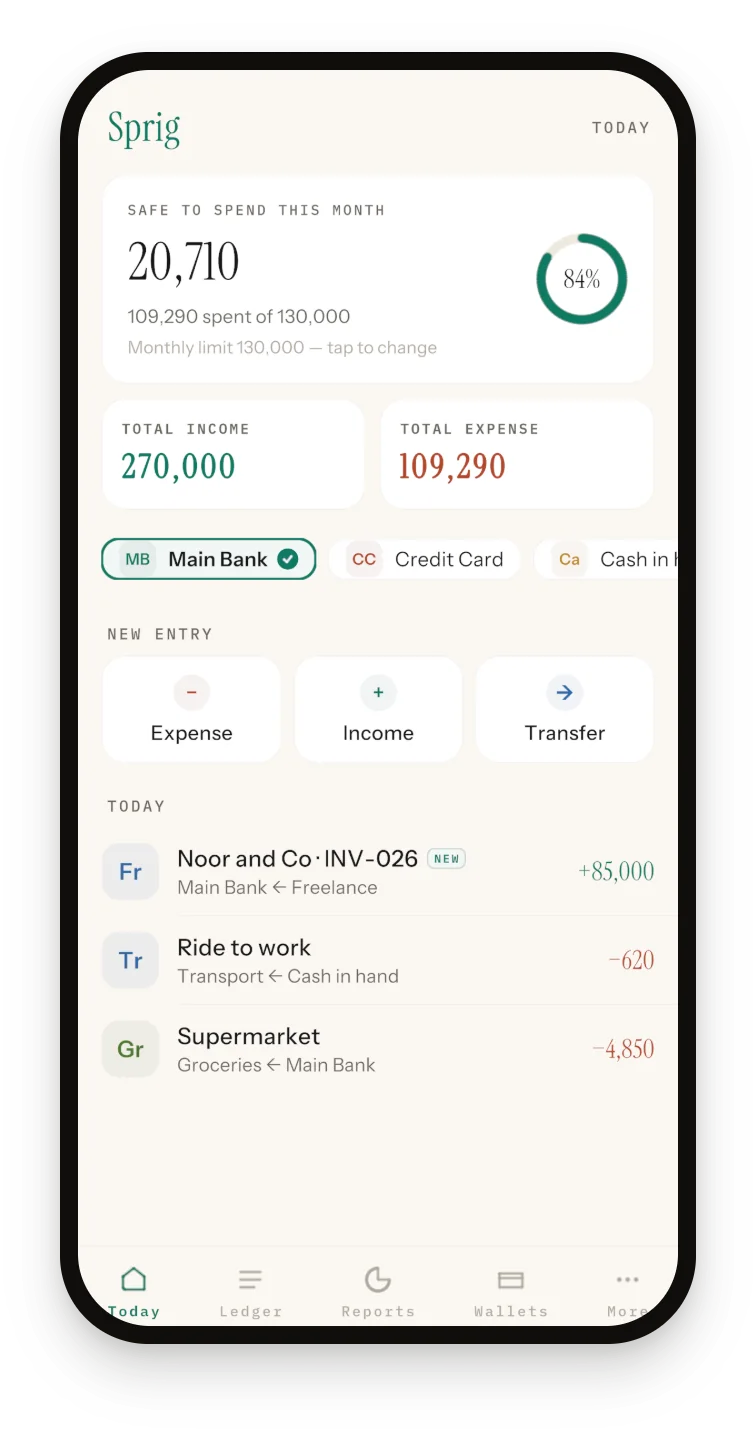
- Add a Savings wallet per fund. On the Wallets tab, tap Add an account, choose Savings, name it (say, "Car fund") and enter what's already saved as its balance. Amounts are plain numbers with no currency symbol, so keep every wallet in the same currency (the default).
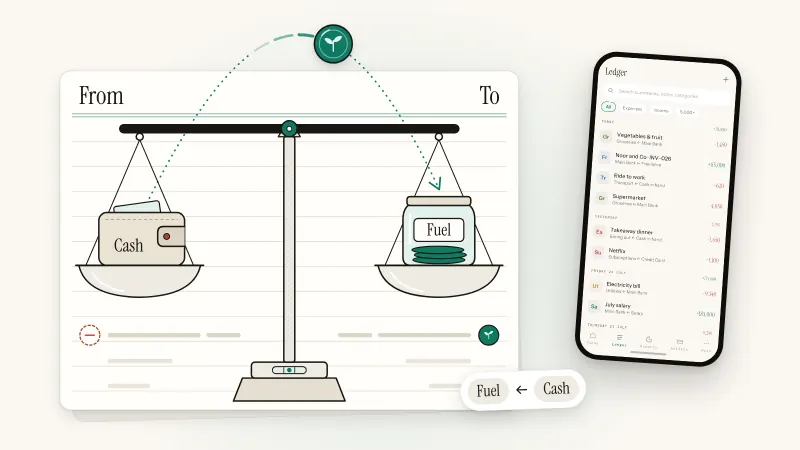
- Transfer on payday. Tap Transfer on Today, pick your bank wallet under OUT OF and the fund under INTO, and type the amount. The entry reads
Main Bank → Car fund, and Safe to spend doesn't move. - Pay the bill from the fund. Select the fund in the wallet strip on Today and log an Expense as usual: category (add Insurance with + New), summary or Skip, amount, Save. The entry reads
Insurance ← Car fund. Then switch the strip back to your bank wallet for everyday entries. If the real money went through checking first, skip logging that hop: once the bill clears, every balance still matches. - Reconcile monthly. The fund wallets should add up to your real savings balance. Record interest as Income → Interest so they still match.
How Sprig helps
Each fund is a wallet, so the balance you see is the progress you've made.
- Transfers stay transfers. Money moved into a fund never counts as spending on Today or in Reports.
- Spot annual bills. After a year of entries, Reports → Range shows 12 months of spending by category, biggest first, and each bar expands into per-item totals.
- Search the Ledger for a fund's name to see every transfer in and every bill out.
- Private by design: no account, no bank login, no cloud.
One quirk: Safe to spend counts every expense in the book, whichever wallet pays it, so a $600 bill paid from a fund lowers it by $600. If you'd rather it reflect only the month's everyday spending, tap the card, raise the monthly limit by the bill, and lower it again next month.
The honest limits: wallets have no targets or due dates, there are no reminders, and Sprig can't schedule transfers, so log each one after your bank's standing order or recurring transfer runs. Each transfer is one entry. Sprig is free for 50 entries, plus 20 per optional ad (up to four a day); yearly Sprig Premium removes the limit and the ads. Read what a private offline app should do, or see how Sprig keeps your books on your phone.
Sprig for iPhone and Android
Keep your books in four taps.
Private, offline double-entry bookkeeping. No account, no bank login, no cloud. Free to start with 50 entries.
Frequently asked questions
What is a sinking fund in simple terms?
A sinking fund is a savings pot for one bill you know is coming, such as car insurance, holiday gifts or a vacation. You pick the amount and the date, then save a slice each month until it's due. When the bill arrives, you pay it from the pot instead of from that month's income.
How many sinking funds should I have?
Start with two or three, for the biggest bills that don't arrive monthly, and add more once those run smoothly. That's our suggestion, not an official rule. Small, related costs can share one fund, such as "Annual subscriptions". More funds mean more transfers and balances to track, which makes the habit harder to keep.
Should sinking funds be in separate bank accounts?
They don't have to be. Separate accounts or bank pots make each balance easy to see, and MoneyHelper suggests separate accounts as a way to spread once-a-year costs. One savings account works too, as long as you keep a record that splits it into named funds and check each month that the funds add up to the balance.
Is a Christmas savings plan a sinking fund?
Yes. It's a sinking fund with a December due date. Add up gifts, food and travel, subtract what you've already saved, and divide by the months left. With three months to go, $600 of gifts works out to $200 a month, and £450 to £150 a month. Started a year ahead, the same $600 is $50 a month.
Can I use my emergency fund as a sinking fund?
It's better not to. An emergency fund covers costs you can't predict, like a sudden repair or a lost job, while a sinking fund covers bills you can see coming. Pay a renewal from the emergency fund and your safety net shrinks just when you might need it. Keep them separate, at least in your records.
Sources and further reading
- CFPB: Improving cash flow (Your Money, Your Goals toolkit, 2020)
- CFPB: Planning for the year (Your Money, Your Goals: Focus on Military Communities, 2021)
- CFPB: An essential guide to building an emergency fund
- CFPB: What is an escrow or impound account?
- MoneyHelper: Managing your money using savings pots (checked via the Internet Archive copy of 15 October 2025)
Published 3 October 2026. Feature details were checked against Sprig 1.1 for iPhone and Android. This article is general information, not tax or legal advice; rules differ by country, so confirm anything you file with your accountant or tax authority.