Getting paid
Cash Flow for Freelancers and Small Businesses: A Weekly Routine
Profit says whether the work pays; cash flow says whether you can pay this month's bills. Here's a 15-minute weekly routine, a 12-month forecast and the US and UK tax dates to plan around.
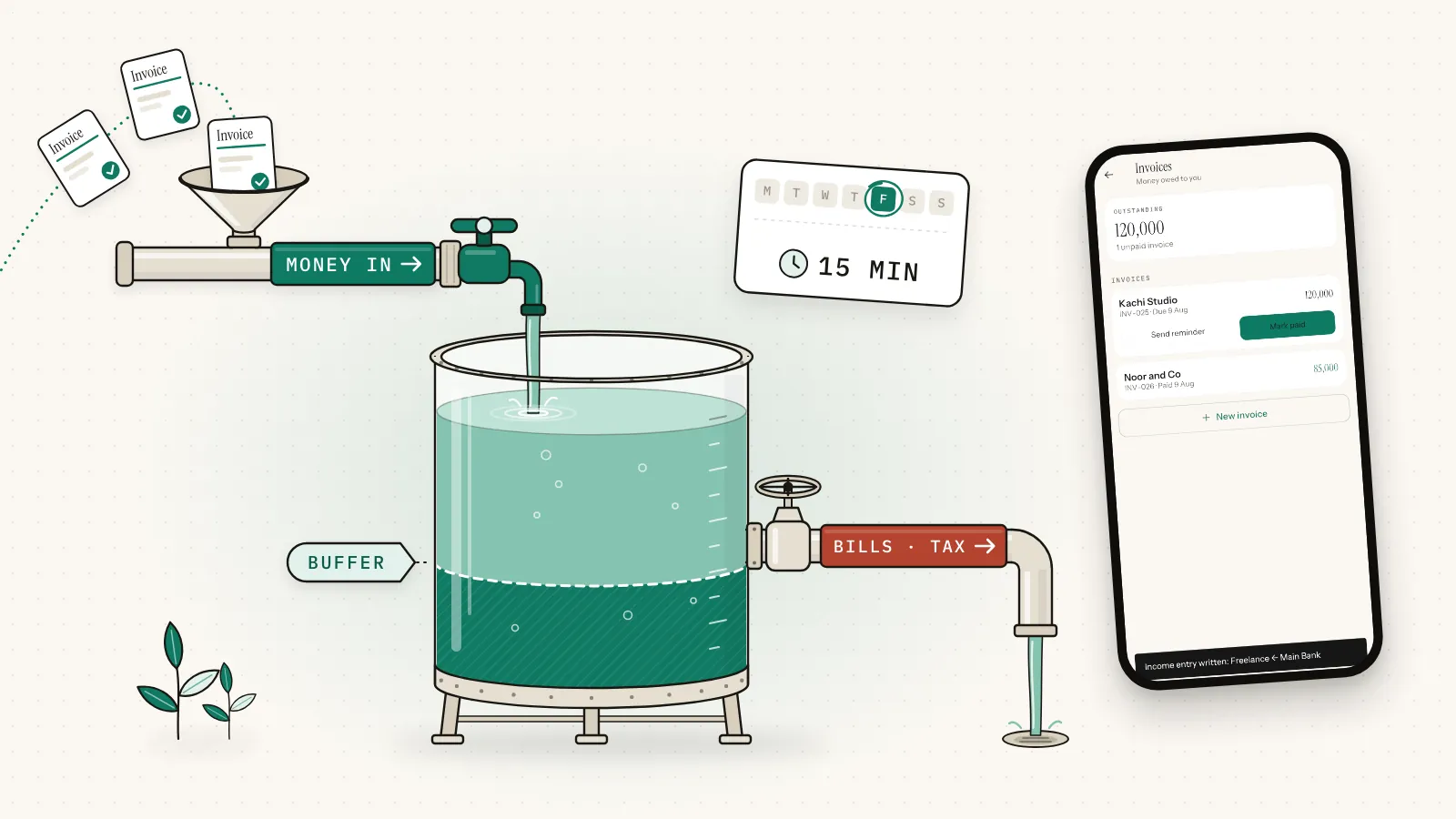
Your books say last quarter was your best yet. Your bank balance disagrees, and the insurance renewal is due Monday. Both can be true: profit counts what you earned, while cash flow tracks when money actually moves.
What is cash flow for freelancers, and how is it different from profit?
Cash flow is the timing of money moving in and out of your accounts. Profit is income minus expenses for a period. A freelancer can be profitable on paper and still short of cash when clients pay late, a large bill lands early or a tax payment falls due.
The Consumer Financial Protection Bureau calls cash flow "the timing of when your money is coming in (your income) and going out (your expenses and spending)" (CFPB). For example, a designer finishes $8,000 of work in March on 30-day terms, so that money lands in April. During March, a $2,000 February invoice is paid and $2,500 of costs go out.
| March | Profit (work done) | Cash (money moved) |
|---|---|---|
| Income | $8,000 | $2,000 |
| Costs | $2,500 | $2,500 |
| Result | +$5,500 | −$500 |
March earned $5,500 while the bank fell $500. The cash method, which the SBA says "shows cash flow clearly," would record that $8,000 in April, when it's paid (SBA). Even then, your own pay and your income tax aren't business expenses (IRS Publication 334; GOV.UK), so both leave the bank without touching profit.
- Cash basis (UK), cash method (US)
- Income counts when you're paid and expenses when you pay. It's the standard for UK sole traders (GOV.UK), and many US sole proprietors without inventory use it (IRS Publication 334).
- Accrual (UK: traditional accounting)
- Income counts when you invoice, expenses when you're billed.
Why do freelancers run short of cash?
Freelancers run short because income arrives late and in lumps while costs arrive on schedule. Thirty-day terms, a quiet month, an annual renewal and a tax payment can all land in the same few weeks. A quarterly or yearly profit figure hides that timing, so cash needs its own weekly check.
- Slow payers. You cover a month of costs before a 30-day invoice clears. Keep one list and track unpaid invoices every week.
- Lumpy income. For example, a £6,000 month can be followed by a £1,500 one. For the household side, see how to budget on an irregular income.
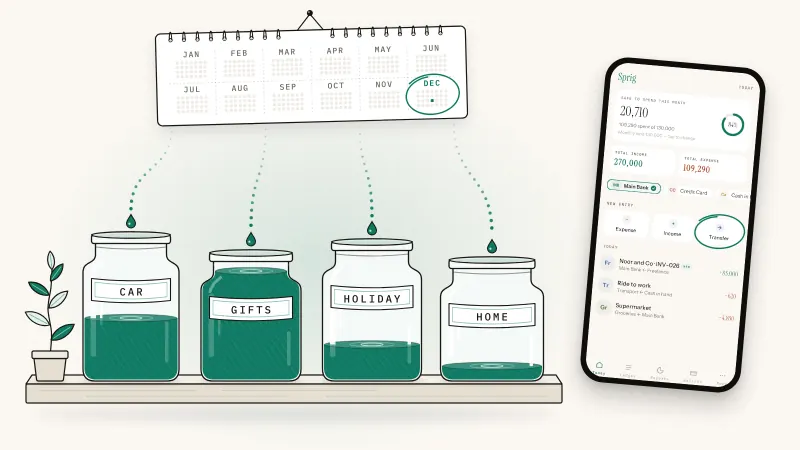
- Annual bills. Insurance and software renewals arrive in one lump; sinking funds turn them into monthly slices.
- Tax dates. Fixed, and often the year's biggest bills (calendar below).
- Growth. A bigger project can mean paying contractors or buying equipment weeks before the client pays you.
What should a 15-minute weekly cash flow review cover?
A weekly cash flow review covers five quick checks: your balances against the bank, money in and out this week compared with last, who owes you and what's overdue, the bills and tax due in the next four to eight weeks, and how much to move into your tax pot and buffer before you pay yourself.
This is our suggestion, not an official rule: pick one day, such as Friday afternoon, and keep it.
- Balances (2 minutes). Match each business account to your banking app; a gap usually means a missing or doubled entry. Monthly, reconcile each account against its statement.
- In and out (3 minutes). Compare this week with last and look for surprises.
- Owed to you (4 minutes). List unpaid invoices, oldest first, and chase anything overdue.
- The next four to eight weeks (3 minutes). Note bills, renewals and tax due, plus income dated by when each client usually pays.
- Move money (3 minutes). Tax pot first, then the buffer, then your pay. Size your tax share with our guides to how much to set aside for taxes in the US and how much tax to set aside in the UK.
A gap in step 4 gives you weeks to act instead of days: chase harder, delay a purchase, ask for a deposit or trim this month's draw.
How do you build a simple 12-month cash flow forecast?
List the money you expect in and out for each of the next 12 months, by the month it will reach or leave your bank, and keep a running total. That's Business.gov.uk's method: income, expenses and what's left at the end of each month, based on real results, with wiggle room.
- Start with today's balance across your business accounts.
- Money in goes in the month you'll be paid. Think about "when customers pay their bills, not when you issue invoices," says Business.gov.uk.
- Money out covers monthly costs, annual renewals, tax on its due date and your pay.
- Keep a running total, circle the lowest month, round costs up and roll the forecast forward each month.
| Month | Money in | Money out | Running total |
|---|---|---|---|
| Opening balance | £3,000 | ||
| Oct 2026 | £3,600 | £2,650 | £3,950 |
| Nov 2026 | £2,400 | £2,650 | £3,700 |
| Dec 2026: accountant £450 | £4,100 | £3,100 | £4,700 |
| Jan 2027: tax £2,350, software £360 | £1,800 | £5,360 | £1,140 |
| Feb 2027 | £3,000 | £2,650 | £1,490 |
| Mar 2027: insurance £240 | £3,900 | £2,890 | £2,500 |
January drops to £1,140 as a Self Assessment payment, a software renewal and a quiet month coincide. Spotted in October, that's easy to fix: hold back some pay in November and December. July's second tax payment will bring another dip. Tax figures are placeholders; US readers would mark January, April, June and September.
How big should your business cash buffer be?
No official rule sets the size of a business cash buffer. A practical starting point is one to two months of business costs, kept apart from your tax money. Hold more if one client dominates, clients pay slowly, income swings or big bills land together, and less if steady retainers cover your costs.
For example, business costs of $1,800 a month mean a buffer of $1,800 to $3,600; at £1,500, it's £1,500 to £3,000. Count what the business must pay in a month with no income, and add your draw if it should keep paying you too.
| Hold more if | Hold less if |
|---|---|
| One client brings in most of your income | Many smaller clients |
| Clients pay on 30- to 60-day terms | Deposits or payment on delivery |
| Big annual bills or tax payments land together | Small, monthly costs |
| Income swings month to month | Steady retainers |
Keep three pots: an operating account, a tax pot you leave alone until a tax date, and the buffer, topped up before your pay whenever you've used it. Your personal safety net is separate: here's how much emergency fund you need.
Seven ways to improve cash flow without borrowing
- Invoice the day you deliver. Payment terms usually run from the invoice date.
- Shorten terms and take deposits. Fourteen days instead of 30, or part up front on new projects.
- Move bill dates. The CFPB suggests changing some due dates so they "better match the times of the month when you receive income" (CFPB: Improving cash flow, 2020).
- Spread annual costs. Save monthly, so "when a large lump-sum payment is due the money is already saved," in the same tool's words.
- Trim subscriptions. Review them quarterly and cancel unused ones.
- Pay yourself a fixed amount on a fixed date, after the tax pot. Here's how to pay yourself from your business.
- Refill the buffer in good weeks. The CFPB suggests using "the weeks when you have more money available to move a little extra into savings."
UK
Selling to other businesses? With no agreed payment date, payment is late 30 days after the customer gets your invoice, or after delivery if later (GOV.UK), and you can usually claim statutory interest of 8% plus the Bank of England base rate unless your contract sets another rate (GOV.UK). The Commercial Payments Bill, which would cap terms at 60 days, was still in the House of Lords in October 2026 and isn't law yet (UK Parliament). More in our guide to chasing unpaid invoices.
US and UK tax dates to put on your cash flow calendar
Tax is often a freelancer's biggest bill, and it's due whether or not clients have paid. IRS Publication 334 calls federal income tax "a pay-as-you-go tax."
| Date | Where | What's due |
|---|---|---|
| 15 January 2027 | US | Last 2026 estimated payment (September to December) |
| 31 January 2027 | UK | What you still owe for 2025-26, plus your first 2026-27 payment on account, if due |
| 15 April 2027 | US | First 2027 payment (January to March) |
| 15 June 2027 | US | Second payment (April and May) |
| 31 July 2027 | UK | Second 2026-27 payment on account |
| 15 September 2027 | US | Third payment (June to August) |
US
The periods are uneven: January's payment covers four months, June's only two (IRS Publication 505). Due dates on a weekend or legal holiday move to the next business day. For amounts, see our guide to quarterly estimated taxes.
UK
31 January 2027 is a Sunday and 31 July 2027 a Saturday. For weekend deadlines, GOV.UK says payment must reach HMRC on the last working day before (Friday 29 January or Friday 30 July), unless you pay by Faster Payments or by debit or corporate credit card (GOV.UK). First bills can run high: GOV.UK's first-time example turns a £3,000 bill into £4,500 due by 31 January, because the first payment on account is due too (GOV.UK). Here's how payments on account work.
Both systems let you pay little and often: the IRS accepts weekly or monthly estimated payments as long as enough is paid by each due date (IRS), and HMRC's Budget Payment Plan takes weekly or monthly Direct Debits if you're up to date (GOV.UK). This is general information, not tax advice; rules change, so check IRS.gov, GOV.UK or a CPA or accountant.
How Sprig helps you run the weekly review
Sprig is a private, offline double-entry bookkeeping app for iPhone and Android, made by Secundum Reality. Set it up once:
- Switch to Side business under More → Books & currencies. Sprig opens on Personal after a restart, so check the book before each review.
- Add Business bank first as a Bank account (Wallets → Add an account), because invoices pay into the book's first wallet. Sprig doesn't connect to banks, so switch Auto-import off; left on, it only labels the wallet "syncing".
- Add Tax pot and Buffer as Savings wallets. Leave the currency as it is so every wallet matches; amounts are plain numbers.
- Log as you go: pick Business bank on Today's wallet strip, then four taps and the amount. Each entry is dated the day you log it.
Then, each week:
- Reports → Week shows Money in and Money out, Monday to Sunday, and compares spending with the week before; on a Friday, tap ‹ for the last full week.
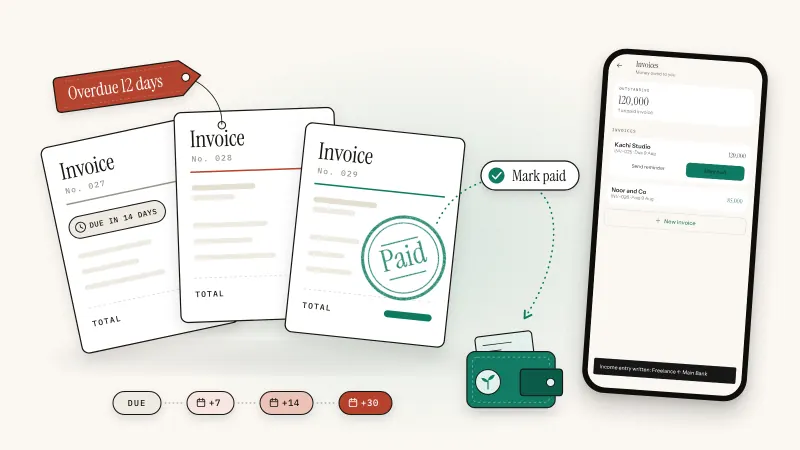
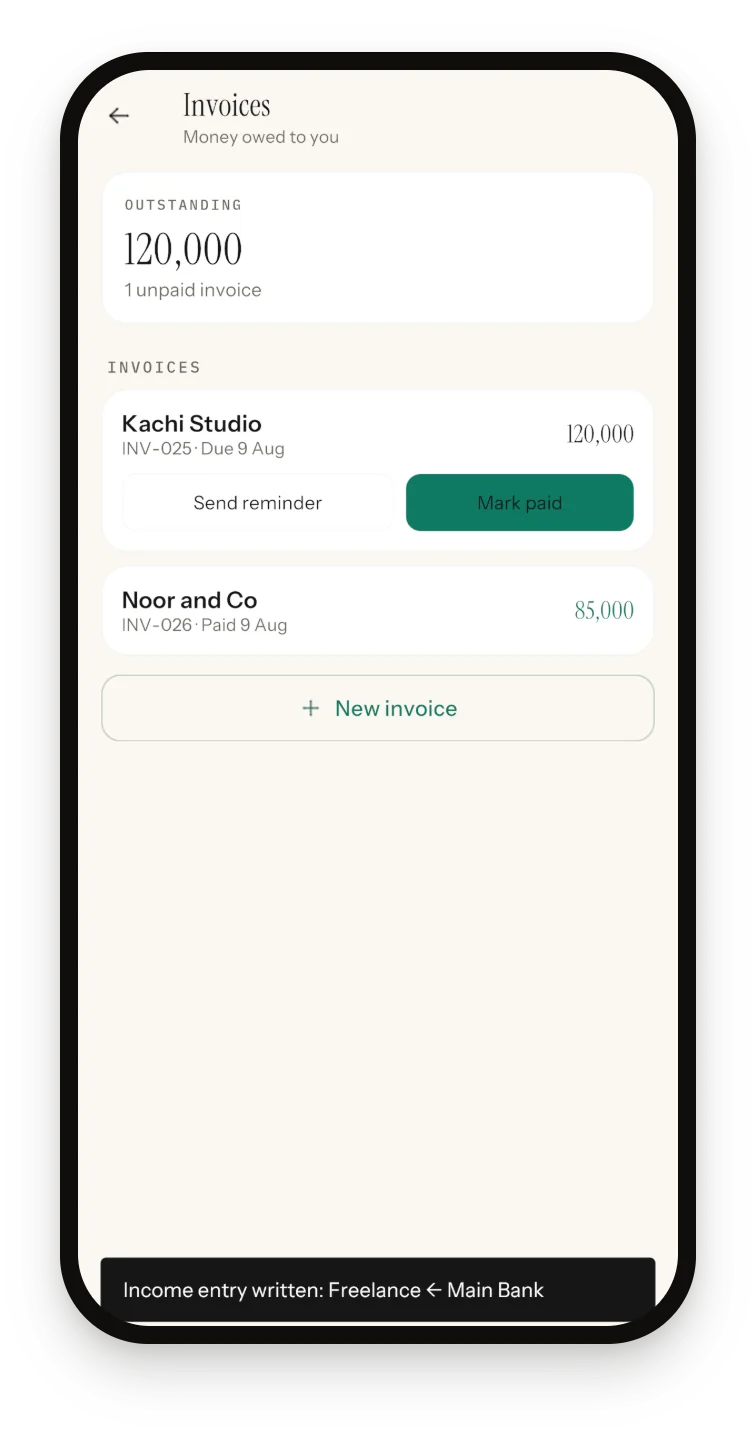
- More → Invoices: enter the client and amount, and Sprig numbers the invoice and sets it due in 14 days. Overdue ones turn red under the Outstanding total. Tap Mark paid the day the money lands, and Sprig writes the income entry into Business bank.
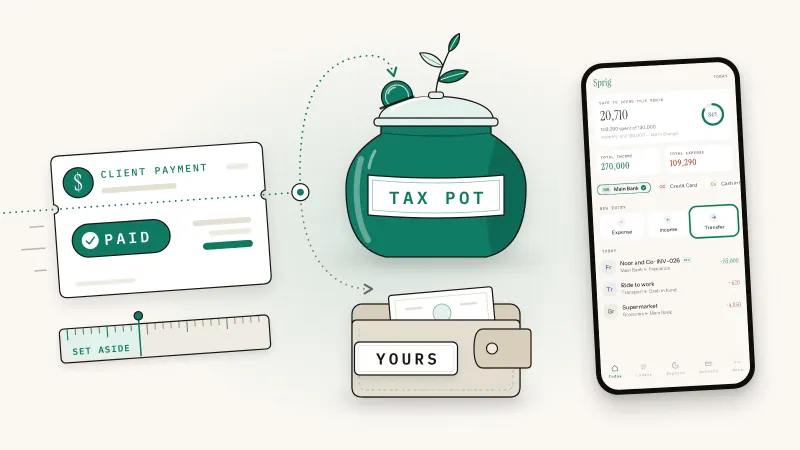
- Transfer your tax share and buffer top-up. Transfers never count as income or spending, and the Wallets tab shows each balance.
- Tax payments go in as an expense from Tax pot, in a category you create; count them for cash flow, not profit.
How Sprig helps
The numbers for the Friday check, in one book.
- Private: no account, no bank login, no cloud. Your books stay on your phone.
- Pots that can't drift: each transfer records both sides, like
Business bank → Tax pot, and balances move only through entries.
What Sprig won't do
- Forecast. The 12-month view lives in your spreadsheet; More → Export → Everything gives you the open book as a CSV to start it.
- Bank sync, reminders or scheduled bills. There's no bank feed and no notifications, and you can't create recurring rules.
- Flexible invoices. You can't edit an invoice or its 14-day due date, and "Send reminder" only marks it "Reminder sent"; it sends nothing.
- Backdating. For older entries, import a CSV with dates written YYYY-MM-DD.
Every feature is free for 50 entries, plus 20 per optional ad (up to four a day); each transfer or Mark paid uses one. Yearly Sprig Premium removes the limit and the ads (US$9.99 or £9.99 on the App Store; your store shows the local price). See the full Sprig bookkeeping app.
Sprig for iPhone and Android
Keep your books in four taps.
Private, offline double-entry bookkeeping. No account, no bank login, no cloud. Free to start with 50 entries.
Frequently asked questions
What is the difference between cash flow and profit?
Profit is income minus business expenses for a period; cash flow is when money actually enters and leaves your accounts. They split when clients pay weeks after the work, when big bills are paid up front, and when your pay or income tax leaves the bank, since neither is a business expense.
How often should a freelancer check cash flow?
We suggest 15 minutes once a week, on the same day: compare money in and out, chase overdue invoices, list the bills and tax due in the next four to eight weeks, and top up your tax pot and buffer. Reconcile monthly and roll your 12-month forecast forward.
How do I forecast cash flow when my income is irregular?
Forecast by the month money will reach your bank, not the month you invoice. Use a cautious income figure, such as your lowest recent month, so a good month tops up the buffer instead of being spent in advance, and leave wiggle room as Business.gov.uk advises.
How much cash should a small business keep in reserve?
No official rule sets a number. A practical start is one to two months of business costs, kept apart from tax money and your personal emergency fund. Hold more if one client dominates, clients pay slowly or income swings; less if steady retainers cover your costs.
Should a freelancer use cash basis or accrual accounting?
Cash accounting is the common choice. GOV.UK calls cash basis the standard for UK sole traders, and IRS Publication 334 says most individuals and many sole proprietors with no inventory use the cash method, which the SBA says shows cash flow clearly. Ask your accountant if you hold stock or need accounts for a loan.
Sources and further reading
- CFPB: An essential guide to building an emergency fund (manage your cash flow)
- CFPB: Improving cash flow, Your Money, Your Goals toolkit (2020)
- Business.gov.uk: Preparing for funding applications, prepare a cash flow forecast
- SBA: Manage your finances
- IRS Publication 505 (2026): Tax Withholding and Estimated Tax
- GOV.UK: Pay your Self Assessment tax bill
Published 3 October 2026. Feature details were checked against Sprig 1.1 for iPhone and Android. This article is general information, not tax or legal advice; rules differ by country, so confirm anything you file with your accountant or tax authority.