Pakistan tax
Business Tax in Pakistan for Sole Proprietors and Small Businesses
In Pakistan, your shop or one-person firm doesn't file its own return; you do. Here is how business income is taxed in tax years 2026 and 2027.
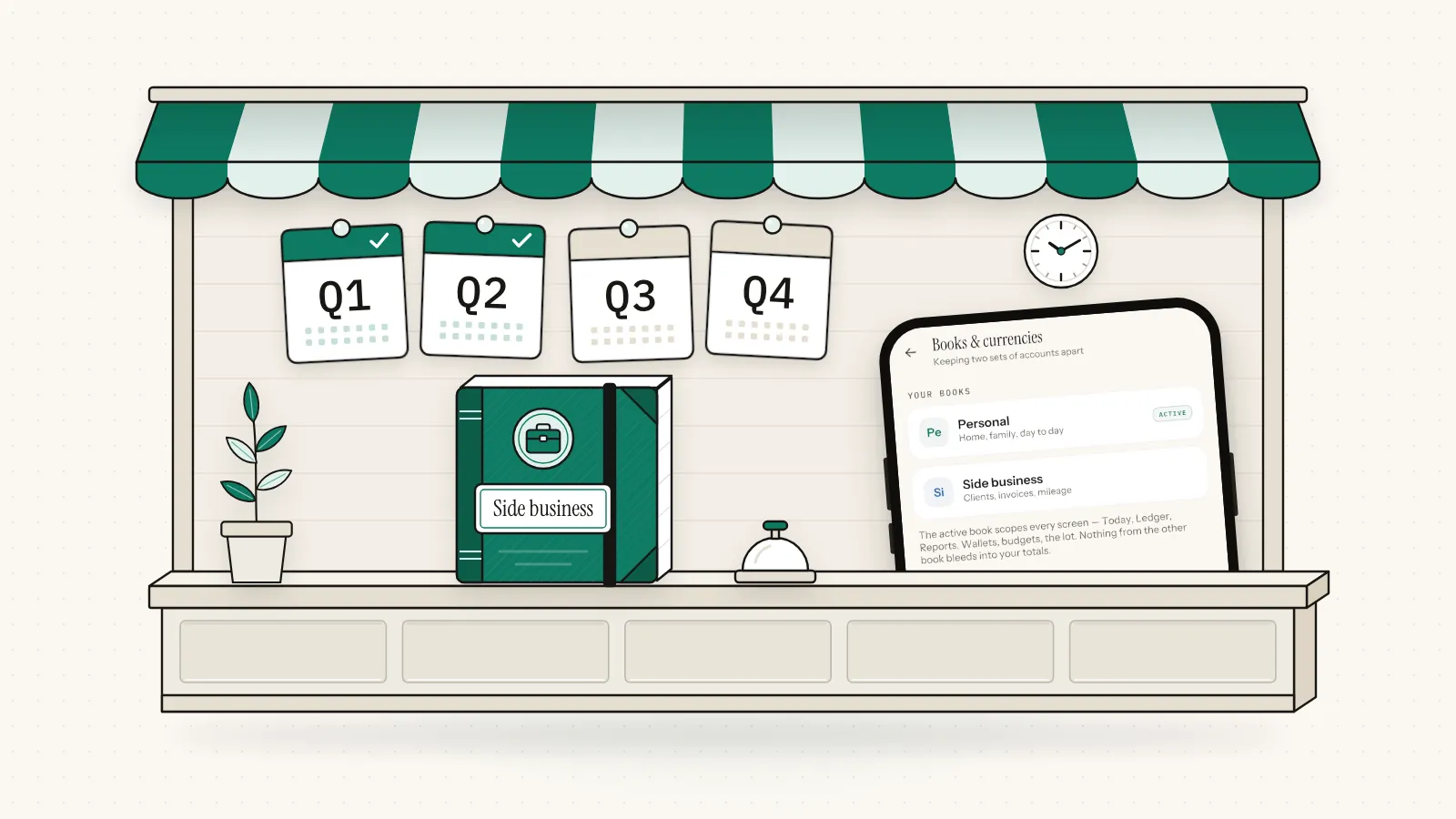
Run a shop, clinic, home kitchen or online store on your own, and its profit goes on your own income tax return. One habit makes the rest easier: keep business money in the bank, and keep it in the books.
| Topic | The rule | Law |
|---|---|---|
| Return due | 30 September; 15 October 2026 for tax year 2026 | s.118(3); FBR Circular No. 3 of 2026-27 |
| Bank account | Declare the one your business uses | s.114A |
| Advance tax | Quarterly once assessed income reaches Rs 1 million | s.147 |
| Cash payments | Not deductible under an account head that tops Rs 250,000 | s.21(l) |
| Cash receipts | Over Rs 200,000 on one invoice: half the related costs disallowed | s.21(s) |
| Records | Six years after the tax year ends | s.174(3) |
Not tax advice: rules change every June with the Finance Act, so confirm your figures with FBR or a registered tax practitioner.
How does business tax in Pakistan work for sole proprietors?
A sole proprietorship isn't a separate taxpayer. Its profit is "income from business" under section 18 of the Income Tax Ordinance, 2001, taxed with your other income on your own return at non-salaried rates. For tax years 2026 and 2027, the first Rs 600,000 of taxable income is tax-free; rates then climb from 15% to 45%.
| Taxable income (Rs) | Fixed tax (Rs) | Rate on income above the band's floor |
|---|---|---|
| Up to 600,000 | 0 | 0% |
| 600,001 to 1,200,000 | 0 | 15% |
| 1,200,001 to 1,600,000 | 90,000 | 20% |
| 1,600,001 to 3,200,000 | 170,000 | 30% |
| 3,200,001 to 5,600,000 | 650,000 | 40% |
| Above 5,600,000 | 1,610,000 | 45% |
For example, taxable profit of Rs 2,400,000 means Rs 170,000 + 30% of Rs 800,000 = Rs 410,000 in tax, before credit for tax already deducted. The lower salaried table applies only if salary exceeds 75% of taxable income.
- Above Rs 10 million of taxable income, add a 10% surcharge on the tax (section 4AB), which FBR's Circular No. 2 of 2026-27 confirms for non-salaried taxpayers.
- Turnover of Rs 100 million or more in any tax year since 2017 brings in minimum tax (section 113): generally 1.25% of turnover when normal tax comes out lower.
- A partnership firm is an association of persons (section 80): it files its own return on this table, and each member files a wealth statement with it.
What registration does a small business need?
Register on IRIS, where an individual's CNIC is the NTN (section 181(4)). Add your business name, address and main activity to your profile, declare the bank account you use for business (section 114A), and display your NTN at every place of business (section 181C).
Online sellers must register too: marketplaces and couriers may not serve unregistered vendors (section 181(1A)). Section 114A doesn't require a new account, but section 21(l) looks for payments from your declared business account (section 2(10A)), so a dedicated one pays off. See how to separate business and personal finances.
You must file if taxable income tops Rs 600,000, and at any income if you hold an NTN, are registered with a chamber, trade association or market committee, or pay a commercial electricity bill above Rs 500,000 a year (section 114(1)). Business income between Rs 300,000 and Rs 400,000 also triggers filing (section 114(1A)).
Which business costs can you deduct?
Admissible business expenses are those incurred "wholly and exclusively for the purposes of business" (section 20). Section 21 blocks personal spending, fines, income tax and capital costs, which are depreciated instead, and trims deductions when large sums move in cash. Without a receipt or other record, a claim can be disallowed (section 174(2)).
| Situation | What happens | Law |
|---|---|---|
| Paying suppliers in cash | Over Rs 250,000 under one account head, payments not made by crossed cheque, draft, pay order, transfer between business accounts or credit card aren't deductible. Exempt: items up to Rs 25,000, utilities, freight, travel fares, postage, taxes | s.21(l) |
| Paying wages in cash | Salary above Rs 32,000 a month must go by crossed cheque, bank transfer or digital means to be deductible | s.21(m) |
| Buying from suppliers without an NTN | 10% of the related expense is disallowed (for farm produce, only purchases from middlemen); FBR can exempt some buyers | s.21(q), Finance Act 2025 |
| Selling for cash | More than Rs 200,000 received against one invoice outside banking or digital channels: half the expenses claimed for that sale are disallowed. A buyer's cash deposited against your invoice straight into your bank account counts as banking, per FBR Circular No. 1 of 2025-26 | s.21(s), Finance Act 2025 |
Mixed personal and business costs
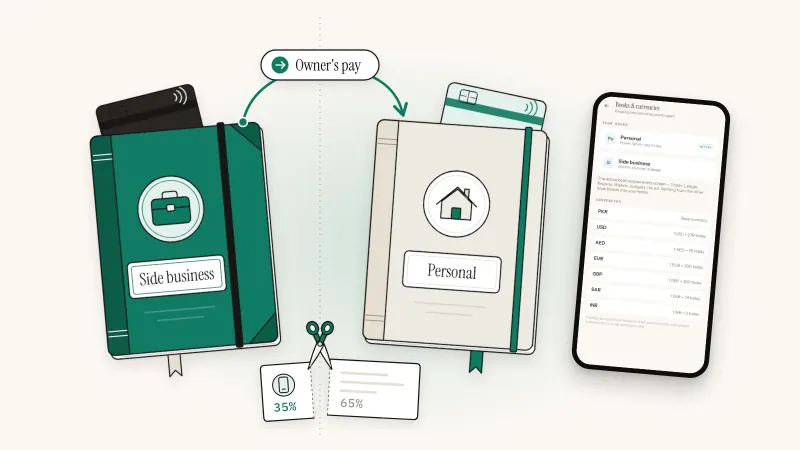
When a cost serves both the business and your household, section 67 says to apportion it "on any reasonable basis". If a Rs 6,000 phone bill is one-third work calls, for example, claim Rs 2,000 and note why. A part-business car works the same way, depreciation included (section 22(3)); with no per-kilometer rate in the Ordinance, keep a trip log. More in the self-employed tax deductions checklist.
Do you have to pay advance tax?
Only if your latest assessed taxable income, leaving out salary and final-tax income, was Rs 1 million or more. Advance tax under section 147 is then a quarter of your last assessed tax, minus creditable tax deducted or collected that quarter (other than salary tax), due by 15 September, 15 December, 15 March and 15 June.
For example, if your tax year 2026 return assesses tax of Rs 240,000, a quarter is Rs 60,000. If customers deducted Rs 15,000 from payments to you between October and December, you pay Rs 45,000 by 15 December 2026, through a PSID on IRIS.
- Miss one and default surcharge runs at 12% a year on the unpaid amount until you pay or the return falls due, whichever is earlier (section 205(1A)).
- Expect a smaller bill? Before the last installment, file an estimate with the Commissioner, backed by turnover for completed quarters and evidence of expenses, and pay on that (section 147(6) and (6B)). It can be rejected, and paying under 90% of the year's tax adds default surcharge from 1 April (section 205(1B)).
- AOPs pay by 25 September, 25 December, 25 March and 15 June.
What are the key tax dates for a small business?
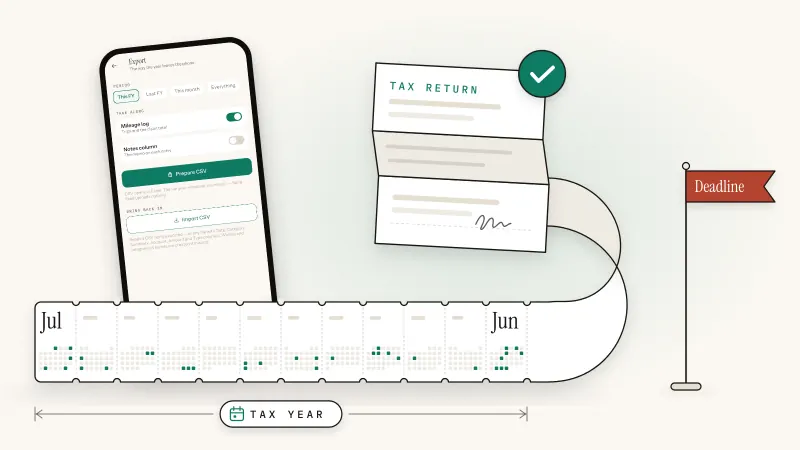
For tax year 2027 (1 July 2026 to 30 June 2027), an individual who owes advance tax pays it by 15 September, 15 December, 15 March and 15 June, and files by 30 September 2027 unless FBR extends it. For tax year 2026, the Federal Board of Revenue extended the return deadline to 15 October 2026.
| Date | What's due |
|---|---|
| 15 September 2026 | Advance tax, first quarter of tax year 2027 |
| 15 October 2026 | Tax year 2026 return and wealth statement (extended) |
| 15 December 2026 | Advance tax, second quarter |
| 15 March 2027 | Advance tax, third quarter |
| 15 June 2027 | Advance tax, fourth quarter |
| 30 September 2027 | Tax year 2027 return, unless extended |
What about tax your customers deduct?
Companies, the Federal Government, non-profits and some larger businesses must deduct income tax when they pay you for goods, services or contracts (section 153). On FBR's tax year 2027 rate card, most goods sold by an individual on the Active Taxpayers' List carry 5.5%, doubled if you're not on it. Keep each certificate and claim the tax.
Deducted tax comes in three types:
- Adjustable
- Credited against your year's tax; any excess is refunded.
- Minimum
- Your tax on that income can't fall below it. Section 153 deductions from individuals are minimum tax (section 153(3)).
- Final
- Settles the tax on that income; no credit or refund (section 168(3)).
Selling online inside Pakistan? Since 1 July 2025, section 6A taxes payments for goods and services ordered through local marketplaces or websites at 1% if paid digitally or 2% cash on delivery, collected by the payment intermediary or courier. It's final tax (section 8); from tax year 2027 it's adjustable for sellers above Rs 200 million of turnover, and smaller sellers may opt out when filing (section 6A(3)).
Check IRIS's withholding summary against your certificates; FBR calls it indicative. See withholding tax in Pakistan.
What records must you keep, and for how long?
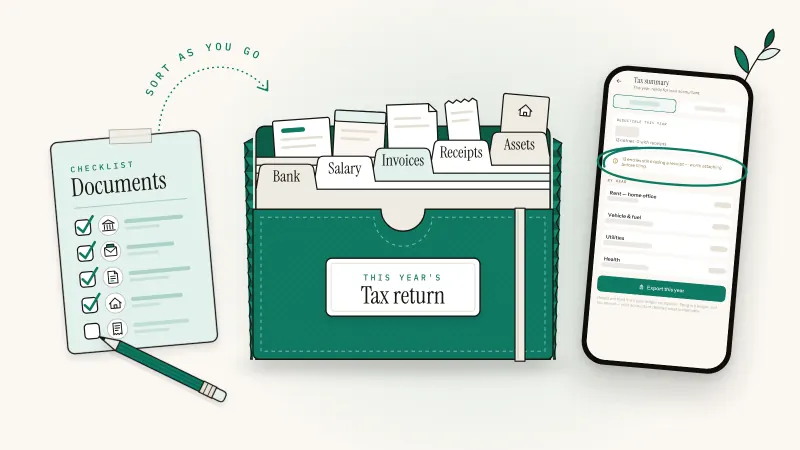
Keep the books the Income Tax Rules, 2002 prescribe, in Pakistan, for six years after the tax year ends, and longer while a case is open (section 174 and rule 29). Rule 32 allows electronic records if "sufficient steps" keep them safe, and rule 30 sets minimum books by type of business.
| Your business | Minimum records |
|---|---|
| Business income up to Rs 500,000, or a new business | Numbered, dated cash memos or invoices for each sale, showing your NTN or CNIC; a daily record of receipts and payments; purchase and expense vouchers |
| Above Rs 500,000; wholesalers, distributors, dealers | The above, plus a cash or bank book, a ledger or annual summary, payee details on vouchers above Rs 10,000, and a quarterly stock count for goods |
| Professionals such as doctors, lawyers and engineers | Numbered invoices with client names and addresses, an appointment diary, a daily record and vouchers |
Not issuing a required cash memo or invoice costs Rs 5,000 or 3% of the tax involved, whichever is higher (section 182). Books can be on a cash or accrual basis (sections 32 to 34); switching later needs the Commissioner's approval. Next: tracking unpaid invoices, how long to keep business records and organizing receipts for taxes.
How do you file the business part of the return?
Business individuals file the same electronic return on IRIS as everyone else. In the tax year 2026 return, pick business among your income sources, enter the year's business figures, claim the tax already deducted, and complete the wealth statement, which must reconcile. Pay any balance against a PSID before you submit, by 15 October 2026.
The return also asks you to declare the records you keep (section 114(2)(b)); manufacturers with turnover up to Rs 250 million have a simplified SME return. Step by step: how to file your income tax return in Pakistan, the documents required for an income tax return and, if a practitioner files for you, preparing your books for your accountant.
Small shopkeepers
If you run one retail shop with turnover up to Rs 200 million, SRO 1166(I)/2026 offers an optional procedure for tax year 2026: 1% of gross turnover, at least Rs 25,000 paid in cash with a simplified return, and no refund of excess withholding. Jewelry sellers, Tier-1 retailers, multi-shop owners and professionals are excluded. On 29 September 2026, FBR said the scheme is in its initial implementation stages.
Running the books in Sprig
Sprig is a private, offline double-entry bookkeeping app for iPhone and Android, made by Secundum Reality. Its tax summary follows Pakistan's July–June tax year. It has no account, no bank link and no cloud, and it doesn't calculate tax or file returns.
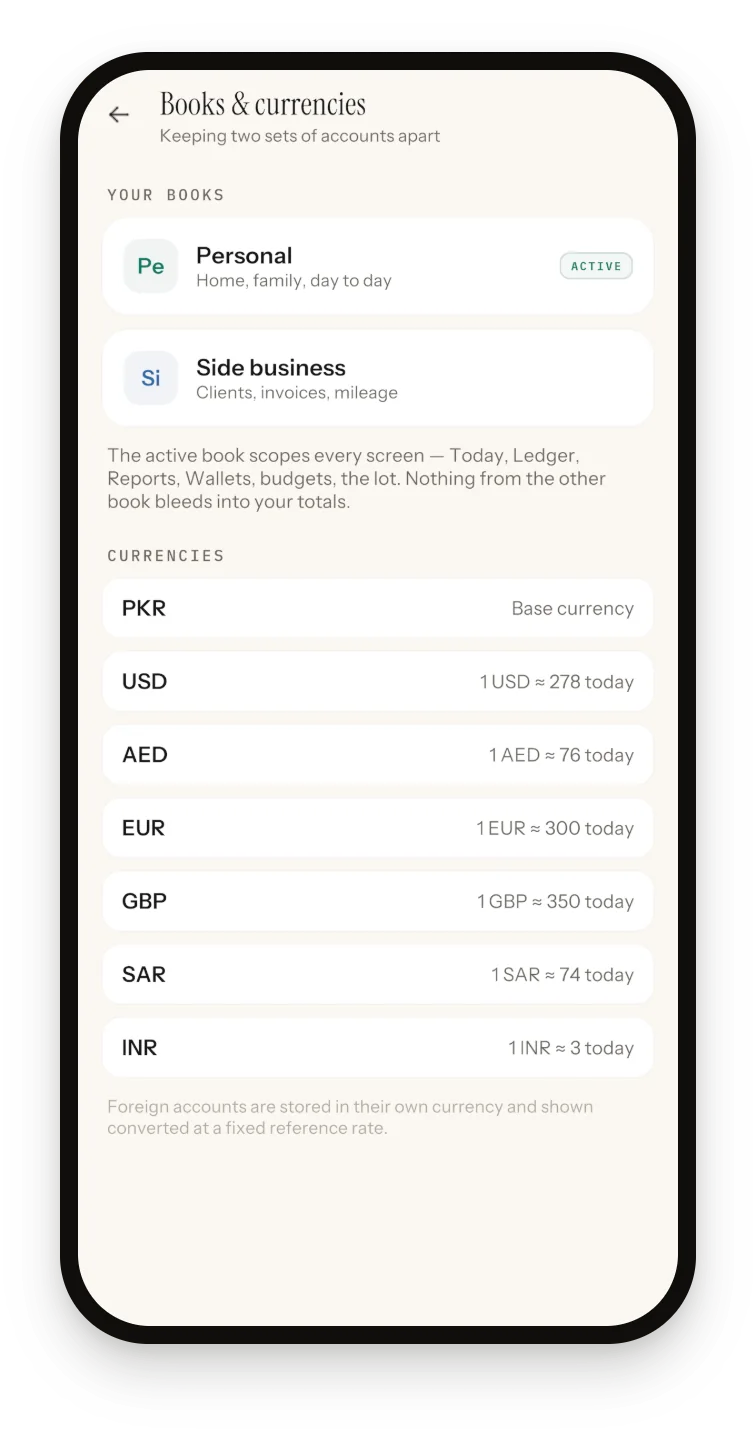
- Open Side business. Switch in More, then Books & currencies; on the Wallets tab, add your declared bank account and the till cash.
- Add your categories, such as Stock purchases, Shop rent or Wages paid, so entries read like
Stock purchases ← Business Bank. Log installments as Advance tax paid and leave them out of profit. - Check each quarter. A Reports custom range, such as 1 October to 31 December, gives money in and out by category; Sprig doesn't work out advance tax.
How Sprig helps
Side business stays apart from household money, with real double entry underneath.
- Invoices for credit sales: overdue ones turn red, and Mark paid writes the income entry.
- Receipts: photograph a bill, add type, category and amount, and it becomes an entry dated with the photo's date.
- CSV export for This FY or Last FY; in October 2026, Last FY is tax year 2026.
The honest limits: no inventory, payroll, sales tax, profit and loss statement, balance sheet or bank feed. Invoice numbers track what you're owed, not the cash memos rule 30 requires, and Mark paid files the money as Freelance income. Typed entries take today's date; rebuild a past year by CSV import. Receipt photos stay on the phone, outside the CSV and encrypted backup, so keep copies. The tax summary's heads and 45-per-km mileage value are Sprig's own, not FBR rules. Free for 50 entries, plus 20 per optional ad (up to four a day); yearly Premium removes the limit. See the offline bookkeeping app.
Sprig for iPhone and Android
Keep your books in four taps.
Private, offline double-entry bookkeeping. No account, no bank login, no cloud. Free to start with 50 entries.
Frequently asked questions
Do I need a separate business bank account in Pakistan?
You must declare to FBR the bank account you use for business, through your registration form (section 114A of the Income Tax Ordinance). It needn't be a new account, but the cash-payment rule in section 21(l) is written around payments from that declared account, so a dedicated account makes deductions easier to prove.
Can I claim business expenses I paid in cash?
Under section 21(l), if payments under one account head add up to more than Rs 250,000, those made in cash rather than by crossed cheque, draft, pay order, transfer between business accounts or credit card aren't deductible. Items of Rs 25,000 or less are exempt, as are utility bills, freight, travel fares, postage and taxes.
Is sales tax part of my income tax return?
No. Sales tax has its own registration and returns: goods fall under the federal Sales Tax Act, 1990, and most services under provincial laws such as the Punjab Sales Tax on Services Act, 2012. Sales tax you charge isn't your income, and turnover for minimum tax under section 113 excludes it. Ask a practitioner which regime applies.
What happens if I miss an advance tax installment?
Default surcharge runs at 12% a year on the unpaid amount, from the due date until you pay or the year's return falls due, whichever is earlier (section 205(1A) of the Income Tax Ordinance). So pay as soon as you can: the surcharge stops on the day you do.
Can Sprig prepare my profit and loss statement or balance sheet?
No. Sprig records each business entry with both sides and totals money in and out by category for any period, the raw material for those statements, but it produces no profit and loss statement, balance sheet, inventory or payroll, and it doesn't calculate tax.
Sources and further reading
- FBR: Income Tax Ordinance, 2001, amended up to 30 June 2026
- FBR: Income Tax Rules, 2002, amended up to 15 September 2026
- FBR Circular No. 3 of 2026-27: extension of the tax year 2026 return date
- FBR Circular No. 1 of 2025-26: Finance Act 2025, explanation of amendments
- FBR SRO 1166(I)/2026: Special Procedure for Small Shopkeepers
- FBR Withholding Tax Rate Card for tax year 2027
Published 3 October 2026. Feature details were checked against Sprig 1.1 for iPhone and Android. This article is general information, not tax or legal advice; rules differ by country, so confirm anything you file with your accountant or tax authority.