Pakistan tax
Income Tax Return for Salaried Persons in Pakistan: Step by Step
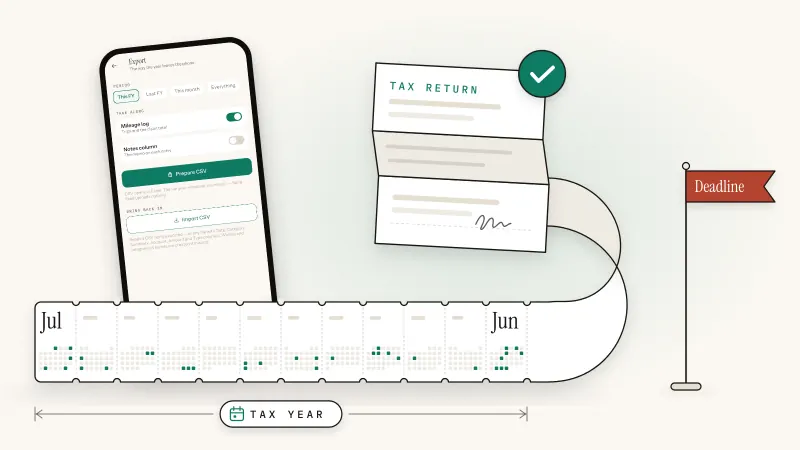
Your employer deducts the tax, but only you can file the return, list what you own and total what your household spent. Here's how, before the 15 October 2026 deadline.
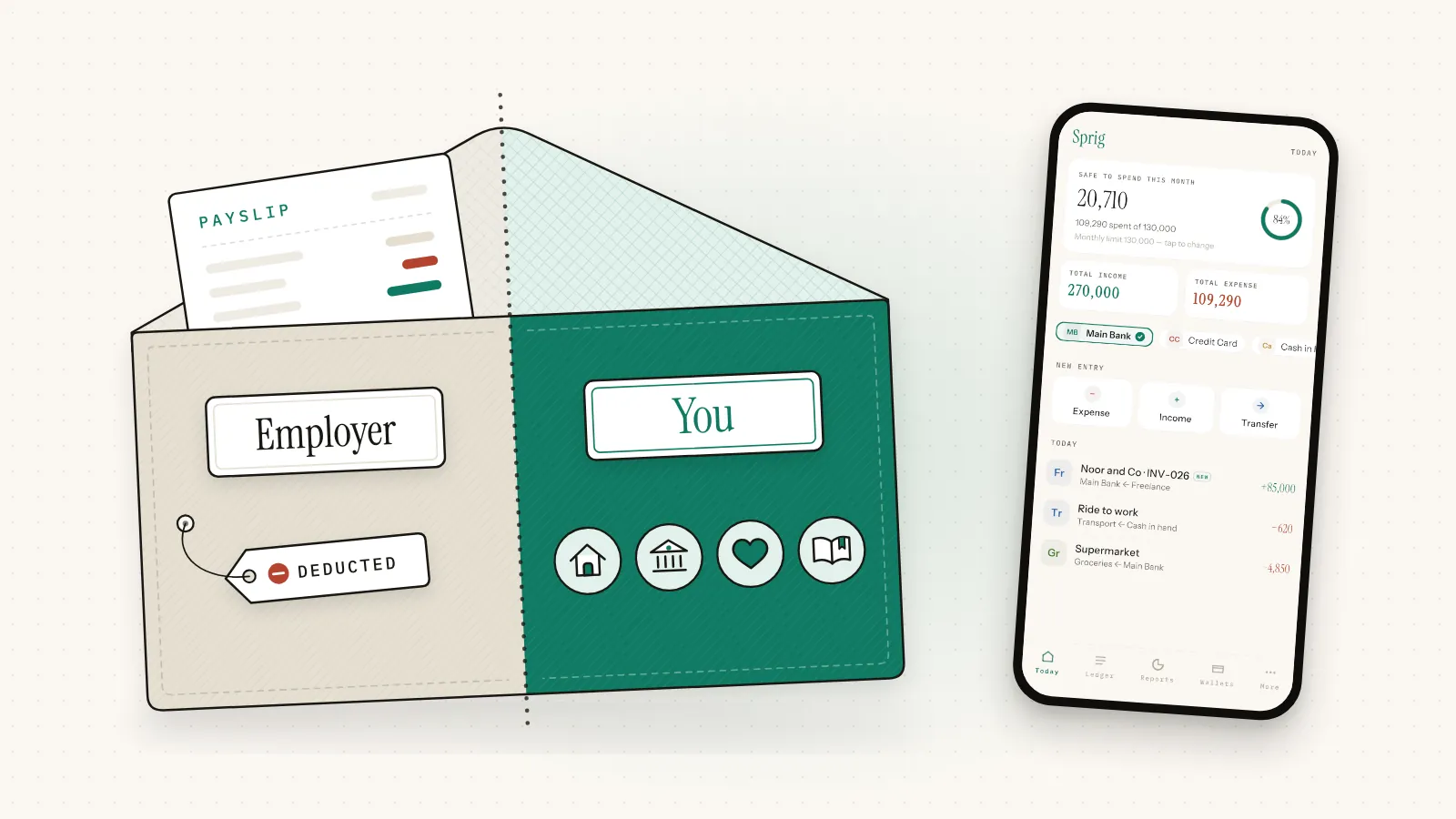
If you're salaried in Pakistan, your employer has done half of your tax return: each month it deducts tax at your average rate under section 149 of the Income Tax Ordinance, 2001, and pays it to the Federal Board of Revenue (FBR). It can't file the return, list what you own or add up what your household spent. That half is yours.
| Question | Answer | Law |
|---|---|---|
| Year being filed | Tax year 2026: 1 July 2025 to 30 June 2026 | Section 74 |
| Deadline | 15 October 2026 (30 September by law) | Section 118(3); Circular No. 3 of 2026-27 |
| How | Electronically, on IRIS or FBR's Tax Asaan app | Sections 114(2A), 118(2A) |
| Wealth statement | Required with every resident individual's return | Section 116(2) |
| Filing late | Minimum penalty Rs 10,000 if 75% or more of income is salary; off the Active Taxpayers' List unless you pay a surcharge or give a property undertaking | Sections 182, 182A |
For tax year 2026, the Federal Board of Revenue extended the return deadline to 15 October 2026 (FBR Circular No. 3 of 2026-27, 30 September 2026). This is general information, not tax advice; rules change every June with the Finance Act, so confirm with FBR or a registered tax practitioner.
Is an income tax return compulsory for a salaried person in Pakistan?
Usually, yes. You must file for tax year 2026 if your taxable income is above Rs 600,000 or another trigger applies, such as holding an NTN, owning a car above 1000cc or earning bank profit. Tax deducted from your salary pays the tax, but it doesn't file the return or put you on the Active Taxpayers' List.
For employees, the usual section 114 triggers are:
- Taxable income above Rs 600,000 (Rs 50,000 a month), the top of the 0% band (section 114(1)(ab)).
- An NTN. Once you have one, you file every year; for individuals who register, the CNIC number is the NTN (sections 114(1)(b)(vii), 181(4)).
- A car above 1000cc, or property of 500 square yards or more or a flat in the listed areas, unless you're a widow, an orphan under 25 or disabled (sections 114(1)(b), 115(3)).
- Bank profit or dividends. Income taxed as a final tax, such as bank profit under section 7B, also means you must file (section 114(1)(ae)).
Filing on time also puts you on the Active Taxpayers' List (ATL). Off it, many deductions double under the Tenth Schedule; banks take 40% of deposit profit instead of 20% in tax years 2026 and 2027. Salary isn't affected (rule 10). Compare rates in withholding tax in Pakistan, and see what late filing costs.
What does your salary certificate cover, and what's left to you?
Your employer's certificate covers the salary side: what you were paid, including allowances and bonuses, and the tax deducted under section 149. It doesn't show bank profit, rent or freelance income, tax collected on phone bills or your car, or the assets and household spending your wealth statement needs.
| Figure | Who has it | Document |
|---|---|---|
| Salary, allowances and bonus | Employer | Salary certificate |
| Tax deducted from salary | Employer | Same certificate, with payment receipt copies (section 164) |
| Bank profit and tax deducted | Bank | Tax deduction certificate |
| Balances on 30 June | Bank | Account statements |
| Tax on phone bills, car registration or token | Telecom company, excise office | Bills and receipts |
| Other income, credits, assets, household spending | Only you | Your records and last year's wealth statement |
Check that the certificate covers July 2025 to June 2026, bonus and arrears included, and matches your payslips; two employers means two certificates. Then compare it with the withholding summary your IRIS return opens with, which FBR calls indicative, and ask HR for the payment receipts if anything is missing. Claim only what was deposited: since 1 July 2026, over-claiming carries a penalty equal to the excess (section 182, entry 36).
Which salary tax slabs apply to your return?
Your tax year 2026 return uses the Finance Act 2025 slabs: 0% up to Rs 600,000 of taxable income, rising through 1%, 11%, 23% and 30% to 35% above Rs 4.1 million. Above Rs 10 million, a 9% surcharge is added to the whole tax. Tax year 2027 cuts the middle rates and has no salaried surcharge.
| Taxable income | Tax year 2026 (your return) | Tax year 2027 (deducted since July 2026) |
|---|---|---|
| Up to 600,000 | 0% | 0% |
| 600,001 to 1,200,000 | 1% | 1% |
| 1,200,001 to 2,200,000 | 6,000 + 11% | 6,000 + 11% |
| 2,200,001 to 3,200,000 | 116,000 + 23% | 116,000 + 20% |
| 3,200,001 to 4,100,000 | 346,000 + 30% | 316,000 + 25% |
| 4,100,001 to 5,600,000 | 616,000 + 35% of the amount over 4,100,000 | 541,000 + 29% |
| 5,600,001 to 7,000,000 | 976,000 + 32% | |
| Above 7,000,000 | 1,424,000 + 35% | |
| Taxable income above 10,000,000 | Plus a surcharge of 9% of the whole tax | No surcharge for salaried individuals |
Sources: the Ordinance as amended to 31 July 2025 (tax year 2026) and FBR's rate cards for tax year 2026 and tax year 2027; the surcharge is section 4AB. These slabs apply only while salary is more than 75% of taxable income (see side income).
| Taxable salary | Tax year 2026 | Tax year 2027 |
|---|---|---|
| 1,800,000 (150,000 a month) | 72,000 | 72,000 |
| 3,600,000 (300,000 a month) | 466,000 | 416,000 |
| 12,000,000 (1 million a month) | 3,685,290, with surcharge | 3,174,000 |
How do you file a salaried return on IRIS?
Log in to IRIS with your CNIC, open the tax year 2026 return, choose Salary as an income source and copy in your salary certificate. Add other income, tax already deducted and your credits, complete the wealth statement until it reconciles, pay any balance and submit by 15 October 2026.
- Log in at iris.fbr.gov.pk with your CNIC as the registration number; first-timers register online first, with a SIM registered to their own CNIC and a personal email.
- Open the tax year 2026 return and choose Salary as an income source.
- Copy in the certificate, entering the section 149 deduction as tax paid.
- Add other income, other tax withheld and credits.
- Reconcile the wealth statement, pay any balance against a payment slip ID (PSID), and submit.
What about Declaration form 114(I)? FBR's filing help page still describes it for people whose income is only salary and other sources, with salary more than 50% of it. It isn't confirmed that IRIS 2.0 offers it for tax year 2026, so if you don't see it, use the regular individual return; our guide on how to file your income tax return in Pakistan walks through it. Its 50% test isn't the 75% test for salaried rates.
Can you file on the Tax Asaan app?
Yes. Tax Asaan is FBR's mobile app, and its Google Play listing, updated on 30 September 2026, still offers wizard-based return filing for salaried people. It suits a straightforward salaried return; with business income, foreign assets or a tangled wealth statement, IRIS on a computer is easier to check.
FBR's FAQ for the app dates from August 2020, when the app filed only tax year 2019 returns. It says the app takes your IRIS login, any IRIS draft should be deleted before filing there, app-filed returns are revised on IRIS, and PSIDs can be created in the app.
How do you fill the wealth statement as an employee?
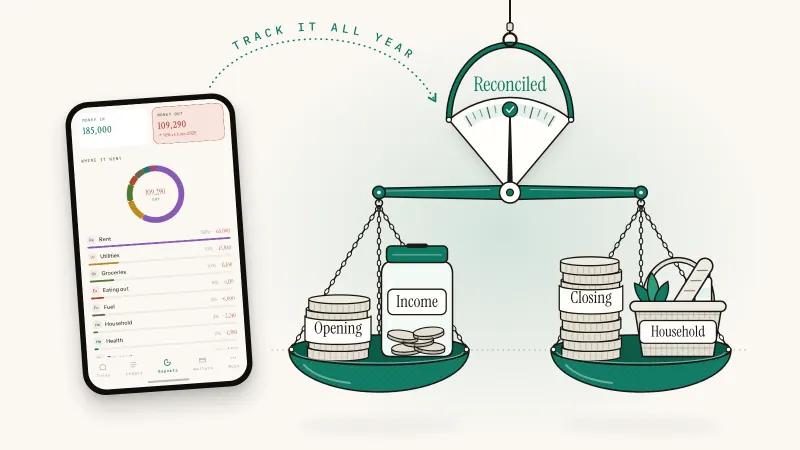
List what you, your dependent spouse, your minor children and other dependents owned and owed on 30 June 2026, starting from last year's closing figures, and add the household's spending for the year. IRIS accepts it only when the change in your net assets equals what came in, mainly income, minus what went out.
Section 116 requires it from every resident individual who files, and it covers foreign assets and liabilities too.
Household spending is the main outflow and the figure most employees guess; a bad guess leaves an unreconciled amount. FBR's 2019 form split it into heads such as rent, electricity, gas, water, telephone, vehicle running, travel, medical and education; check the tax year 2026 labels on IRIS. See our guide to the wealth statement and how to make it reconcile.
What if you also freelance, rent out a room or earn bank profit?
Declare it in the same return, under its own head. Side income taxed at normal rates, such as rent or work for local clients, can also change your rate table, because the salaried slabs apply only while salary is more than 75% of taxable income. At 75% or less, the higher non-salaried table applies to all of it.
For example, on Rs 2,400,000 of taxable income in tax year 2026, the tax is Rs 162,000 if more than 75% is salary, but Rs 410,000 on the non-salaried table, which is the same in tax years 2026 and 2027.
- Rent and work for local clients are taxed at normal rates (rent as income from property, section 15), so they count toward the 75% test.
- Work for clients abroad: banks deduct 0.25% of IT and IT-enabled export proceeds if you're PSEB-registered, or 1% otherwise (section 154A), final only if conditions are met. See freelancer tax in Pakistan.
- Bank profit up to Rs 5 million is taxed separately under section 7B as a final tax kept out of taxable income (section 8), so it doesn't affect the test.
Keep side money out of your salary account; here's why side income belongs in its own book.
Can a salaried person pay less tax or get some back?
Yes, within the law. Contributions to an approved Voluntary Pension System fund (section 63) and donations to eligible institutions (section 61) earn tax credits, while Zakat (section 60) and, below Rs 1.5 million of taxable income, children's tuition fees (section 60D) are deducted from income. Tax deducted beyond what you owe is refundable.
| Item | What counts | Law |
|---|---|---|
| Pension (VPS) contributions | Credit on the lower of the amount paid or 20% of taxable income | Section 63 |
| Donations | Credit on the lower of the amount given or 30% of taxable income; money counts only if paid by crossed cheque | Section 61 |
| Zakat | Deducted from income; any unused part is lost | Section 60 |
| Tuition fees | Below Rs 1.5 million of taxable income: the lowest of 5% of fees, 25% of taxable income or Rs 60,000 per child | Section 60D |
A credit is worth your average tax rate times the amount that counts. Pension and donation credits, and tax withheld from you elsewhere, can reduce your monthly deduction once HR has the evidence (section 149(1)); the tuition allowance never goes through payroll (section 60D(5)). Credits for shares, insurance and health insurance are gone: sections 62 and 62A were deleted in 2022. See legal ways to save tax in Pakistan.
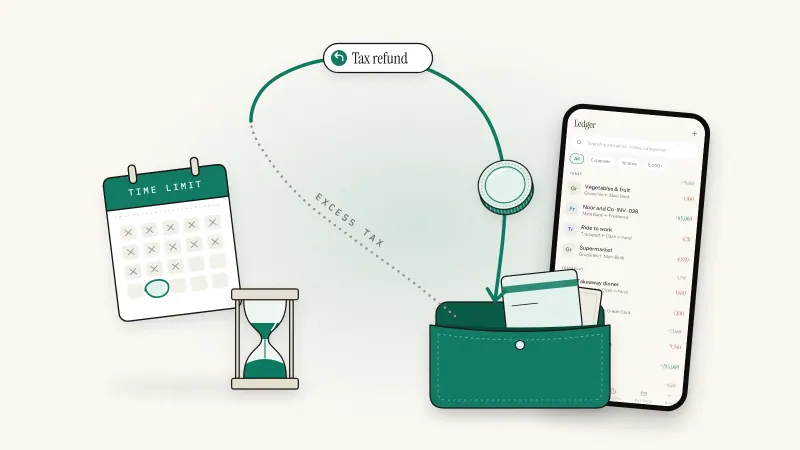
Overpaid? You can claim the excess within three years (section 170), but late filers get no refund while off the ATL. Here's how to claim an income tax refund.
A salaried year in Sprig
Sprig is a private, offline double-entry bookkeeping app for iPhone and Android, made by Secundum Reality. Its tax summary follows Pakistan's July–June tax year. It has no account, no bank link and no cloud, and it doesn't calculate tax or file returns. It can total the household spending and side income in the "only you" row above.
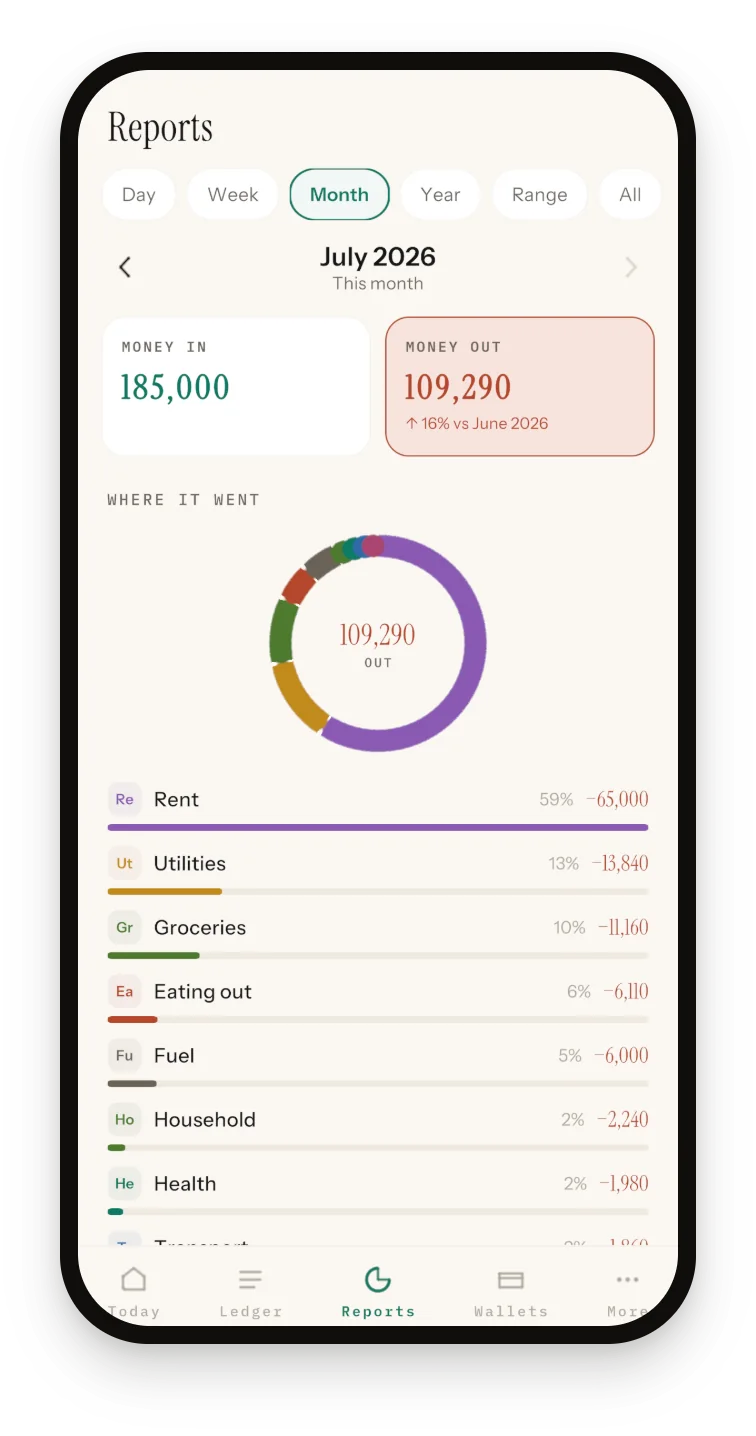
How Sprig helps
Tax year 2027 began on 1 July 2026, so start next year's records now.
- One book for the household: log pay as Salary income and spending in the Personal book; keep side income in Side business.
- Utilities, split: the Electricity bill, Gas bill, Water board and Internet summaries each get a total when you expand Utilities in Reports.
- The tax year in one view: Reports, Range, 1 July 2025 to 30 June 2026 totals spending by category, and Export, Last FY gives the CSV. Transfers between wallets never count as spending.
- Proof on the entry: photograph school-fee and donation receipts; the entry keeps the photo and its date, on your phone.
Know the limits. Sprig doesn't read salary slips, connect to IRIS or check ATL status, and it has no Urdu interface. Its tax summary heads, such as 25% of Rent as a home office, are its own groupings, not deductions under the Ordinance; section 12(4) allows employees no deduction for the cost of earning a salary. Typed entries are dated the day you save them, so rebuild last year by importing a CSV with Date, Category, Account and Amount columns, or by adding receipt photos. Keep tax records in PKR wallets. It's free for 50 entries, plus 20 per optional ad: Sprig, the offline bookkeeping app.
Sprig for iPhone and Android
Keep your books in four taps.
Private, offline double-entry bookkeeping. No account, no bank login, no cloud. Free to start with 50 entries.
Frequently asked questions
Do I need to file a tax return if my salary is below Rs 600,000?
Not because of income alone: for tax year 2026, the income test starts above Rs 600,000 of taxable income. Other section 114 triggers still apply, such as holding an NTN, owning a car above 1000cc or earning bank profit taxed as a final tax. Filing anyway also puts you on the Active Taxpayers' List, which lowers withholding on many transactions.
Is a wealth statement required for salaried individuals?
Yes. Section 116(2) requires every resident individual who files a return to include a wealth statement and reconciliation, employees included. It lists what you and your dependents owned and owed on 30 June, plus the year's household spending. Leaving it out costs 0.1% of taxable income per week or Rs 100,000, whichever is higher.
My employer deducted too much tax. How do I get it back?
File your return showing the full deduction as tax paid, so the excess shows as a refund due. Section 170 gives you three years to apply, and the Commissioner must decide within 60 days; FBR can also refund system-verified credit without an application (section 170A). File on time, because late filers get no refund while off the Active Taxpayers' List.
What is the late filing penalty for a salaried person?
Under section 182, it's the higher of 0.1% of the tax payable or Rs 1,000 for each day late, with a minimum of Rs 10,000 where 75% or more of income is salary and a cap of 200% of tax payable. Filing within one, two or three months after the due date cuts it by 75%, 50% or 25%.
Sources and further reading
- FBR: Income Tax Ordinance, 2001, amended up to 30 June 2026
- FBR: Income Tax Ordinance, 2001, amended up to 31 July 2025 (tax year 2026 law)
- FBR Circular No. 3 of 2026-27: tax year 2026 return date extended to 15 October 2026
- FBR: Withholding Tax Rate Card for Tax Year 2026 (updated to 30 June 2025)
- FBR: File Income Tax Return (declaration form 114(I) and wealth reconciliation)
- FBR: Tax Asaan FAQs (August 2020)
Published 3 October 2026. Feature details were checked against Sprig 1.1 for iPhone and Android. This article is general information, not tax or legal advice; rules differ by country, so confirm anything you file with your accountant or tax authority.