Pakistan tax
Freelancer Tax in Pakistan: PSEB, the 0.25% Rate and Your Return
If clients abroad pay you, your bank has probably taken a slice already. Here's what that 0.25% or 1% covers, when it settles your tax, and what still goes in your return.
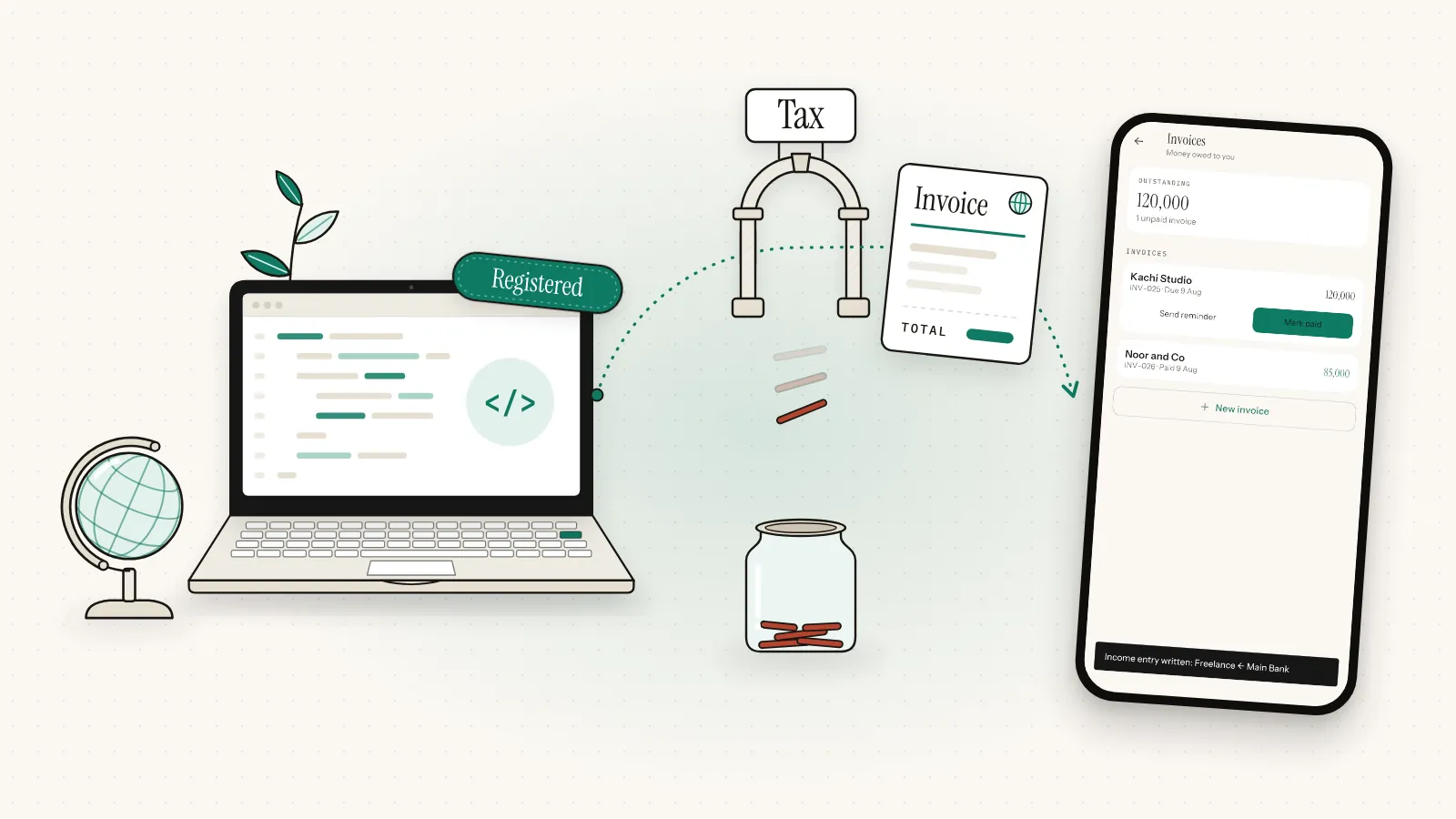
If a client abroad pays you for code, design, writing or support work, your bank usually takes a slice before the rupees reach you. That slice is income tax, and whether it settles your bill depends on conditions most freelancers never hear about. For tax year 2026, the Federal Board of Revenue extended the return deadline to 15 October 2026 (Circular No. 3 of 2026-27).
| What | Rule | Law |
|---|---|---|
| Who deducts | The bank, when it realizes foreign-exchange proceeds | s.154A(1) |
| Rate | 0.25% if PSEB-registered (software, IT, IT-enabled services), tax years 2024 to 2029; 1% otherwise | First Schedule, Part III, Division IVA |
| Not on the Active Taxpayers' List (ATL) | Same rate | Tenth Schedule, rule 10(ca) |
| Final tax only if | Return filed; withholding statements and sales tax returns filed where required; no foreign tax credit | s.154A(2) |
| Opting out | Each year, when you file | s.154A(3) |
| Section 231AA (bank transactions) | Omitted by the Finance Act, 2021 | s.231AA |
| Social media revenue | 5% (10% non-ATL) from 1 July 2026; minimum tax for residents | s.154B |
| PSEB freelancer fees | Rs 1,000 a year to register, Rs 2,000 a year to renew | PSEB |
| Tax year 2026 return | Due 15 October 2026 | s.118(3), s.214A |
Not tax advice; rules change every June with the Finance Act; confirm with FBR or a tax practitioner.
Is freelance income taxable in Pakistan?
Yes. If you're resident in Pakistan, your freelance earnings are taxable income, whether clients pay through a platform or straight into your bank. The Income Tax Ordinance, 2001 taxes a resident on income from Pakistani and foreign sources alike (section 11(5)). What foreign clients change is how the tax is collected, not whether it's owed.
The platform doesn't change the answer: the same rules cover tax on Upwork and Fiverr income and on direct clients. Freelancing normally counts as a business, since the Ordinance's definition of business includes a profession or vocation (section 2(10)).
- Final tax
- Settles the tax on that income. No expenses, allowances or credits count against it (section 169).
- Minimum tax
- A floor: your tax on that income can be higher than the deduction, never lower.
- Adjustable tax
- Credited against the tax in your return, with any excess refundable (section 168).
- IT and IT-enabled services
- Open-ended lists that include software development, web design and hosting, call centers, graphic design, accounting and data entry (section 2(30AD) and (30AE)).
For the wider picture, see how withholding tax works in Pakistan.
Freelancer tax in Pakistan: how does the 0.25% or 1% deduction work?
When a foreign payment for your services reaches your bank, the bank deducts tax from the proceeds under section 154A. The rate is 0.25% for software, IT or IT-enabled services exported by someone registered with PSEB, and 1% in any other case. Being off the Active Taxpayers' List doesn't double it.
| Exporter | Tax year 2026 (Jul 2025 to Jun 2026) | Tax year 2027 (Jul 2026 to Jun 2027) |
|---|---|---|
| Software, IT or IT-enabled services, registered with and certified by PSEB | 0.25% | 0.25% |
| Any other case, including IT work by an unregistered freelancer | 1% | 1% |
| Either of the above, not on the ATL | Same rate | Same rate |
Clause (a) of section 154A covers PSEB-registered exporters; clause (b) covers other exported services, including unregistered IT work. The Finance Act, 2026 moved the 0.25% rate's end date from tax year 2026 to 2029. For example, on a Rs 500,000 payment the bank deducts Rs 1,250 at 0.25% or Rs 5,000 at 1%.
Non-ATL rates usually double, but rule 10(ca) of the Tenth Schedule, in force since the Finance Act, 2022, exempts section 154A. FBR's tax year 2026 rate card still printed 0.5% and 2% for non-ATL exporters; the tax year 2027 card doesn't, and both say the Ordinance prevails. Deducted at double? Show the certificate to a tax practitioner.
When is the deduction your final tax?
Only when four conditions in section 154A(2) are met: you file your return; you file withholding statements for the year if the law requires them; you file sales tax returns if required, which PSEB-registered IT exporters are spared; and you take no credit for foreign tax paid. Miss one, or opt out, and normal tax rules apply.
When those conditions hold, section 169 applies: the income stays out of your taxable income, no expense or allowance reduces it, no tax credit cuts the tax, and there's no refund unless the bank deducted more than you're chargeable for. You still file, because section 114(1)(ae) requires a return from everyone with income under final taxation.
Final tax or normal tax: how do you decide?
You choose every year when you file (section 154A(3)). Under normal tax, freelance profit is business income, and expenses incurred wholly and exclusively for the business are deductible (section 20). Unless salary is over 75% of your taxable income, the non-salaried rates apply: from 0% up to Rs 600,000 to 45% above Rs 5.6 million in tax years 2026 and 2027.
Which costs less depends on your expenses, other income, tax withheld abroad and credits, so ask a registered tax practitioner to run both.
Should you register with PSEB?
If you export software, IT or IT-enabled services, PSEB registration is what moves you from 1% to 0.25%. As of October 2026, the Pakistan Software Export Board charges freelancers Rs 1,000 a year to register and Rs 2,000 a year to renew. Renewal asks for your previous year's income tax return, so filing also protects the lower rate.
PSEB registration for freelancers runs through Tech Destination, the board's own site:
- Sign up and upload. Your personal NTN (with no business name), CNIC (both sides) and a personal bank account letter or certificate.
- Pay after initial approval. Through the portal's payment gateway, or a pay order or demand draft to Pakistan Software Export Board (G) Ltd.
- Get the certificate. Usually 2 to 5 working days after the payment is verified.
- Renew yearly. Add a summary of export revenue with the State Bank of Pakistan's IT/ITeS code and your previous year's return.
On Rs 2,400,000 of proceeds, for example, that's Rs 6,000 instead of Rs 24,000. Ask your bank what it needs to apply the lower rate.
What if your clients are in Pakistan?
Then section 154A doesn't apply, because no foreign exchange is involved. A Pakistani company or other "prescribed person" paying you for services deducts tax under section 153(1)(b) instead, and that deduction is minimum tax (section 153(3)), a floor under your tax on that income. Which rate applies to a solo developer isn't settled.
The tax year 2027 rate card has two rows that could fit: IT and IT-enabled services at 4% (8% non-ATL), and a new row for independent professionals, naming "software engineers or developers, working independently", at 15% (30% non-ATL). As of October 2026, no FBR guidance we found says which covers a solo developer, so check the payer's certificate and ask a practitioner.
YouTubers and creators: what is the new 5% under section 154B?
From 1 July 2026, banks and other financial institutions deduct 5% when revenue from social media platforms such as YouTube, Facebook, Instagram or TikTok is credited to your account, or 10% if you're not on the ATL. For residents it's a minimum tax: your tax on that income can't be lower than the deduction.
That's the new tax on YouTube income in Pakistan. It came with the Finance Act, 2026, so it affects tax year 2027, not the return you're filing now. It also reaches money routed through online payment service providers, and FBR may prescribe rules for identifying it, so ask your bank how it applies the deduction.
Do US or UK clients withhold tax from your fees?
Normally not, when you do the work in Pakistan. US tax law sources pay for services where the work is performed, so a US client usually just asks for Form W-8BEN. UK tax reaches a non-resident's trading profits only when the trade is carried on in the UK, though no GOV.UK page states the freelancer case outright.
US
The IRS sources pay for services where the work is performed, wherever the payer or contract is (Publication 515), and generally taxes a nonresident alien only on US-source income (IRS). Give the client a Form W-8BEN, not a W-9: it goes to the payer, not the IRS, and exempts you from backup withholding and Form 1099 reporting (IRS). Without it, the payer may have to withhold at 30% or at the backup rate.
UK
HMRC's manual says trading with the UK, as opposed to in it, doesn't bring a non-resident into UK tax (INTM262210). "Normally no deduction" is our reading of that and the law (ITTOIA 2005, section 6), not a published HMRC rule for freelancers.
Three things can change the answer: working while you're in the US or UK; fees paid before the work is done, which Publication 515 treats as US-source; and royalties or license fees for intellectual property. If tax is withheld abroad, remember that final tax under section 154A allows no foreign tax credit, so ask a practitioner which route costs less.
How do you declare freelance income in your return?
Report the gross rupee proceeds for the tax year, before the bank's deduction, because tax deducted counts as part of your income (section 168(1)). Enter the deduction from your bank's certificate, choose final tax or normal tax, and make sure the money shows up as an inflow when you reconcile your wealth statement.
- Total the year. Tax year 2026 runs from 1 July 2025 to 30 June 2026; add each payment's rupee value before the deduction.
- Collect certificates. Whoever deducts tax must give you a certificate (section 164). IRIS also shows a Summary of Economic Transactions, which FBR calls indicative.
- Use the right block. The tax year 2026 return (SRO 1495(I)/2026) has separate blocks for adjustable, final and minimum tax withheld.
- Reconcile your wealth. Resident individuals who file must attach a wealth statement and reconciliation (section 116(2)); its inflows list normal-tax income and receipts subject to final or fixed tax separately. Here's how to fill the wealth statement so it reconciles.
- File by 15 October 2026. See our guides to filing your income tax return on IRIS and the documents required for your return.
Keep invoices, bank statements and certificates for six years after the tax year ends (section 174(3)); see how long to keep business records.
Keeping freelance books in Sprig
Sprig is a private, offline double-entry bookkeeping app for iPhone and Android, made by Secundum Reality. Its tax summary follows Pakistan's July–June tax year. It has no account, no bank link and no cloud, and it doesn't calculate tax or file returns.
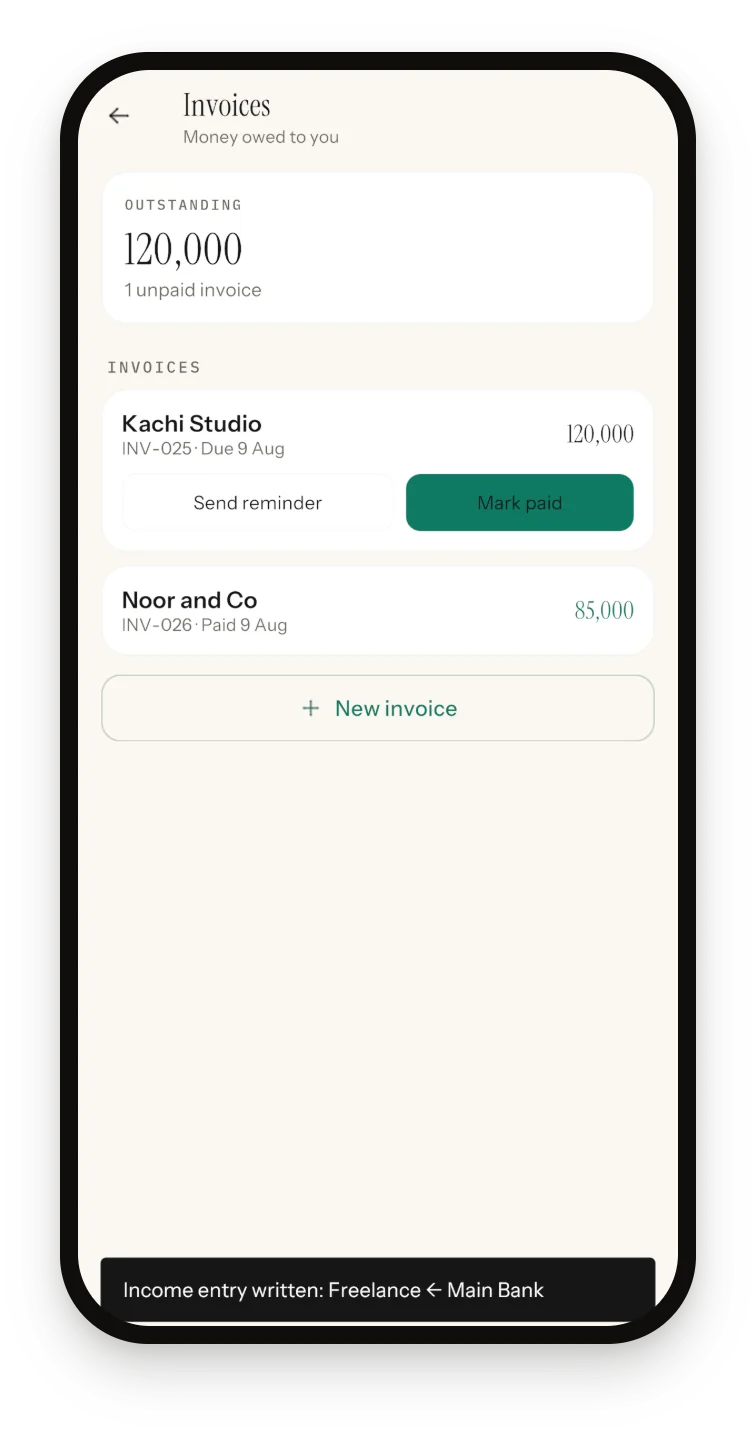
- Use the Side business book. Keep freelance money in its own book, with a PKR bank wallet first, since invoices pay into the book's first wallet.
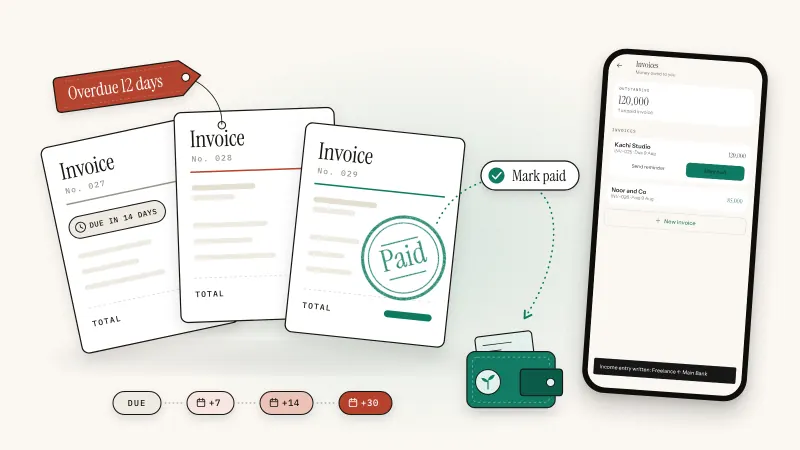
- Log each invoice. Add the client and amount; Sprig numbers it, sets it due in 14 days and turns it red when overdue.
- Mark it paid. Sprig writes a Freelance income entry for the invoice amount, dated the day you tap it.
- Correct it to the rupee figure. In the Ledger, swipe right and set the amount to the rupee value before the bank's deduction. Then log the deduction as an expense in a category you add, such as Tax deducted, so the wallet matches what the bank credited.
- Pull out the year. In Reports, a custom range of 1 July 2025 to 30 June 2026 gives the totals; Export, then Last FY, gives the CSV.
Paid in dollars? Reports, the tax summary and the CSV add amounts without converting currencies, and a USD-to-PKR transfer moves the same number, so keep the records you file from in PKR.
How Sprig helps
Freelance records that line up with the year you file for.
- Same year as FBR: Sprig's FY 2025–26 is tax year 2026, so Last FY is this filing season.
- Who owes you, in one list: see how to track unpaid invoices.
- Private: no account, no bank login, no cloud.
Limits: Sprig doesn't know section 154A rates, compute tax, connect to IRIS or check ATL status. Custom categories such as Tax deducted show in Reports and the CSV, not in the tax summary. It doesn't produce invoice documents or send them, and "Send reminder" only marks one as chased. Invoices come free, like every other feature of Sprig, the offline bookkeeping app.
Sprig for iPhone and Android
Keep your books in four taps.
Private, offline double-entry bookkeeping. No account, no bank login, no cloud. Free to start with 50 entries.
Frequently asked questions
Do freelancers have to file an income tax return in Pakistan?
Usually, yes. Section 114(1)(ae) requires a return from anyone whose income is subject to final taxation, including section 154A export proceeds, and anyone with taxable income above Rs 600,000 must file anyway. Filing is also the first condition for final tax, and PSEB asks for last year's return at renewal. The tax year 2026 deadline is 15 October 2026.
Do I need PSEB registration to get the 0.25% rate?
Yes. Section 154A gives 0.25% only to software, IT and IT-enabled exports by an exporter registered with and certified by PSEB; everything else under the section pays 1%. Registration costs Rs 1,000 a year and renewal Rs 2,000. The rate runs to tax year 2029, so watch each June's Finance Act.
Can I claim expenses against freelance income in Pakistan?
Not while the section 154A deduction is your final tax, because section 169 allows no deduction for expenditure incurred to earn that income. If you opt out or miss a condition, the normal business rules apply, and expenses incurred wholly and exclusively for the business are deductible (section 20). Keep receipts either way, and confirm the choice with a tax practitioner.
Is there tax when I move money from a payment platform to my bank?
If it's payment for services you exported, yes, under section 154A: when the money reaches a Pakistani bank as foreign exchange, the bank deducts 0.25% or 1% as it realizes the proceeds, and its certificate shows what was taken. Section 231AA, which some guides still quote for platform withdrawals, was omitted by the Finance Act, 2021.
Do freelancers pay advance tax every quarter?
Only some do. Final-tax income is left out of the advance-tax rules, and an individual whose latest assessed taxable income, excluding that income and salary, is below Rs 1 million is exempt (section 147). Otherwise, installments are due by 15 September, 15 December, 15 March and 15 June; our business tax guide shows how they're worked out.
Sources and further reading
- FBR: Income Tax Ordinance, 2001, amended up to 30 June 2026 (sections 114, 153, 154A, 154B, 169; First and Tenth Schedules)
- FBR: Withholding Tax Rate Card for tax year 2027 (Finance Act 2026)
- Finance Act, 2026 (Gazette of Pakistan, 26 June 2026): new section 154B and the 0.25% rate extended to tax year 2029
- FBR Circular No. 3 of 2026-27: tax year 2026 return date extended to 15 October 2026
- PSEB (Tech Destination): Freelancer registration and renewal
- IRS: About Form W-8BEN
Published 3 October 2026. Feature details were checked against Sprig 1.1 for iPhone and Android. This article is general information, not tax or legal advice; rules differ by country, so confirm anything you file with your accountant or tax authority.