Pakistan tax
How to Become a Filer in Pakistan, and What Late Filing Costs
An NTN alone doesn't make you a filer; filing on time does. Here's how to get onto FBR's Active Taxpayers' List and check your status, and what a late return can cost under the Finance Act 2026.
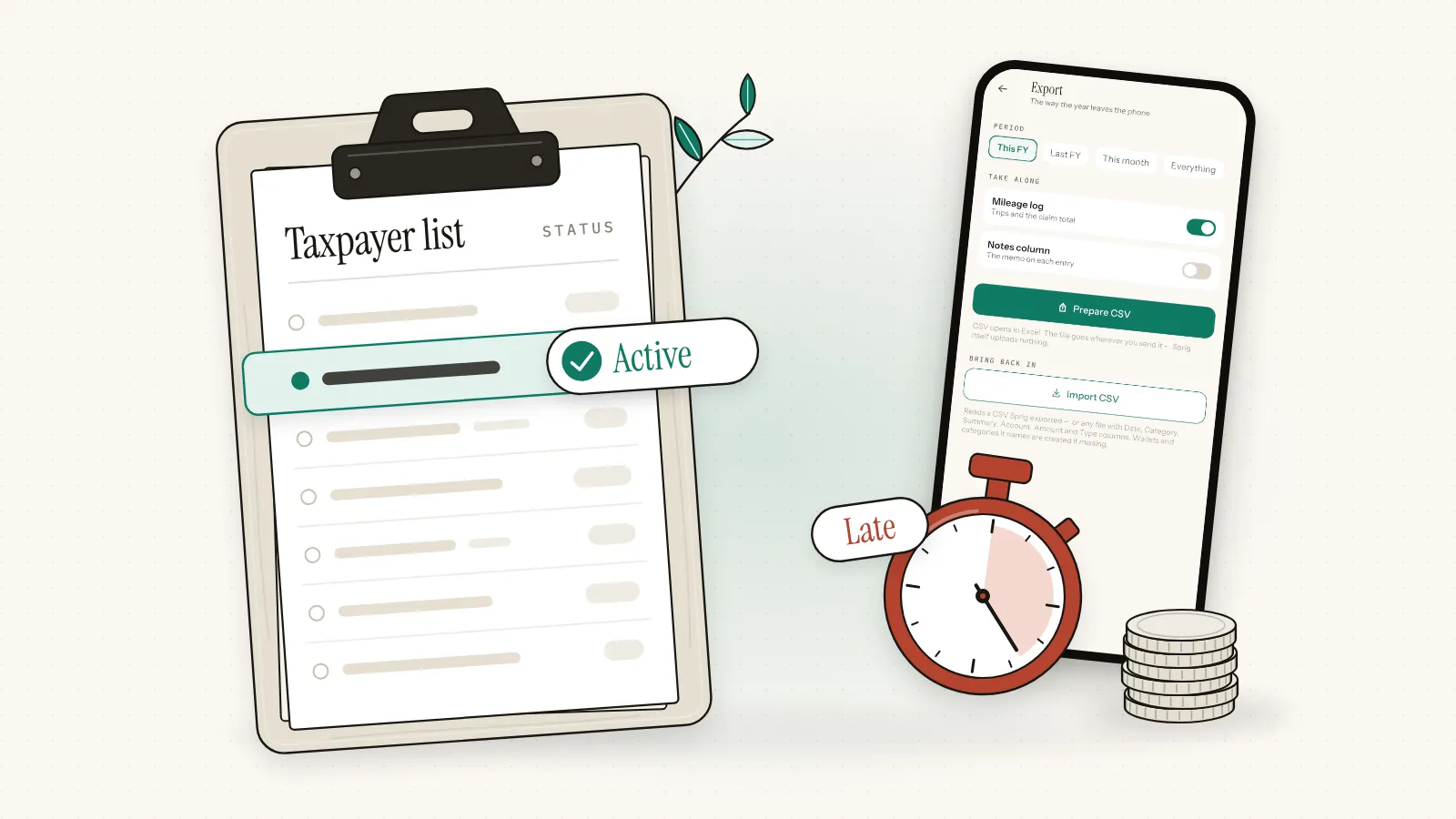
Your name goes on the Federal Board of Revenue's Active Taxpayers' List (ATL) when you file the latest year's return on time, and it stays off for any year you file late until you pay a surcharge or, as an individual, give an undertaking. For tax year 2026, FBR extended the deadline to 15 October 2026 (Circular No. 3 of 2026-27, issued 30 September 2026).
| Fact | Rule | Law or source |
|---|---|---|
| Tax year 2026 deadline | 15 October 2026, extended from 30 September | Circular No. 3 of 2026-27; s.214A |
| Who is a filer | Anyone on the ATL, which FBR updates daily | s.181A; SRO 1638(I)/2024 |
| Checking status | SMS ATL, a space and your CNIC to 9966 | FBR ATL page |
| NTN holders | Must file every year | s.114(1)(b)(vii) |
| Late-filing penalty | For each day late, the higher of 0.1% of tax payable or Rs 1,000; minimum Rs 10,000 or Rs 50,000 | s.182(1), entry 1 |
| Back on the ATL after filing late | Rs 25,000 surcharge for individuals (law since 1 July 2026) or a six-month property undertaking; unconfirmed for late tax-year-2026 returns | s.182A(1)(a), (3) |
| Not on the ATL | Most withholding rates doubled | Tenth Schedule, rule 1 |
Not tax advice; rules change every June with the Finance Act; confirm with FBR or a tax practitioner.
What is a filer, and what is the Active Taxpayers' List?
A filer is someone whose name is on the Active Taxpayers' List, which FBR keeps under section 181A of the Income Tax Ordinance, 2001. You get on it by filing your income tax return for the latest tax year by the due date. A non-filer isn't on the list and pays higher withholding tax on many transactions.
The Finance Act 2019 deleted the Ordinance's definitions of "filer" and "non-filer", and its higher-rate rules now apply to persons "not appearing" in the list. We use the everyday words.
- Active Taxpayers' List (ATL)
- FBR's list of people and businesses that filed the latest year's return on time, or filed late and then paid the surcharge or gave an undertaking.
- NTN
- National Tax Number. For individuals, it's the CNIC number (section 181(4)).
- Tax year 2026
- 1 July 2025 to 30 June 2026, named after the year in which it ends (section 74).
How do you become a filer in Pakistan, step by step?
Register on IRIS, FBR's online portal, with your CNIC, a mobile number on a SIM registered to your own CNIC, and your email address. Then file your income tax return and wealth statement for the latest tax year, paying any tax due, before the deadline. On-time filers join the ATL, which FBR updates daily.
- Check whether you must file. Section 114 tests include taxable income above Rs 600,000, a vehicle above 1000cc, certain property and holding an NTN; our guide on how to file your income tax return in Pakistan lists them all. If none applies, you can still file.
- Register on IRIS. Individuals enroll online at iris.fbr.gov.pk; associations of persons (AOPs) and companies go through a Regional Tax Office. FBR's registration guidance also asks for a bank account certificate.
- File the return and wealth statement. Returns are filed electronically on IRIS (section 114(2A)), and resident individuals must attach a wealth statement and reconciliation (section 116(2)). Here's how to fill a wealth statement that reconciles.
- Pay any tax due. It's due by the return's due date (section 137(1)), and the return needs evidence of payment.
- Check the list. FBR says on-time filers are included "immediately upon filing".
Only the latest tax year counts for the list (Income Tax Rules, rule 81B), so a first return for tax year 2026, filed by 15 October 2026, gets you on it. Earlier years you were required to file aren't forgiven, though: the Commissioner can still send a notice to file for any of the last five completed tax years, or ten if you filed none of the last five (section 114(4) and (5)).
How do you check your ATL status?
Text ATL, a space and your 13-digit CNIC to 9966. An AOP or company sends ATL, a space and its 7-digit NTN instead. You can also check ATL status online on FBR's ATL page or download the full list there. FBR updates the list daily, so if you've just filed, recheck the next day.
| Who | Message |
|---|---|
| Individual | ATL [space] 13-digit CNIC |
| AOP or company | ATL [space] 7-digit NTN |
| Individual in AJ&K | AJKATL [space] CNIC without dashes |
Some of FBR's older help pages are out of date: SRO 1638(I)/2024 made updates daily, not weekly, and the Finance Act 2026 replaced the Rs 1,000 surcharge in the law (more below).
On the list because of last year's return? Check again after 15 October. The list follows the latest tax year, so your status should then depend on your tax-year-2026 return; FBR hasn't announced the exact switch date.
What changes when you're on the ATL?
Mostly, you pay less tax at source. Under the Tenth Schedule to the Ordinance, most withholding and advance tax rates double for people who aren't on the ATL. Banks also deduct 0.8% from a non-filer's cash withdrawals on any day they total more than Rs 50,000. That's the practical difference between filer and non-filer.
- Property. From 1 July 2026, advance tax on buying property (section 236K) is 1.25% of fair market value on the ATL, against 10.5% to 18.5% off it.
- Vehicles. Advance tax on registering or transferring a vehicle (section 231B) is tripled off the list.
- Bank profit and more. Doubled too, though salary and a few others are excluded. Compare rates in our guide to withholding tax in Pakistan.
- Refunds. A late filer off the list gets none until back on (section 182A(1)(c)); see how income tax refunds work in Pakistan.
- Enforcement. Ignore a notice to file, and section 114B lets FBR block your SIMs, cut electricity or gas, or restrict foreign travel.
Section 114C limits on "ineligible persons" buying cars or property start only from a date the Federal Government notifies (section 114C(5)); we found no such notification as of 3 October 2026.
What does filing late cost in 2026?
The late filing penalty (section 182) is, per day late, the higher of 0.1% of tax payable or Rs 1,000; minimum Rs 10,000 or Rs 50,000. You stay off the ATL until you pay a surcharge or, as an individual, give an undertaking. The law sets the individual surcharge at Rs 25,000; FBR hasn't confirmed it for late tax-year-2026 returns.
| What | Rule | Law |
|---|---|---|
| Daily penalty | For each day of default, the higher of 0.1% of tax payable or Rs 1,000 | s.182(1) |
| Minimum | Rs 10,000 if 75% or more of an individual's income is salary; Rs 50,000 otherwise | s.182(1) |
| Maximum | 200% of tax payable | s.182(1) |
| Reductions | 75%, 50% or 25% off if filed within one, two or three months of the (extended) due date | s.182(1) |
| ATL surcharge | Rs 25,000 individual, Rs 50,000 AOP, Rs 100,000 company (Rs 1,000, 10,000 and 20,000 until 30 June 2026); unconfirmed for late tax-year-2026 returns | s.182A(1)(a) |
| Losses and refunds | No loss carry-forward for that year; no refund, or compensation for delay, while off the ATL | s.182A(1)(b)–(d) |
Since the Finance Act 2026, "tax payable" means the higher of the tax assessed for the year and the tax payable for "the immediately preceding tax year for which a return of income was duly filed". A penalty needs a written order after a hearing, unless you admit the default and pay voluntarily (section 182(2)). The law doesn't say how the reductions interact with the minimum, so have a tax practitioner check any figure.
The Finance Act 2026 put the new surcharge amounts into section 182A from 1 July 2026; FBR Circular No. 02 of 2026-27 calls them "substantially enhanced". We found nothing in writing from FBR on how they apply to tax-year-2026 returns filed after 15 October, so confirm the amount with FBR before you pay.
Pakistan · new in 2026
Since 1 July 2026, the law lets an individual skip the surcharge by undertaking before the Commissioner not to acquire any property, or a beneficial interest in property, for six months (section 182A(3)). The Income Tax Rules (amended to 15 September 2026) prescribe no form yet, so ask your tax office how to give one.
Penalty, surcharge and default surcharge are different things
- Penalty (section 182)
- For filing late, set by a written order.
- ATL surcharge (section 182A)
- The price of getting back on the list. It doesn't cancel the penalty.
- Default surcharge (section 205)
- For paying late: 12% a year or KIBOR plus 3%, whichever is higher, on unpaid tax or penalty, from its due date until paid.
How to file your tax return after the due date
- File anyway, and soon. The penalty reduction shrinks each month. Pay the tax due with the return; default surcharge runs from the due date.
- Get back on the list. Pay the surcharge, or give the undertaking if you're an individual.
- Answer any notice by its date. A tax practitioner can help you respond.
Deadline not passed yet? Before it does, you can ask your Commissioner in writing for a section 119 extension (absence from Pakistan, illness or another reasonable cause), normally up to 15 days. Filing within it keeps you on time for the ATL, but default surcharge still runs from the original due date.
Once you're a filer, do you have to file every year?
Yes. Section 114 requires anyone who has obtained a National Tax Number to file a return every year, whatever their income. Registering makes your CNIC your NTN, so becoming a filer is a yearly commitment: miss a year and you drop off the ATL for that year and risk a late-filing penalty.
The exceptions are narrow. Section 115(3) excuses widows, orphans under 25, disabled persons and, for property, non-residents only from the property and vehicle tests, not from the NTN or income tests.
Students and housewives get no separate rule: no taxable income above Rs 600,000, no income taxed as final tax (bank profit, for example), no NTN and none of the other triggers means no return. Register and file to buy property or a car at ATL rates, and the yearly duty comes with the NTN.
Keep each year's records for six years after the tax year ends (section 174(3)); see how long to keep business records.
Staying on time every year with Sprig
Sprig is a private, offline double-entry bookkeeping app for iPhone and Android, made by Secundum Reality. Its tax summary follows Pakistan's July–June tax year. It has no account, no bank link and no cloud, and it doesn't calculate tax or file returns.
Because Sprig's financial year runs July–June, its FY 2025–26 is what FBR calls tax year 2026.
How Sprig helps
Keep the year as you go, and filing starts with a file, not a hunt.
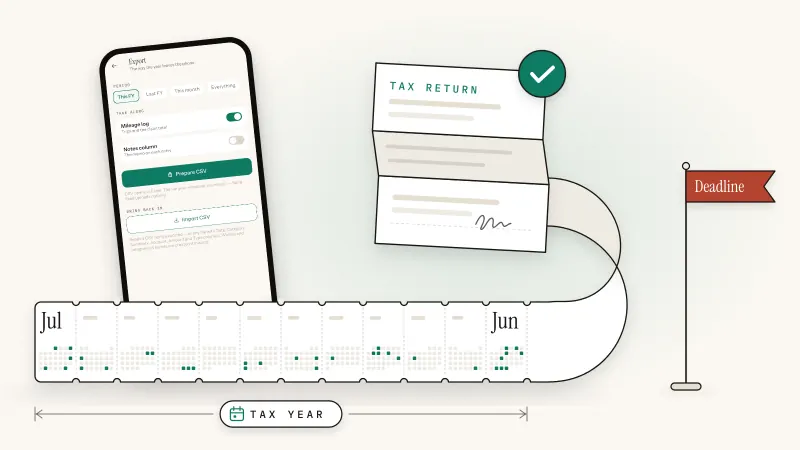
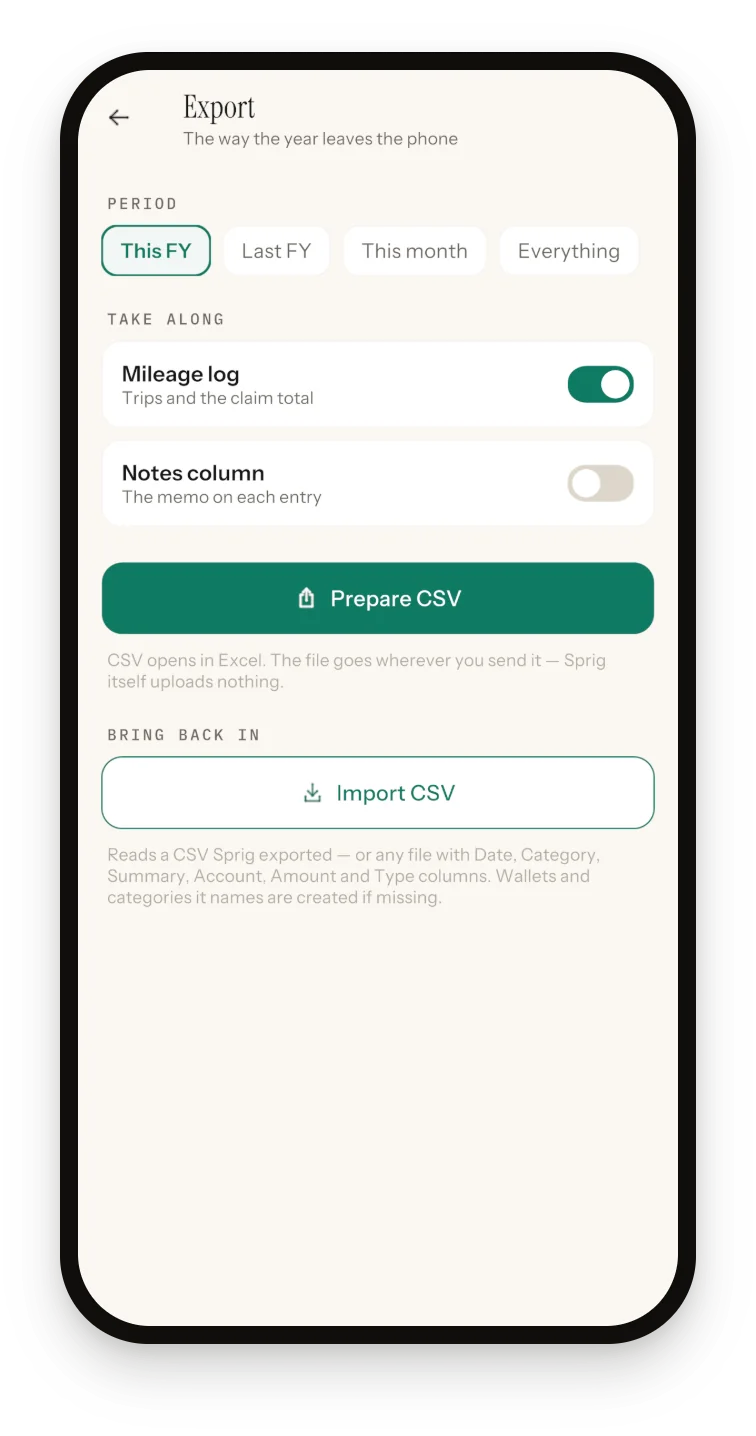
- One CSV for the year. Export, Last FY, Prepare CSV: every entry plus the mileage log, for the book that's open (Personal or Side business).
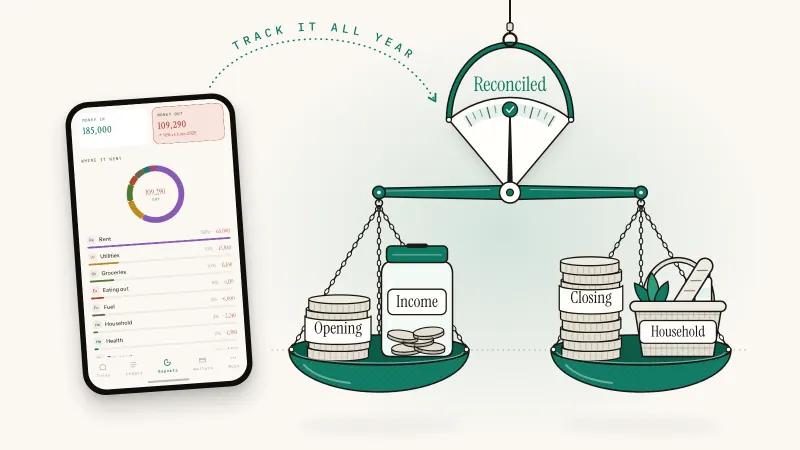
- The household figure. Reports for 1 July 2025 to 30 June 2026 in the Personal book give the year's spending, a starting point for the wealth statement.
- What to fix first. The tax summary counts expense entries still missing a receipt.
- Tax payments on record. A custom category such as Advance tax paid shows in Reports and the CSV, though not in the tax summary.
What Sprig won't do: check your ATL status, connect to IRIS or work out penalties. Entries you type are dated the day you save them; to rebuild a past year, import a CSV or add receipt photos, which keep the photo's date.
Every feature is in the free version: 50 entries, plus 20 more for each optional ad (up to 4 a day); yearly Premium removes the limit and the ads. See how the Sprig bookkeeping app works.
Sprig for iPhone and Android
Keep your books in four taps.
Private, offline double-entry bookkeeping. No account, no bank login, no cloud. Free to start with 50 entries.
Frequently asked questions
How long after filing does my name appear on the ATL?
FBR says a return filed by the due date puts you on the list immediately upon filing, and the list has been updated daily since SRO 1638(I)/2024. File late, and you appear only after paying the surcharge or, as an individual, giving the six-month property undertaking.
Does getting an NTN make me a filer?
No. Registering gives you an NTN (for individuals, your CNIC number), but you become a filer only by filing your return for the latest tax year: on time, or late with the surcharge or undertaking. Registering also creates a duty: section 114(1)(b)(vii) requires everyone who has obtained an NTN to file a return every year, even with no income.
What is the penalty for filing a tax return late in Pakistan?
Under section 182, for each day of default it's the higher of 0.1% of tax payable or Rs 1,000. The minimum is Rs 10,000 if 75% or more of your income is salary and Rs 50,000 otherwise; the maximum is 200% of tax payable. Filing within one, two or three months of the (extended) due date cuts it by 75%, 50% or 25%, but the law doesn't say how those cuts interact with the minimum.
How much is the ATL surcharge for late filers in 2026?
Since 1 July 2026, section 182A sets it at Rs 25,000 for an individual, Rs 50,000 for an association of persons and Rs 100,000 for a company, up from Rs 1,000, 10,000 and 20,000. An individual can instead give a six-month property undertaking. FBR hasn't confirmed in writing how these rules apply to late tax-year-2026 returns, so confirm the amount before paying.
Do students and housewives have to file an income tax return?
Only if a section 114 test applies, such as taxable income above Rs 600,000, income taxed as final tax (bank profit, for example), a vehicle above 1000cc, certain property, or an NTN. There's no separate rule for students or housewives. Anyone who registers must then file every year.
Sources and further reading
- FBR: Income Tax Ordinance, 2001 (amended up to 30 June 2026), sections 74, 114 to 119, 137, 174, 181 to 182A, 205, 231AB, 231B, 236K and the Tenth Schedule
- FBR Circular No. 3 of 2026-27: tax year 2026 return deadline extended to 15 October 2026
- FBR Circular No. 02 of 2026-27: Finance Act 2026 amendments explained (item 27, section 182A)
- FBR: Active Taxpayer List (ATL), how to check your status
- FBR press release: ATL updated daily under SRO 1638(I)/2024
- FBR: Income tax registration process on Iris
Published 3 October 2026. Feature details were checked against Sprig 1.1 for iPhone and Android. This article is general information, not tax or legal advice; rules differ by country, so confirm anything you file with your accountant or tax authority.