 Last Charge
For parents
Games that teach kids to plan ahead, and what the research says
Planning in a game means spending something limited and getting steps in the right order. These games ask for it, and the research says how far that practice goes.
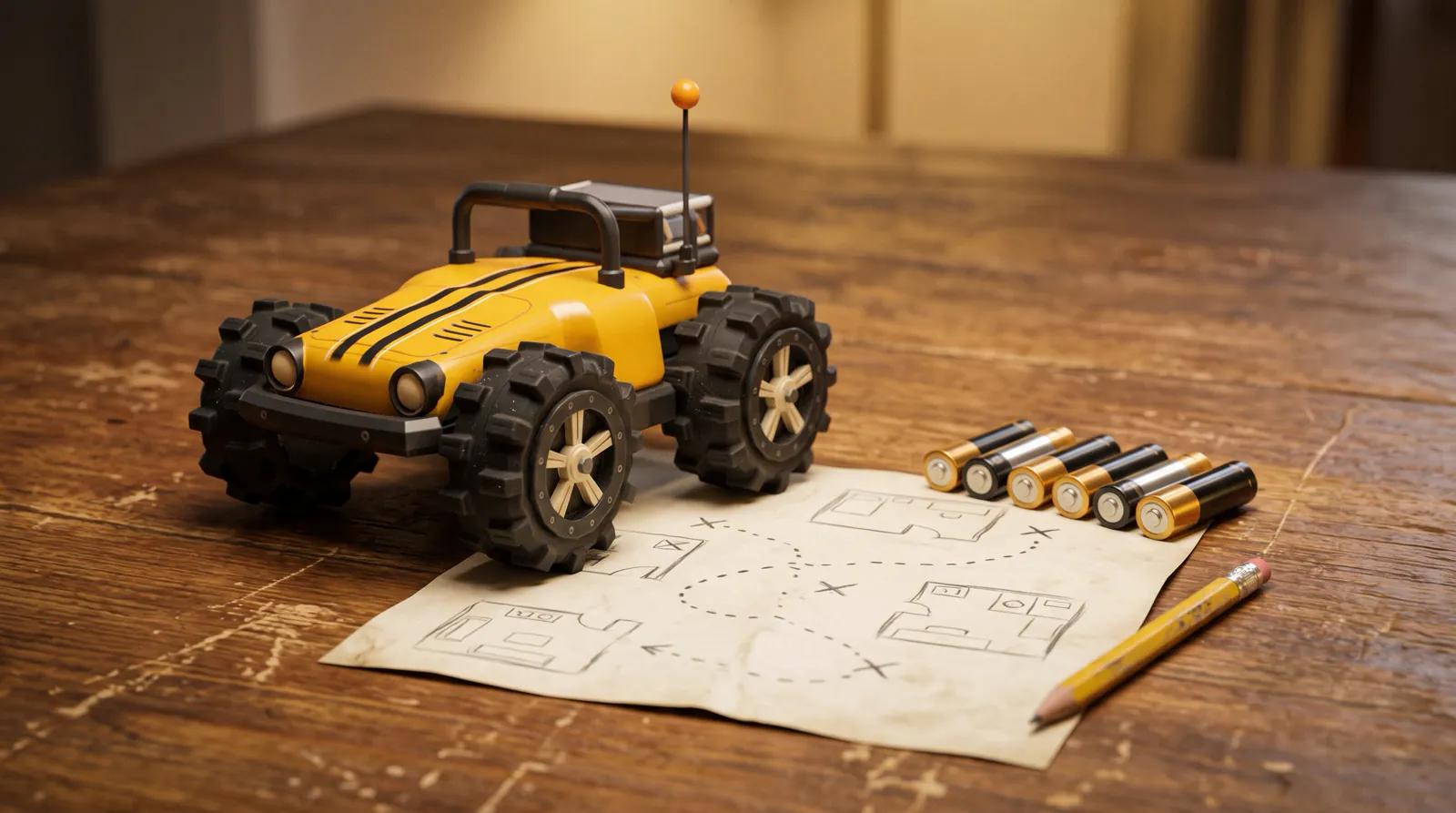
Games that teach kids to plan ahead give them something limited to spend and steps that only work in the right order, so thinking first pays off. Mini Metro, Lightbot, Human Resource Machine, Monument Valley and chess on Lichess all work this way, and so does Last Charge, the toy car physics puzzle game by Secundum Reality, which we make.
Research on planning skills says practice helps, but the gains stay close to what was practiced, so a game won't fix homework by itself.
Ratings and prices are from the US App Store and Google Play, checked on . They can differ by country and change with updates.
What does planning ahead look like in a game?
In a game, planning ahead means deciding before you act. The game gives you something limited to spend, such as track, trains or battery, and a goal that only comes together if the steps happen in the right order. Your child pictures what will happen, tries it, watches the result and changes the plan.
What to look for:
- A budget
- Something runs out, so every choice costs something: lines and trains in Mini Metro, battery in Last Charge.
- An order of steps
- Some moves only work after others. In Lightbot, the order of a robot's commands decides where it ends up.
- Free thinking time
- You can stop and look without losing anything.
- Cheap retries
- A failed try shows what to change, and starting again is quick.
Check for combat as well. We left out Kingdom Rush, a popular tower-defense game, because the App Store rates it 13+ for frequent cartoon or fantasy violence and guns or other weapons.
What is executive function, in plain words?
Executive function is the set of mental skills you use to hold a plan in mind, stop yourself acting on the first impulse, and switch approach when something changes. The Harvard Center on the Developing Child compares it to an air traffic control system. Nobody is born with these skills, but children build them slowly from infancy into early adulthood.
The Center's activities guide splits it into three parts: working memory (holding information in mind and using it), inhibitory control (resisting impulses and pausing to think before acting) and cognitive flexibility (switching gears when demands change). Together they're what you use to set a goal, plan how to reach it, check progress and adjust, while keeping frustration in check.
For ages 7 to 12, the guide suggests strategy games such as chess and Go as practice in holding complicated moves in mind, planning many moves ahead and adjusting to an opponent's moves. It adds that video games can give practice too, but some include violent content, so choose carefully and set time limits. Its authors say plainly that studies haven't yet proven all of its suggestions, which reflect the judgment of experts in the field.
Can games really improve a child's planning skills?
Practice helps, but the gains tend to stay close to what was practiced. A 2011 review in Science of programs tested with children aged 4 to 12 found executive function can improve with repeated practice that keeps getting harder, including some games. It found the transfer to other skills narrow, and it didn't test the games in this list.
Adele Diamond and Kathleen Lee reviewed programs tested with children, many of them in randomized trials: computer training, games on and off screens, aerobics, martial arts, yoga, mindfulness and school curricula. Three findings matter for parents:
- Every program that worked involved repeated practice with a rising challenge. Groups doing the same activity without the difficulty increasing didn't improve.
- Children who started with the weakest executive function gained the most.
- Transfer was narrow. In one study they describe, 7- to 9-year-olds randomly assigned to reasoning games or speed games each got better at what they had practiced, and not at the other skill.
The review didn't test entertainment apps, and it doesn't show that a game raises grades. It does suggest picking games where the challenge grows and letting your child play them often enough to get good.
Last Charge: a battery you spend like a budget
We make Last Charge, so it isn't ranked against the games below; it's included because its battery works as a budget and we can tell you exactly what costs what.
Last Charge is a story-driven 3D physics puzzle game for Android and iPhone, made by Secundum Reality. You drive Watt, a small yellow toy RC car, through a dark house during a storm. There are four levels so far: the kitchen (High Tide), the living room (Lights Out), the garage (The Breaker) and the garden (Windfall). It's free to play, with no account and nothing to buy, and the App Store rates it 9+.
Every level starts with Watt's battery at 60%, shown on a meter on screen. In Last Charge, standing still with the headlights off costs no battery, and there's no level timer, so a child can stop and plan for as long as they like.
| What Watt does | Charge |
|---|---|
| Stand still with the lights off | Free |
| Hold GAS or BRAKE (reversing too) | 0.15% a second |
| Headlights on, moving or parked | 0.10% a second |
| Boost | 4% each |
| Pick up an AA battery | +15% |
| Reach a power bank | Fills to its tag (usually 50%) and saves |
Power banks along the route are the checkpoints. Reaching one saves progress and tops the battery up to the number on its tag. If the battery runs flat, Watt wakes at the last bank with 40% (20% on the garage's top shelf), so a plan that fails costs a short drive back.
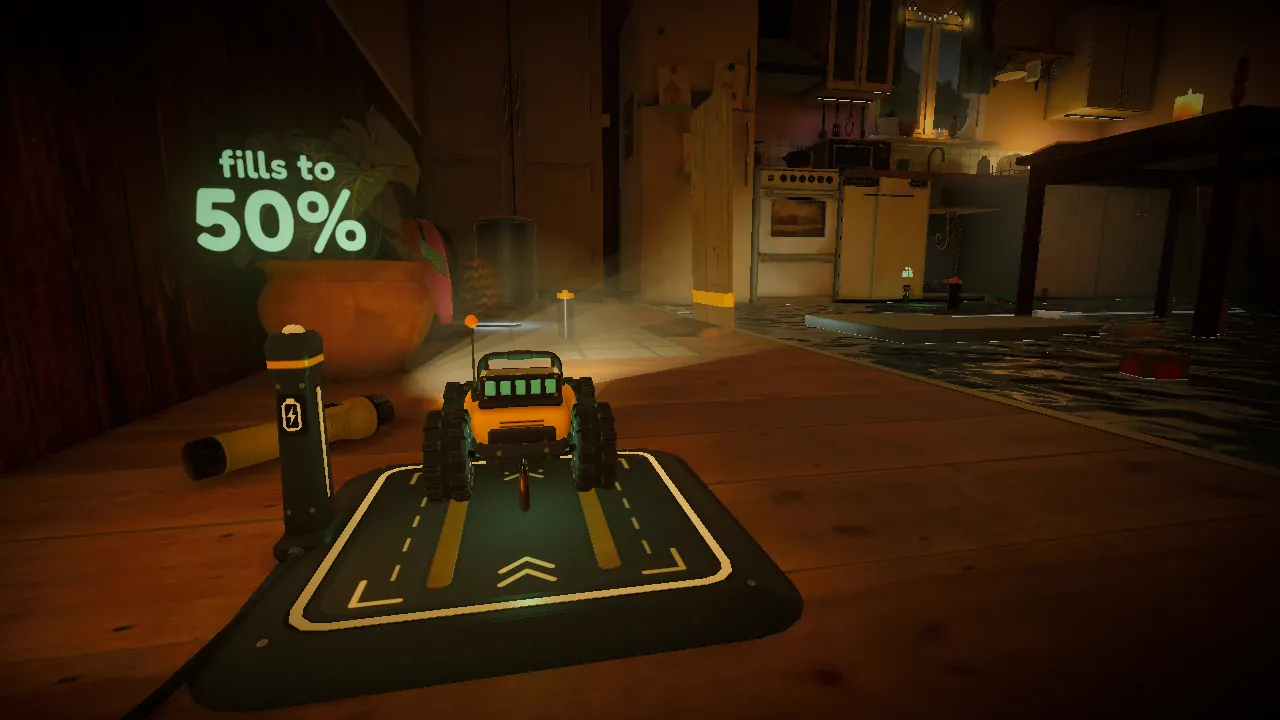
The budget tightens further into the house: the garage's banks fill to 50%, then 35%, then 20% as Watt climbs toward the breaker panel. Our Last Charge tips for making one battery last include a habit that's pure planning. When you're low and an AA battery sits near a bank, reach the bank first and collect the AA after, because a bank only fills to its tag.
Order matters too. In the kitchen, one fix won't work until another is done, and the game says so in a few words if you try them the wrong way round. There are no hints, so a child works that out by watching.
Last Charge is a puzzle game, not a school program. What your child practices while playing is planning with the battery budget, watching cause and effect, trying an idea and adjusting it, and finding a way through without hints. The rooms are dark, there's a storm outside, lightning flashes now and then, and a robot vacuum called Grumble patrols the living room. There's no blood, no weapons and no fighting, and we don't suggest it for children under 9. The how to play section of the game page explains the controls.
Which other games teach kids to plan ahead?
Mini Metro, Lightbot, Human Resource Machine, Monument Valley and chess on Lichess all reward thinking before acting. Mini Metro is a budget of subway lines, Lightbot and Human Resource Machine are about putting steps in order, Monument Valley is short spatial planning, and chess is planning against an opponent. Most are rated 4+ on the App Store.
| Game | Developer | App Store | Google Play | Price model | What you plan |
|---|---|---|---|---|---|
| Mini Metro | Dinosaur Polo Club | 4+ | Everyone | Paid, one-off ($3.99 App Store, $0.99 Google Play) | Where your limited lines and trains go |
| Lightbot: Programming Puzzles | SpriteBox LLC | 4+, made for ages 9 to 11 | Not available when checked | Paid, $2.99; Lightbot: Code Hour is free | The order of a robot's commands |
| Human Resource Machine | Tomorrow Corporation | 9+ | Everyone 10+ | Paid, $4.99; the Google Play page also lists extra purchases | A step-by-step program for an office worker |
| Monument Valley | ustwo games | 4+ | Everyone | Paid, $3.99; extra chapters sold separately | How each turn of a building changes the path |
| Lichess | lichess.org | 4+, contains messaging and chat | Everyone, Users Interact | Free, funded by donations | Chess moves ahead of an opponent |
The games are in no particular order. Mini Metro, Human Resource Machine and Monument Valley are also included with a Google Play Pass subscription.
Mini Metro
Dinosaur Polo Club · iPhone, iPad and Android · App Store 4+ · Google Play Everyone · paid
You design the subway map for a growing city, drawing lines between stations and redrawing them as new stations open. The store page puts the planning plainly: decide where to use your limited resources. After a round, ask your child where the lines went and what they'd change.
Lightbot
SpriteBox LLC · iPhone and iPad · App Store 4+ · paid, with a free Code Hour version
You light up tiles by lining up commands for a small robot, and the store page says the puzzles build up to procedures, loops and conditionals. Lightbot: Code Hour is a free 20-level version. Programming Puzzles has 50 levels, and the App Store lists it as made for ages 9 to 11. Its Google Play page wasn't available when we checked.
Human Resource Machine
Tomorrow Corporation · iPhone, iPad and Android · App Store 9+ · Google Play Everyone 10+ · paid
Each level, your boss gives you a job, and you automate it by programming a little office worker. The developers, who also made World of Goo, say you don't need to have programmed before. It's the hardest game here and suits older children who liked Lightbot. The App Store rating notes infrequent cartoon or fantasy violence, and Google Play lists fantasy violence.
Monument Valley
ustwo games · iPhone, iPad and Android · App Store 4+ · Google Play Everyone · paid
You turn and slide impossible buildings to open a path for a silent princess, Ida, picturing how each turn will join or break the path before you make it. It's the gentlest game here and a good first pick. The Forgotten Shores chapters cost extra.
Lichess
lichess.org · iPhone, iPad and Android · App Store 4+ · Google Play Everyone · free
Chess is one of the strategy games the Harvard guide names for 7- to 12-year-olds. Lichess is a free, open-source chess app run by volunteers and donations, with puzzles, computer bots and live games against other people. Because of those live games, the App Store lists messaging and chat, and Google Play shows Users Interact. Lichess's terms ask that players under 15 have a parent's or guardian's permission for an account, and leave it to parents to turn on kid mode, which switches off public chat among other protections.
Our list of STEM games for kids covers more coding and building games, and are puzzle games good for kids looks at the research on puzzles in general.
How can you practice planning with your child away from the screen?
Ask the questions a budget game asks: what do we have, what does each choice cost, and what has to happen first? Pocket money, packing a school bag and planning a day out all work. For teenagers, the Harvard guide suggests starting with simple goals that matter to them, such as saving up for something they want.
- Pocket money for a week. What's the budget, what's free, and when is the next top-up? Spending it all on day one is a lot like boosting everywhere in the first room.
- Packing a bag the night before. What goes in first, and what will tomorrow need that today didn't?
- A day out. List the stops, what each costs in time or money, and what happens to the rest of the day if one runs late.
- A recipe or a model kit. Which steps come first, and what goes wrong if you do one too early?
After a game, two questions do a lot: "What was your plan?" and "What would you change next time?" The Harvard guide says children need practice talking about what they're doing and why, thinking about next steps and judging how a decision worked out, with adults helping at first and stepping back as the child is ready. Our post on how to play video games with your child has more questions that leave the answer to them.
For what to say when a plan fails and your child wants to give up, read why getting stuck in a puzzle game can be good for your child.
Frequently asked questions
What are executive function games for kids?
They are games that ask a child to hold information in mind, resist the first impulse and change approach when something goes wrong. Strategy games such as chess, programming puzzles such as Lightbot and resource games such as Mini Metro all do this. The Harvard Center on the Developing Child suggests strategy games for ages 7 to 12, while noting its suggestions haven't all been proven in studies.
Is chess good for kids' planning skills?
Chess asks a child to think several moves ahead and adjust when the other player does something unexpected, and the Harvard Center on the Developing Child lists it among strategy games for 7- to 12-year-olds. It's good practice, but it doesn't guarantee better grades: a 2011 review in Science found gains from executive function training stay close to what was practiced. Lichess is a free way to start.
Do brain training games work for kids?
Partly. Diamond and Lee's 2011 review in Science found that computer working-memory training improved children's working memory, and the gains carried over to other working-memory tasks but usually not to other skills. The improvements came from repeated practice that kept getting harder. The review doesn't show that brain-training apps raise school results.
Are strategy games good for kids?
They give a child practice in planning many moves ahead and changing the plan, which is why the Harvard Center on the Developing Child suggests them for ages 7 to 12. Check the content first, because some strategy games include combat. Kingdom Rush, for example, is rated 13+ on the App Store for frequent cartoon or fantasy violence. Mini Metro, Lightbot and Lichess are rated 4+.
What age are these planning games for?
On the App Store, Mini Metro, Lightbot, Monument Valley and Lichess are rated 4+, and Human Resource Machine is 9+ (Everyone 10+ on Google Play). The App Store lists Lightbot: Programming Puzzles as made for ages 9 to 11. Last Charge is rated 9+ on the App Store. Lichess has live games and chat with other players, so set up kid mode for a child.
Sources
- Harvard Center on the Developing Child: A Guide to Executive Function
- Harvard Center on the Developing Child: Enhancing and Practicing Executive Function Skills with Children from Infancy to Adolescence (PDF)
- Diamond A, Lee K (2011). Interventions shown to aid executive function development in children 4 to 12 years old. Science 333:959-964 (PubMed Central)
- App Store: Mini Metro (Dinosaur Polo Club)
- Google Play: Mini Metro
- App Store: Lightbot : Programming Puzzles (SpriteBox LLC)
- App Store: Lightbot : Code Hour (SpriteBox LLC)
- App Store: Human Resource Machine
- Google Play: Human Resource Machine (Tomorrow Corporation)
- App Store: Monument Valley (ustwo games)
- Google Play: Monument Valley
- App Store: Lichess
- Google Play: Lichess
- About lichess.org
- Lichess Terms of Service (age and kid mode)
- App Store: Kingdom Rush Tower Defense TD (Ironhide)