 Last Charge
For parents
Are puzzle games good for kids? What the research says
What the studies found, who took part, how strong each finding is and what it doesn't show, then a short checklist for choosing a puzzle game for your child.
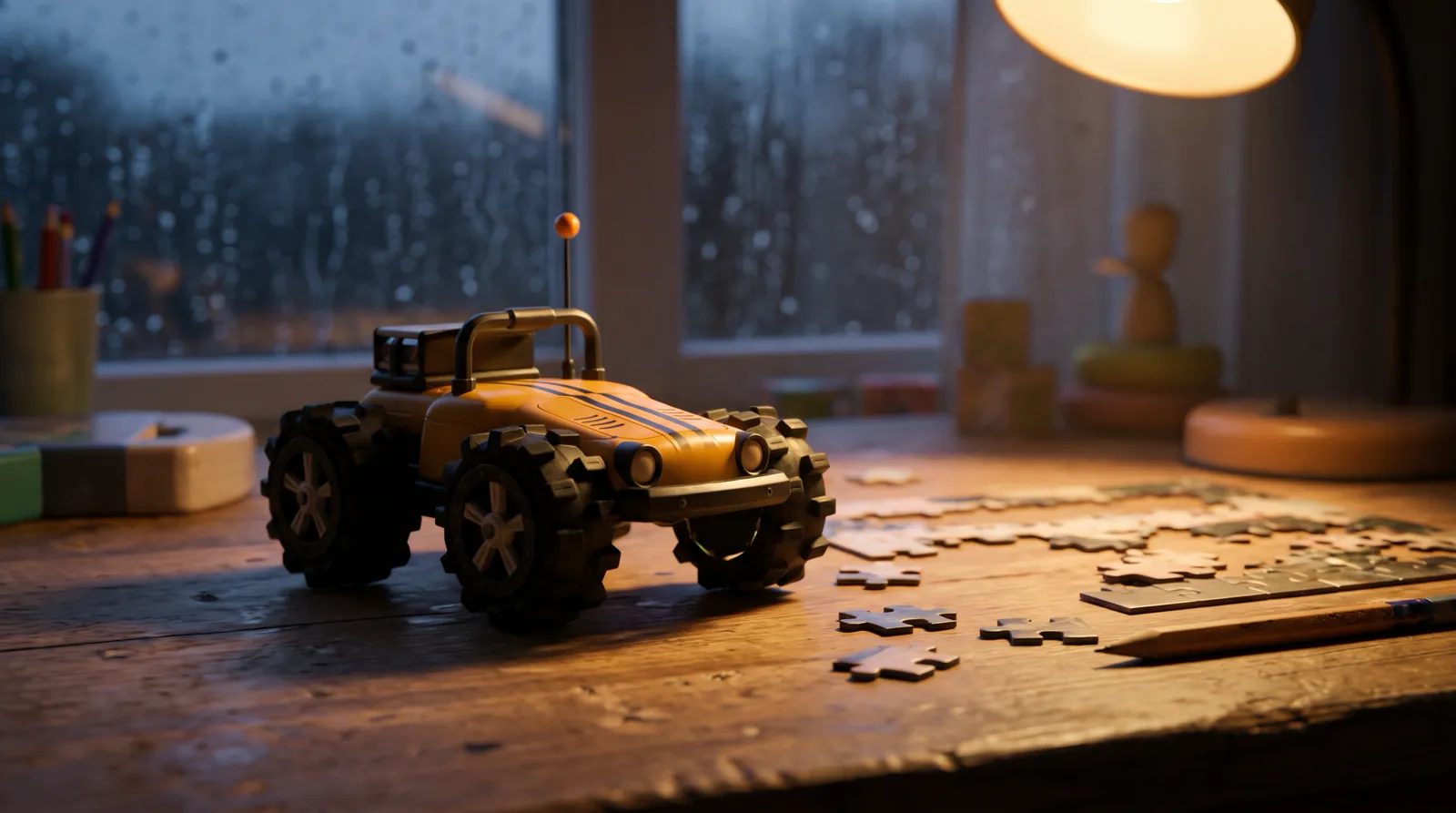
Puzzle games can be good for kids, but the research supports narrower claims than a lot of game marketing does. Studies link puzzle play to better spatial skills in young children, and spatial skills improve with practice, yet no study shows that puzzle games make children smarter in general, and the video game studies we found were done with teenagers and adults.
We make Last Charge, the toy car physics puzzle game by Secundum Reality, so we would like the answer to be yes. Each study below comes with who took part and what kind of study it was, and our game gets one section near the end.
- Correlational study
- Researchers check whether two things go together. It can't show that one caused the other, because something else, such as home life, might explain both.
- Experiment
- People are randomly assigned to do different things and then compared, so it can show cause and effect.
- Meta-analysis
- A study that pools many earlier studies to estimate an average effect.
- Far transfer
- Getting better at something quite different from what you practiced.
What does research say about puzzles and young children?
Two studies of young children found that those who played with puzzles more often scored higher on spatial tests, even after researchers allowed for things like family income or other thinking skills. Both were about physical puzzles, and both were correlational, so they show that puzzle play and spatial skill go together and can't show the puzzles caused it.
In a 2012 University of Chicago study, researchers visited 53 families at home every four months while the children were about 2 to 4 years old, and recorded what they played. At 4 and a half, the children took a test of mentally moving and turning flat shapes. Children who had been seen playing with puzzles did better, and among them, more frequent play went with higher scores. That held after allowing for parents' education, income and how many different words they used with their child (Levine and colleagues, Developmental Psychology).
A larger 2015 study used a nationally representative sample of 847 US children aged 4 to 7. Children whose parents said they often played with puzzles, blocks and board games scored higher on Block Design, a standard spatial test, after allowing for other thinking skills. Drawing, riding a bike and the other kinds of play the study asked about showed no such link. The authors said future research should test whether the play causes the skill (Jirout and Newcombe, Psychological Science).
Neither study looked at apps or video games. The children were 2 to 7, younger than most children who pick their own phone games, and families who do lots of puzzles may differ in ways the researchers couldn't measure.
Can spatial skills be trained?
Yes, as far as the evidence goes. A 2013 review pooled 217 training studies and found that practice improved spatial skills by a moderate amount, that the gains held up when people were tested later, and that they carried over to untrained spatial tasks. A 2020 review of 20 studies with children up to age 8 found bigger gains.
Spatial skill means picturing objects and how they fit, turn and move, and as the review notes, it predicts success in science, math and engineering. The 2013 meta-analysis, led by David Uttal at Northwestern University, covered studies with people of different ages and found an average effect of 0.47 in favor of training, moderate by the usual yardstick (Psychological Bulletin). The authors suggested spatial teaching could bring more people into science and engineering; the studies themselves measured spatial tests.
The 2020 meta-analysis in Frontiers in Psychology looked only at children from birth to 8 and found a larger average effect of 0.96 (Yang and colleagues). Its authors warn that the studies were few and varied a lot, and that including only published English-language papers could have inflated the estimate.
Neither review was about puzzle apps. The practical reading is modest: a game that has your child picturing how things turn, fit and move gives them spatial practice, and practice is what these studies tested.
Do brain-training games make kids smarter?
There's little evidence that they do. A 2016 review of the studies that brain-training companies themselves cite found that people get better at the trained games, somewhat better at closely related tasks, and rarely better at different tasks or everyday thinking. That missing carry-over to different tasks is what researchers call a lack of far transfer.
The review, by Daniel Simons and six colleagues in Psychological Science in the Public Interest, also found that many of the studies had major flaws in design or analysis, and none met every standard the authors set for clear conclusions. An app that promises to boost your child's memory, attention or IQ is promising something this research hasn't shown.
One small experiment did pit a puzzle game against brain training. In a Florida State University study, 77 students aged 18 to 22 were randomly assigned to eight hours in the lab with either Portal 2, a first-person puzzle game, or Lumosity, a brain-training program. Afterwards the Portal 2 group scored higher on combined measures of problem solving, spatial skill and persistence, and the Lumosity group showed no gains on any measure (Shute, Ventura and Ke, Computers & Education, 2015). The authors call the sample small and urge caution in generalizing from it, and there were no children in it.
Do video games help teenagers solve problems?
Possibly. The main evidence is a four-year study of 1,492 high school students: those who played more strategy and role-playing games rated their own problem-solving skills higher over time, and those ratings went with better grades. It tracks a link, relies on the students' own ratings, and didn't look at puzzle games.
That study, by Adachi and Willoughby of Brock University in Canada, appeared in the Journal of Youth and Adolescence in 2013. Following the same students through high school makes the link more convincing than a one-off survey, but it still can't prove the games caused the change, and problem solving was a questionnaire the students filled in about themselves.
A 2014 review in American Psychologist by Granic and colleagues argued that research on gaming had focused on harms and that possible benefits deserved study too. It called the evidence for those benefits a small body of research, mostly from the previous five years, and asked intervention researchers to test it. The two video game studies in this guide were with high school and university students.
The evidence at a glance
| Study | Who took part | Kind of study | What it found | What it can't tell you |
|---|---|---|---|---|
| Levine et al., 2012 | 53 children aged 2 to 4 | Observational | Puzzle play went with better spatial scores | Cause; anything about apps |
| Jirout and Newcombe, 2015 | 847 US children aged 4 to 7 | Correlational | Puzzles, blocks and board games went with better spatial scores | Cause; older children |
| Uttal et al., 2013 | 217 studies, mixed ages | Meta-analysis | Training helped; gains lasted and spread to other spatial tasks | Effects on grades |
| Yang et al., 2020 | 20 studies, children 0 to 8 | Meta-analysis | Larger gains in young children | Firm numbers: few, mixed studies |
| Simons et al., 2016 | Studies cited by brain-training firms | Review | Gains on trained tasks, little far transfer | Whether one program suits your child |
| Shute, Ventura and Ke, 2015 | 77 students aged 18 to 22 | Experiment | Portal 2 beat Lumosity on all three measures | Children; lasting effects |
| Adachi and Willoughby, 2013 | 1,492 high school students | Long-term survey | Strategy games went with higher self-rated problem solving | Cause; puzzle games |
What does the American Academy of Pediatrics advise?
The AAP's guidance for school-age children is about choosing and sharing media. Its "5 C's" ask who your child is, whether the content is worth their attention, how they calm down, what screens are crowding out, and how you talk about media. It suggests playing video games with your child and avoiding Teen-rated games for children 5 to 10.
The 5 C's come from the AAP's Center of Excellence on Social Media and Youth Mental Health, and HealthyChildren.org has a version for each age. For school-age children it suggests reading reviews, using parental controls while knowing they aren't 100% effective, and playing games together to see whether you like the messages they send. It warns that games can be designed to keep kids playing for hours, and its main 5 C's page moves away from a single daily limit in hours toward asking what screen time is crowding out, such as sleep, homework and time with family.
The AAP's page on co-playing suggests asking an older child's permission before you join in, following their interests without judging, and asking open questions such as "How did you pick this game? What's your favorite part?" It treats playing together as a way to learn about your child's games, which it says isn't the same as policing them. Our guide to playing a puzzle game with your child without giving away the answer turns that into things to say and do.
What makes a puzzle game worth your child's time?
Look for a game that's hard in the thinking and easy in the controls, where a failed try costs little and the game shows what went wrong without handing over the answer. Then check the practical things: an age rating that fits your child, no chat with strangers, and costs you understand before your child starts.
This list is our own judgment as people who make puzzle games.
- The age rating fits. Check the App Store age and the Google Play rating on the store your child uses, with the content notes listed under them.
- The challenge is in the thinking. If your child keeps fighting the controls, the game is hard for the wrong reason. Our post on games that teach kids persistence covers how to tell useful struggle from plain frustration.
- Failing is cheap. A quick restart, no lives to lose and no countdown let a child try an idea just to see what happens.
- The game shows what happened, so a child can adjust without being told the answer.
- Help is a choice. Some puzzle games sell hints (our post on puzzle games with no hints names two); a walkthrough your child opens on purpose is easier to ration.
- Nobody can message your child, and you know what the game costs before they start.
For game ideas sorted by age, see our list of puzzle games for kids that build problem-solving skills.
Where Last Charge fits
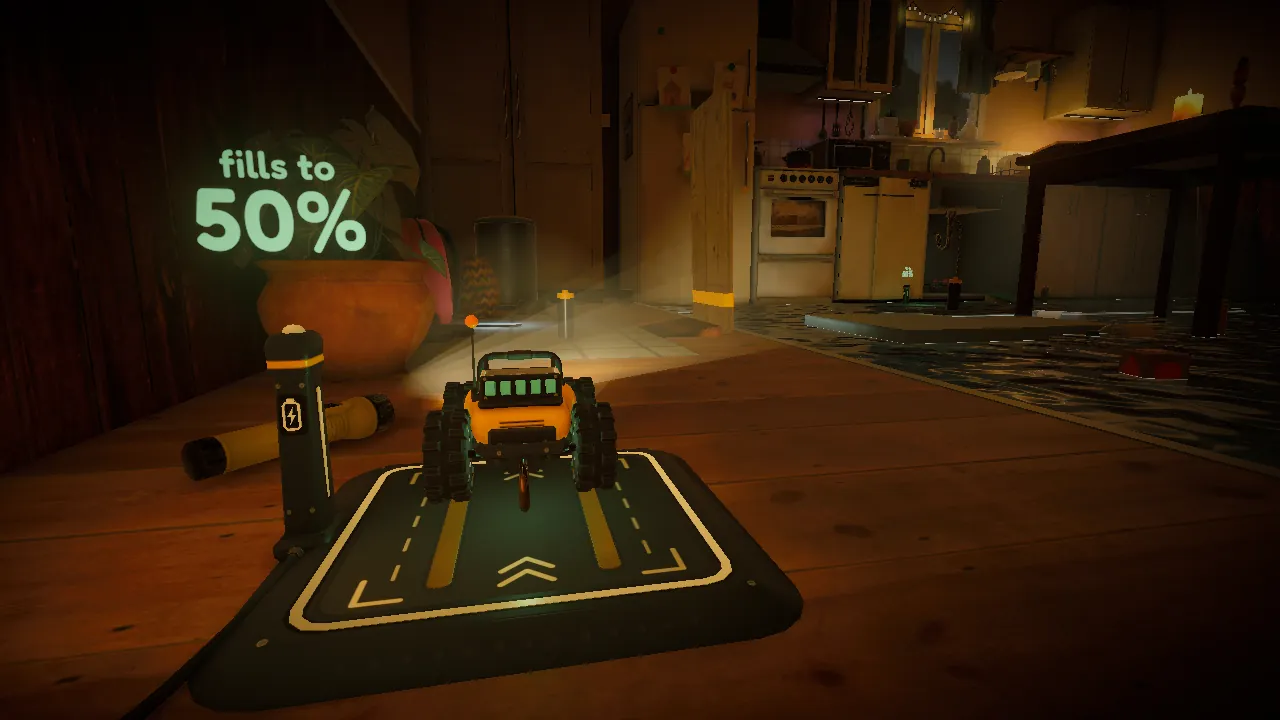
We make Last Charge, so read this section as the maker's description. Last Charge is a story-driven 3D physics puzzle game for Android and iPhone, made by Secundum Reality. You drive Watt, a small yellow toy RC car, through a dark house during a storm to get the power back on before its battery runs out. There are four levels so far: the kitchen (High Tide), the living room (Lights Out), the garage (The Breaker) and the garden (Windfall).
Last Charge is rated 9+ on the App Store, so it's for children 9 and up. The rooms are dark, a storm rumbles, and in the living room a robot vacuum called Grumble charges at Watt's headlights. There's no blood, no weapons and no fighting. Lightning flashes every 10 to 20 seconds in the dark rooms, with no setting to turn the flashes off, so take care if your child is sensitive to flashing light. It's single player and free to play, with no chat, no account and nothing to buy. It's in English and runs on Android 8.0 or later and on iPhone and iPad with iOS 15 or later.
Nobody has studied Last Charge, and we don't claim it improves any skill. This is what a child practices while playing it:
- Planning with a budget. Every level starts with the battery at 60%, and driving, the headlights and a boost all cost charge. Power banks along the route top it up and save progress. In Last Charge, standing still with the headlights off costs no battery, so stopping to think is free. Our tips for making one battery last have the numbers.
- Watching cause and effect. Grumble reacts only to Watt's headlights, and when something your child does sets off a change across the room, the camera turns to show it.
- Trying an idea and adjusting it. A failed try gets a few words of feedback, such as "Too gentle" when something needed more speed.
- Finding a way without hints. Each level states one goal once and shows the exit at the start, and there's no hint button.
For more on the content, read the Last Charge parents' guide; the game page explains the controls and the battery.
Frequently asked questions
Do puzzles help brain development?
The research doesn't support a claim that broad. What it shows is narrower: preschoolers who played with physical puzzles more often scored higher on spatial tests, in studies that were correlational, and training studies show spatial skills improve with practice. Treat "brain development" claims on puzzle apps as marketing, and look at what the game asks your child to do.
What are the benefits of puzzle games for kids?
The best-supported benefit is practice with spatial thinking: picturing how shapes turn, fit and move. Beyond that the evidence is thin, and the studies we found were with teenagers and adults. A good puzzle game also gives a child plenty of practice at getting stuck, trying something and adjusting, and it's something you can play together, which the American Academy of Pediatrics encourages.
Are puzzle games better than brain-training apps?
One small experiment says they might be. University students who played the puzzle game Portal 2 for eight hours in the lab scored higher afterwards on problem solving, spatial skill and persistence than students who played Lumosity, a brain-training program. The sample was 77 students aged 18 to 22, so it says little about children. A 2016 review found brain-training gains rarely spread to different tasks.
Will puzzle games help my child do better at school?
The evidence for that is weak. In a four-year study of 1,492 high school students, those who played more strategy and role-playing games rated their own problem solving higher, and that went with better grades, but it was a correlation based on the students' own ratings. Brain-training research finds that gains rarely carry over to different tasks.
What age is Last Charge for?
Last Charge, which we make, is rated 9+ on the App Store, so it's for children 9 and older. It's spooky: dark rooms, a storm with lightning flashes, and a robot vacuum called Grumble that charges at the car's headlights. There's no blood, no weapons and no fighting. It's single player, with no chat, no account and nothing to buy.
Sources
- Levine, Ratliff, Huttenlocher and Cannon (2012), Early puzzle play: a predictor of preschoolers' spatial transformation skill, Developmental Psychology (PubMed abstract)
- Jirout and Newcombe (2015), Building blocks for developing spatial skills, Psychological Science (PubMed abstract)
- Association for Psychological Science: Playing with puzzles and blocks may build children's spatial skills
- Uttal et al. (2013), The malleability of spatial skills: a meta-analysis of training studies, Psychological Bulletin (PubMed abstract)
- Yang et al. (2020), Is early spatial skills training effective? A meta-analysis, Frontiers in Psychology
- Simons et al. (2016), Do "brain-training" programs work?, Psychological Science in the Public Interest (PubMed abstract)
- Shute, Ventura and Ke (2015), The power of play: the effects of Portal 2 and Lumosity on cognitive and noncognitive skills, Computers & Education (author copy)
- Adachi and Willoughby (2013), More than just fun and games: strategic video games, self-reported problem solving skills and academic grades, Journal of Youth and Adolescence (PubMed abstract)
- Granic, Lobel and Engels (2014), The benefits of playing video games, American Psychologist (PubMed abstract)
- HealthyChildren.org (AAP): Kids & Screen Time: How to Use the 5 C's of Media Guidance
- HealthyChildren.org (AAP): Kids & Screen Time: 5 C's Questions for School-Age Children
- HealthyChildren.org (AAP): Why Co-Viewing Is Important: Tips to Share Screen Time With Your Kids