 Last Charge
For parents
Games that teach kids persistence: why getting stuck can help
Getting stuck is most of what a puzzle game is. What the research says about struggle, frustration and mindset, and how to help a child keep going without taking over.

We found no study showing that a game builds persistence in children, but a well-made puzzle game gives a child plenty of practice at getting stuck and trying again somewhere failing costs very little. The closest evidence is one experiment with university students, and classroom research on "productive failure" adds a useful idea, with an important exception for younger children.
We make Last Charge, the toy car physics puzzle game by Secundum Reality, and it appears here as one example. The studies come first, each with who took part and what kind of study it was.
Can video games teach kids persistence?
We haven't found a study that shows it in children. The closest is an experiment in which 77 university students were randomly assigned to eight hours of the puzzle game Portal 2 or the brain-training program Lumosity. Afterwards the Portal 2 players kept trying longer at picture puzzles that, unknown to them, couldn't be solved. The sample was small.
The study, from Florida State University, was published in Computers & Education in 2015 (Shute, Ventura and Ke). The students were 18 to 22 and didn't play video games every day. To measure persistence, the researchers showed them pairs of pictures, asked them to find four differences when only three existed, and timed how long they kept at it before skipping. The Portal 2 group kept at it longer than the Lumosity group, after allowing for how persistent the students said they were, and also scored higher on problem solving and spatial skill.
Comparing against a brain-training program was a careful choice, because both groups expected to get sharper. Its limits are bigger: the authors call the sample small and warn against generalizing from it, persistence was measured once, after play, and no children took part. Their explanation is that the game's repeated challenges and failures made players try harder on the next task, but the study wasn't designed to test why the difference appeared.
What is productive struggle, and does it help?
Productive struggle means working on a problem you can't solve yet, before anyone shows you how. A 2021 meta-analysis of 53 classroom studies found that trying a problem first and getting the lesson afterwards beat lesson-first teaching by a moderate amount on average. For children in grades 2 to 5, though, the results favored teaching first.
The meta-analysis, by Tanmay Sinha and Manu Kapur in Review of Educational Research, pooled 166 comparisons. Problem-first teaching came out ahead with an average effect of 0.36, and further ahead (0.37 to 0.58) when lessons closely followed the principles of "productive failure", Kapur's version of problem-first teaching. After adjusting for publication bias, the authors estimated the true effect to be larger still.
For younger learners, second to fifth graders, and for general skills, the results favored teaching first, and many 9- and 10-year-olds are in that group. These were school lessons on new concepts, and the review wasn't about games. Our cautious reading for a puzzle game: let your child try first, and with a younger child, offer a nudge sooner.
Is frustration with games good for kids?
It depends what the frustration is about. Being stuck on a fair puzzle is the kind of struggle the classroom research describes. Fighting clumsy controls or a game that's rigged against you is different: in experiments with university students, those versions of a puzzle game raised aggressive feelings and made players like the game less.
That research is a set of seven studies by Przybylski and colleagues, published in the Journal of Personality and Social Psychology in 2014, mostly with undergraduates around 20 years old. In two of them, students played a Tetris-style puzzle game with either a simple button layout or a complicated one. The complicated layout left them quicker to recognize aggressive words, more aggressive in mood and less keen on the game. In another, the game was rigged to hand players the worst possible piece most of the time, and afterwards those players reported more aggressive feelings and set a longer dip in cold water for the next participant. Across the studies, feeling incompetent drove the effect, whether or not the game was violent.
These were short lab sessions with young adults, so they say nothing direct about children or lasting effects. They do give you a good question for when your child gets upset: is the trouble the puzzle, or the game getting in the way of the puzzle?
| Useful struggle | Frustration worth fixing |
|---|---|
| Your child can say what they're trying | They can't say what they want to happen |
| Each try is a little different | The same move, over and over |
| Failing costs a few seconds | Each failure means replaying a long stretch |
| They're annoyed with the puzzle | They're annoyed with the controls or the camera |
| They go back to it later by choice | It ends in tears, or they won't touch it again |
If the controls are the problem, change them first. In Last Charge the default is an on-screen steering wheel, and Settings offers a slider, left and right buttons, or tilt instead; the pause menu has a Steering button too.
What makes failing cheap in a game?
Failing is cheap when a missed try costs seconds instead of progress. Look for a restart close to where your child failed, no lives to run out, no countdown, feedback that says what went wrong, and a way to stop and think without losing anything. Then a child can afford to test an idea they aren't sure about.
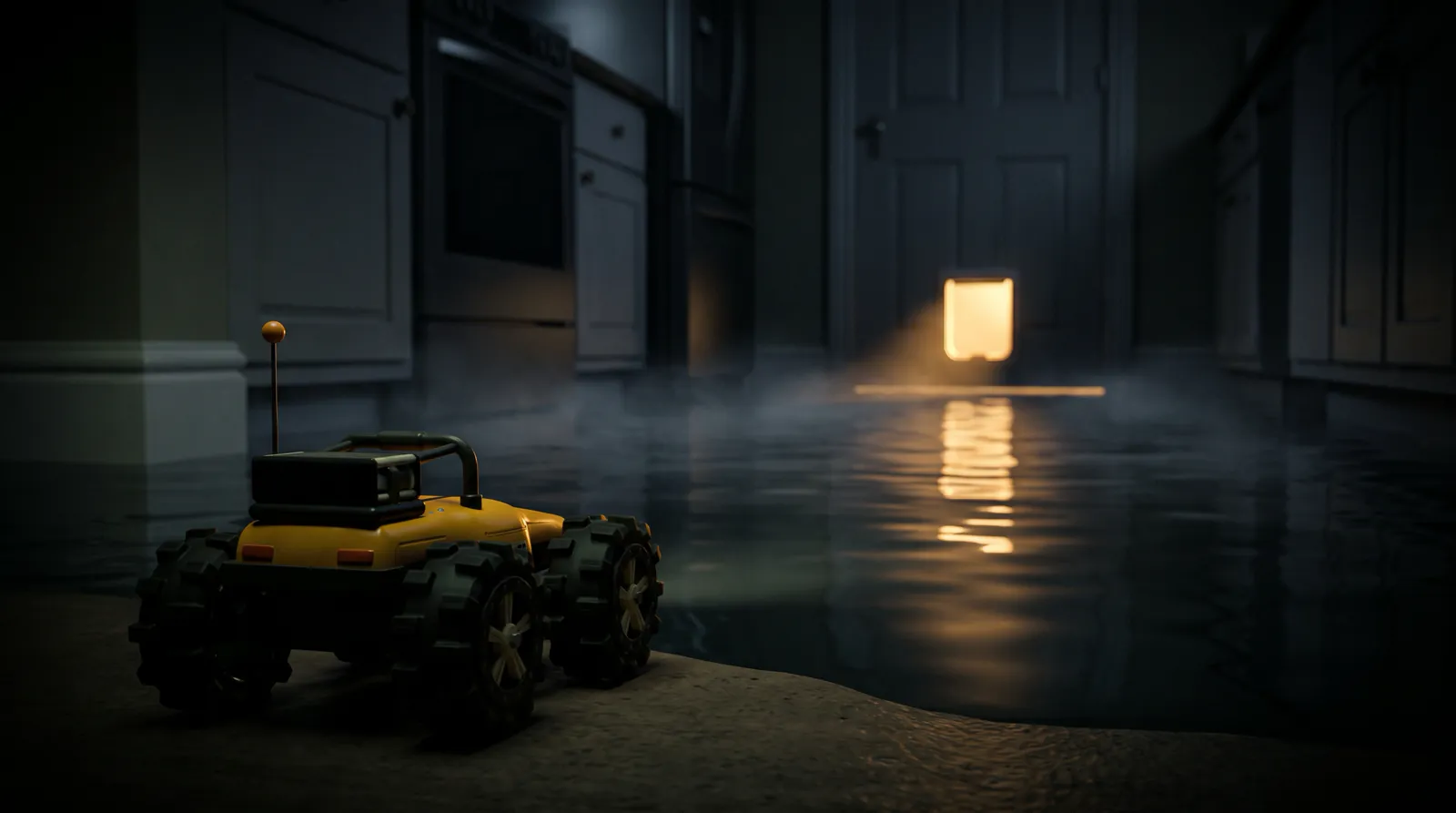
We make Last Charge, so it's our example here and not a neutral pick. Last Charge is a story-driven 3D physics puzzle game for Android and iPhone, made by Secundum Reality. You drive Watt, a small yellow toy RC car, through a dark house in a storm to get the power back on before the battery runs out. It's rated 9+ on the App Store, so it's for children 9 and up. It's spooky, with dark rooms and lightning flashes (take care if your child is sensitive to flashing light), but there's no blood, no weapons and no fighting. It's single player and free to play, with no chat, no account and nothing to buy. This is how failing works in it:
- Running out of charge, driving into deep water or getting caught by Grumble, the robot vacuum, sends Watt back to the last power bank after a quick fade. There are no lives and no level timer.
- Power banks along the route save progress, so a failed try doesn't mean starting the level again.
- The pause menu has Restart from power bank, for a clean try at the same spot, and Restart level.
- A failed try gets a few words of feedback. "Too gentle" means more speed, "Too heavy for Watt" means pushing won't work, and "Held fast" means not right now.
- In Last Charge, standing still with the headlights off costs no battery, so your child can stop and think for free.
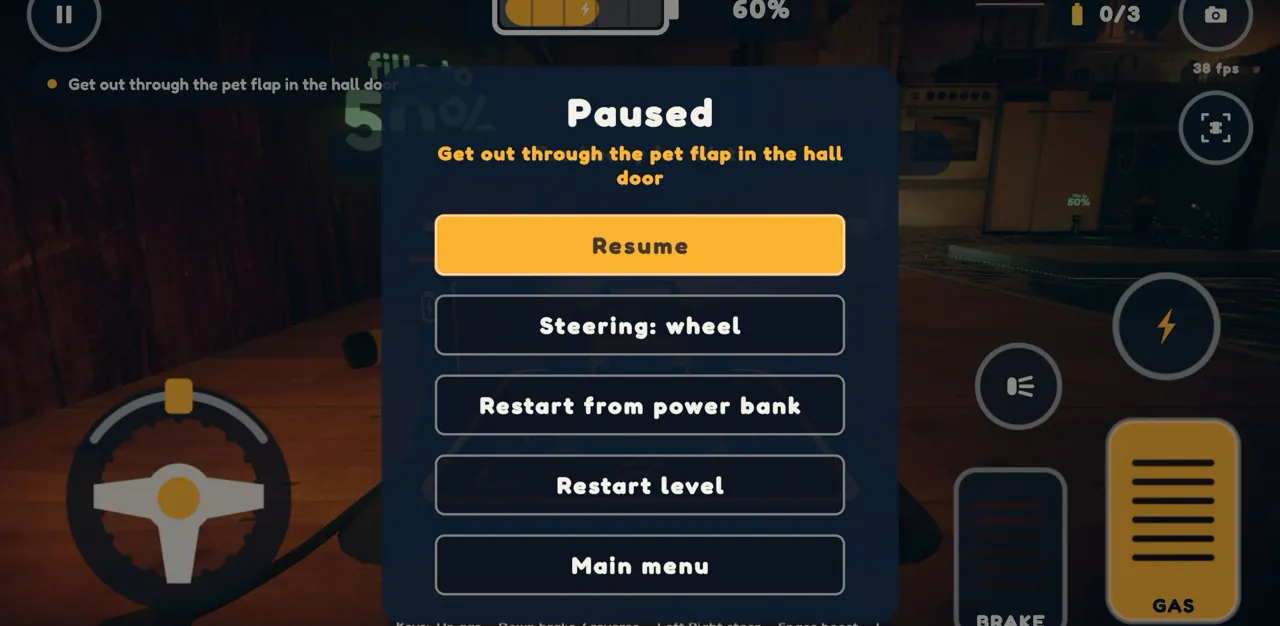
The how to play section of the game page explains the battery and the controls.
Do growth mindset games work?
The evidence is thin. In one large online experiment, children who played a fractions puzzle game that rewarded effort and strategy played a little longer and tried more levels than children rewarded for finished levels, but the effects were very small and learning wasn't tested. Research on growth mindset itself finds small average effects on school achievement.
That game study, by O'Rourke and colleagues at the University of Washington and Stanford, was presented at the CHI 2014 conference. About 15,000 children on BrainPOP, an educational website used mostly in schools, were randomly given one of two versions of Refraction, a puzzle game about fractions. One version gave "brain points" for effort, new strategies and progress; the other gave points for finished levels. The brain points group played a little longer, and more of its low performers kept going. The effect sizes were very small, the researchers couldn't record the children's ages, and they had no way to test what the children learned.
Mindset research is mixed. Two 2018 meta-analyses in Psychological Science found a weak link between students' mindsets and their academic achievement, and a very small average effect of mindset programs on it, with some sign of benefit for students from poorer homes or at academic risk (Sisk and colleagues). A large 2019 US experiment in Nature found that a short online growth mindset program raised grades for lower-achieving secondary-school students, in schools where classmates' attitudes backed up its message (Yeager and colleagues).
So a "growth mindset" label on a game tells you little. What the game rewards is more telling: effort and new strategies, or only winning.
What to say when your child wants to quit
These are our suggestions, built on the AAP's advice to ask open questions while you play together and on the research above.
Mild spoiler
The example below uses one idea from the kitchen, Level 1 (High Tide).
Say your child keeps ramming the red valve under the kitchen sink and the game keeps saying "Too gentle".
- Say what you see before you suggest anything: "You've hit that valve three times. What did the game say?" Reading the feedback out loud slows things down.
- Ask what they're trying to do. If they can explain it, the plan is fine and the doing needs work. Here, "Too gentle" means the idea is right and Watt needs more speed.
- Ask for one change per try, such as a different angle, more speed or a different order, and comment on what they tried.
- If the controls are the trouble, fix the controls. Switch the steering, or take a turn driving while your child does the planning.
- Agree on a break before it turns into tears, and say when you'll come back to it together.
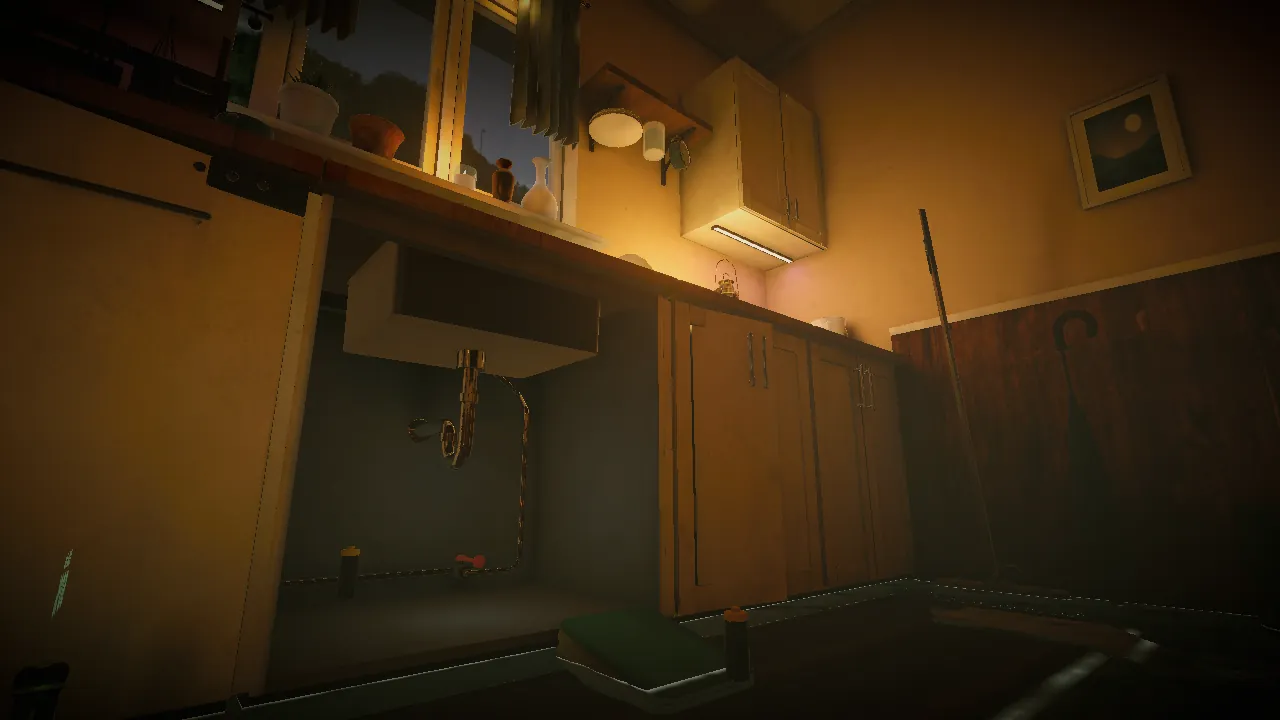
The AAP's advice for school-age children also warns against letting screens become a child's go-to whenever homework or another hard task gets frustrating. Sticking with a game counts for less if the game is where your child goes to avoid struggling with something else. Our guide to playing a puzzle game with your child has more questions to ask.
When to open a walkthrough
A walkthrough is help your child chooses, and using one is fine. Our suggestions:
- Open it after a real attempt and a break.
- Read one step, then close it, so most of the puzzle stays your child's.
- With a younger child, open it sooner. In the classroom research, second to fifth graders did better when taught first.
- If the trouble is the controls, fix those before reaching for answers.
Last Charge has no hint button (our post on puzzle games with no hints explains why), so its help lives on this blog, starting with the Level 1 walkthrough for the flooded kitchen. For a child who wants more of a challenge after finishing a level, the gold batteries are optional: three per level, and they're simply counted on the results card. For the wider evidence, see are puzzle games good for kids.
Frequently asked questions
Should I let my child quit a game when they're stuck?
A break is fine, and if your child goes back to the game later by choice, that is persistence too. If a game keeps ending in tears, check whether the trouble is the puzzle or the controls. A game that's hard because it's clumsy or unfair isn't worth fighting through, and some games are simply wrong for a child at a given age.
Why does my child get so angry at video games?
One possible reason is feeling incompetent. In experiments with university students, versions of a puzzle game with clumsy controls or rigged pieces left players in a more aggressive mood than the fair version, whether or not the game was violent. Those were adults in short lab sessions, so treat it as a lead and check whether your child is angry at the puzzle or at the controls.
Are there growth mindset games for kids?
Some games are sold that way, but the evidence is thin. In one experiment with about 15,000 children, a fractions puzzle game that gave points for effort and strategy kept children playing slightly longer than a version that rewarded finished levels. The effects were very small and learning wasn't tested. Look at what a game rewards: effort and new strategies, or only winning.
Is it bad to use a walkthrough for a puzzle game?
No. A walkthrough is help your child chooses, and reading one step and closing it keeps most of the puzzle theirs. Classroom research found that trying a problem first helped on average, but second to fifth graders did better when taught first, so it's reasonable to open the walkthrough sooner with a 9-year-old than with a 12-year-old.
What happens when you fail in Last Charge?
In Last Charge, which we make, running out of charge, driving into deep water or getting caught by Grumble sends Watt back to the last power bank after a quick fade. There are no lives and no level timer. Power banks save progress, the pause menu can restart from the last one, and short feedback such as "Too gentle" says why a try didn't work.
Sources
- Shute, Ventura and Ke (2015), The power of play: the effects of Portal 2 and Lumosity on cognitive and noncognitive skills, Computers & Education (author copy)
- Sinha and Kapur (2021), When problem solving followed by instruction works: evidence for productive failure, Review of Educational Research
- Przybylski, Deci, Rigby and Ryan (2014), Competence-impeding electronic games and players' aggressive feelings, thoughts, and behaviors, Journal of Personality and Social Psychology (PubMed abstract)
- Przybylski et al. (2014), full text hosted by the Center for Self-Determination Theory
- O'Rourke, Haimovitz, Ballweber, Dweck and Popović (2014), Brain points: a growth mindset incentive structure boosts persistence in an educational game, CHI 2014
- Sisk et al. (2018), To what extent and under which circumstances are growth mind-sets important to academic achievement? Two meta-analyses, Psychological Science (PubMed abstract)
- Yeager et al. (2019), A national experiment reveals where a growth mindset improves achievement, Nature (PubMed abstract)
- HealthyChildren.org (AAP): Kids & Screen Time: 5 C's Questions for School-Age Children
- HealthyChildren.org (AAP): Why Co-Viewing Is Important: Tips to Share Screen Time With Your Kids